
World War II
Puzzle 31 · Sicily to Cassino · Page 50 in print
Monte Cassino
Polish troops occupied Monte Cassino on 18 May 1944, after four Allied battles for the position.
Jump to a word
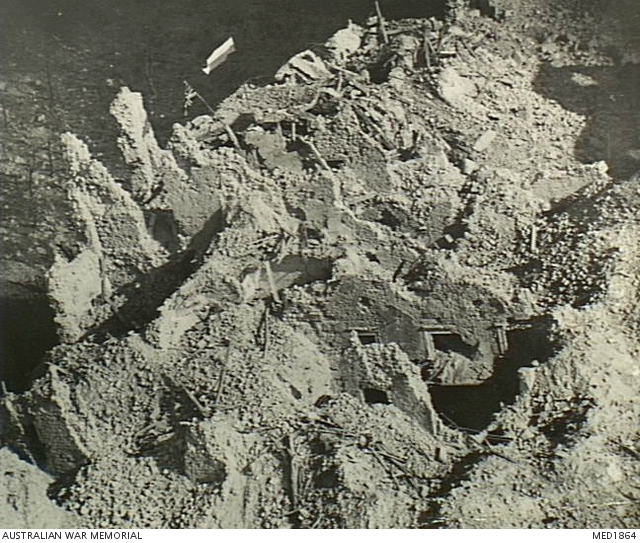
The ruined monastery of Monte Cassino, photographed from the air on May 19, 1944, after its capture.
RAF official photographer / Australian War Memorial (MED1864) · Public domain · Original recordImage changes
Display copies resized; original downloaded JPEG preserved.
The words
Abbey
Allied bombers destroyed the abbey on February 15, 1944. Civilians who had sought refuge within its walls were killed in the attack.
The February bombardment and refugees · WWII Museum: the destruction of the abbey (opens a new tab)
Benedictine
Benedict of Nursia founded the monastery in 529. Its monks preserved manuscripts and maintained a center of learning through repeated rebuilding.
Did you know?
The complex standing above Cassino in 1944 had been built mainly in the sixteenth and seventeenth centuries.
Foundation, manuscripts and rebuilding · WWII Museum: the destruction of the abbey (opens a new tab)
Cassino
Cassino guarded the entrance to the Liri valley, a route toward Rome. Flooding, mines and fortifications made the town and its approaches difficult to attack.
Opening account; A defender’s dream · NZ History: the Cassino campaign (opens a new tab)
Castle Hill
A New Zealand battalion captured Castle Hill on March 15, 1944. German resistance and flooded craters stalled the wider attack before the town could be taken.
The March attack and its aftermath · NZ History: Castle Hill at Cassino (opens a new tab)
French
In May 1944, the French Expeditionary Corps attacked the mountains south of Cassino. Members of the corps also committed mass rapes against Italian civilians during the advance.
Rappel historique; Violences; Impossibles statistiques · Baris: French forces and civilian violence (opens a new tab)
Indian
The 4th Indian Division attacked the high ground behind Cassino. Its infantry tried repeatedly to advance toward the abbey but faced German counterattacks on the steep slopes.
Ch. XXIII, the Indian division’s attacks · Army history: the abbey bombardment (opens a new tab)
Maori
The 28th (Māori) Battalion seized positions at Cassino’s railway station on February 17, 1944. Without reinforcements, it was forced back; men were killed, wounded or captured.
The 17 February attack · NZ History: the Cassino campaign (opens a new tab)
Monastery
Before the bombing, the abbey was off limits to German troops. Their defensive positions occupied the surrounding slopes, while monks and civilians sheltered inside.
Ch. XXIII, the abbey and surrounding positions · Army history: the abbey bombardment (opens a new tab)
Moroccan
Moroccan goumiers helped the French corps advance through the Aurunci mountains. Some took part in mass rapes of Italian civilians during the 1944 campaign.
Rappel historique; Violences; Impossibles statistiques · Baris: French forces and civilian violence (opens a new tab)
Mortars
German mortars and machine guns fired on New Zealand and Indian infantry after the March bombing. Air attack had not silenced every defensive position.
Ch. XXV, the ground attack after the bombing · Army history: the bombing of Cassino (opens a new tab)
Polish
Polish troops reached the abbey ruins on May 18, 1944. New Zealand artillery supported the final fighting, after its division’s earlier assaults had failed.
NZ History: Castle Hill at Cassino (opens a new tab) · WWII Museum: the destruction of the abbey (opens a new tab)
Rubble
Bombing left craters and rubble that blocked tanks in Cassino. Engineers clearing routes came under fire from German troops concealed in the ruined houses.
Ch. XXV, blocked routes and engineer work · Army history: the bombing of Cassino (opens a new tab)
Snakeshead
Snakeshead was the Allied name for a ridge northwest of the abbey. Point 593 on this high ground was an objective in the February attacks.
Wikipedia: Cassino ridge names (opens a new tab) · UK Defence: the battles for Monte Cassino (opens a new tab)
Tuker
Major General Sir Francis Tuker urged bombing the abbey before the 4th Indian Division’s attack. Illness forced him to hand over command before the assault.
Army history: the abbey bombardment (opens a new tab) · UK Defence: the battles for Monte Cassino (opens a new tab)
Winter
Freezing rain delayed the planned March bombing for three weeks. When the attack began, more rain flooded bomb craters and made movement through Cassino’s ruins harder.
Weather before and during the March attack · NZ History: Castle Hill at Cassino (opens a new tab)
Sources
- Salerno to Cassino, Chapter XXIII: The Bombardment of the Abbey of Monte CassinoMartin Blumenson; US Army Center of Military History, HyperWar transcription
- Salerno to Cassino, Chapter XXV: The Bombing of CassinoMartin Blumenson; US Army Center of Military History, HyperWar transcription
- New Zealand forces capture Castle Hill at CassinoManatū Taonga — Ministry for Culture and Heritage, New Zealand
- The Italian Campaign, Page 4 – CassinoManatū Taonga — Ministry for Culture and Heritage, New Zealand
- The Destruction of Monte CassinoChrissy Gregg; The National WWII Museum, January 15, 2021
- Le corps expéditionnaire français en Italie : Violences des « libérateurs » durant l’été 1944Tommaso Baris; Vingtième Siècle. Revue d’histoire, 2007/1, no. 93, pp. 47–61; Presses de Sciences Po, Cairn.info
- The Battles For Monte Cassino: Central Italy, 12 January – 5 June 1944UK Ministry of Defence; Crown copyright 2004
- Battle of Monte CassinoWikipedia; used only for uncontested ridge naming