
World War II
Puzzle 29 · Sicily to Cassino · Page 48 in print
Salerno Beachhead
The crisis at Salerno peaked from 12-14 September 1943 when German Panzers nearly overran the beachhead, averted by heavy Allied naval bombardment and reinforcement by airborne troops.
Jump to a word
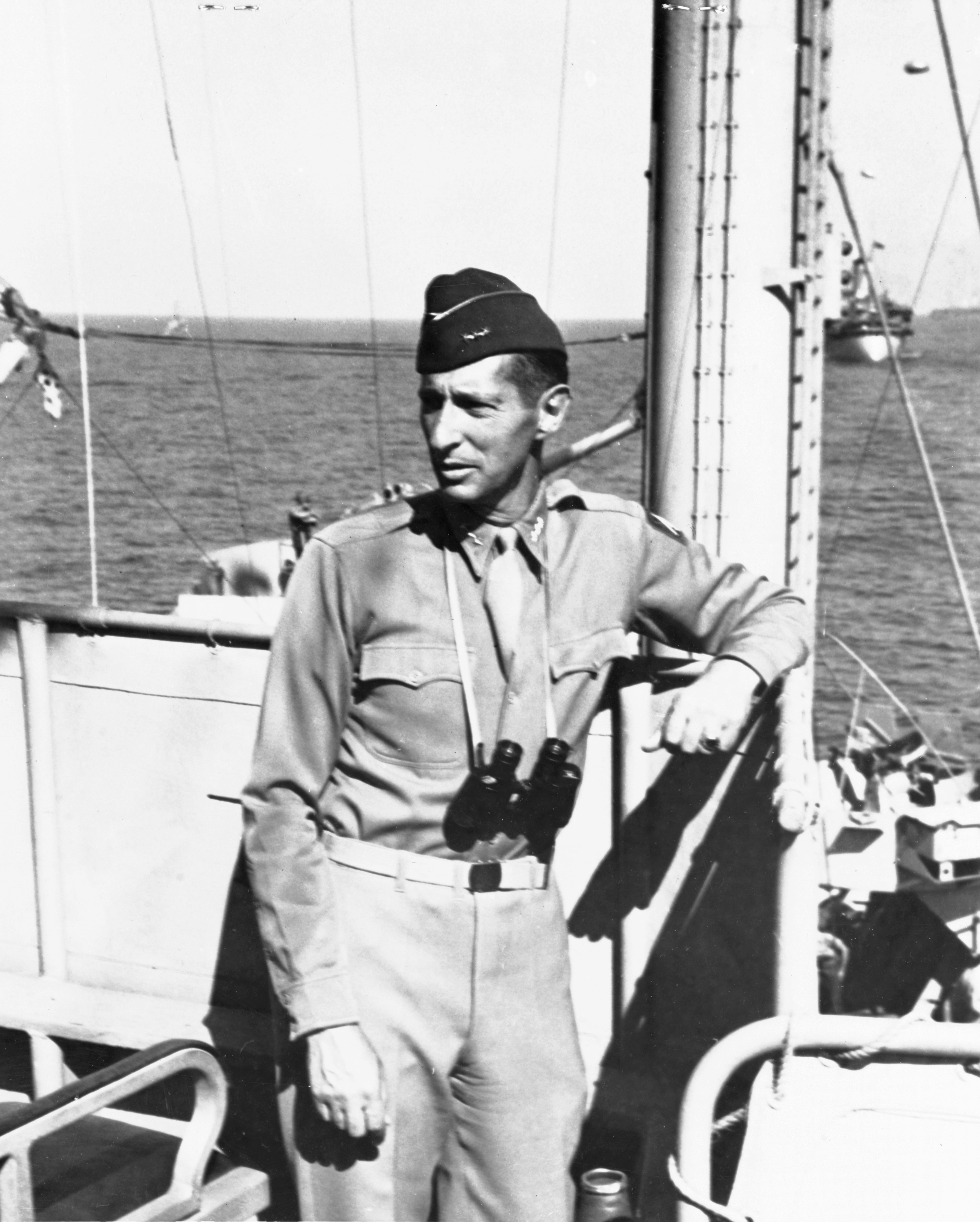
Mark W. Clark aboard USS Ancon during the Salerno landings on September 12, 1943.
U.S. Navy / National Archives (80-G-87335) · Public domain · Original recordImage changes
Display copies resized; original downloaded JPEG preserved.
The words
Altavilla
Altavilla’s heights overlooked the beachhead. American attacks sought Hill 424 to deny German observers a commanding view of the plain.
Ch. VII, the attacks near Altavilla · Army history: the Salerno beachhead (opens a new tab)
Amphibious
At Salerno, an amphibious landing carried Fifth Army from ships to the Italian coast. Fighting ashore followed the crossing from the sea.
Landing and campaign objectives · Park Service: Salerno (opens a new tab)
Beachhead
The beachhead was a shallow coastal foothold. German attacks through the Sele valley threatened to divide the Allied position before reinforcements could strengthen it.
The landing and German counterstroke · WWII Museum: the invasion of Italy (opens a new tab)
Clark
Lieutenant General Mark W. Clark commanded Fifth Army. During the crisis he considered evacuating the beachhead, but the army remained ashore and held its position.
WWII Museum: the invasion of Italy (opens a new tab) · Park Service: Salerno (opens a new tab)
Cruisers
Cruisers fired on German attacks threatening the beachhead. That support came at a cost: a guided bomb struck USS Savannah, killing members of her crew.
Naval gunfire and guided-bomb attacks · Navy history: Sicily and Salerno (opens a new tab)
Dawley
Major General Ernest J. Dawley led VI Corps. His responsibilities included combat south of the Sele, beach unloading, supply dumps and roads.
Army history: the Salerno beachhead (opens a new tab) · Army history: preparing Avalanche (opens a new tab)
Fifth Army
Fifth Army aimed to take Naples and cut across Italy. The port was intended to sustain the advance with a reliable supply line.
Campaign objectives · Park Service: Salerno (opens a new tab)
Fighters
Allied fighters intercepted high-flying German bombers attacking the ships. Breaking up a bomber’s steady flight could disrupt the guidance of its bomb.
Air interception and guided-bomb defenses · Navy history: Sicily and Salerno (opens a new tab)
Holding Action
Artillery, naval guns and bombers helped stop the German attacks. Holding the beachhead required support from land, sea and air as troops resisted the counteroffensive.
Combined fire support during the crisis · WWII Museum: the invasion of Italy (opens a new tab)
Kesselring
Generalfeldmarschall (general of the army) Albert Kesselring commanded German forces in southern Italy. On September 16, 1943, he ordered a fighting withdrawal. His command also enforced arrests and deportations of forced laborers from Naples after Italy’s armistice.
Navy history: Sicily and Salerno (opens a new tab) · Gentile: Kesselring’s command in Italy (opens a new tab) · Fisher, Cassino to the Alps, ranks table (opens a new tab)
Middleton
Major General Troy H. Middleton commanded the 45th Division. Its infantry fought around Persano and the Sele crossing as German pressure increased.
Army history: the Salerno beachhead (opens a new tab) · Army history: preparing Avalanche (opens a new tab)
Persano
German attacks near Persano overran American positions in the Sele-Calore corridor. Many American soldiers were captured as the center of the beachhead gave way.
Ch. VII, the Sele-Calore corridor crisis · Army history: the Salerno beachhead (opens a new tab)
Reinforce
Paratroopers flew from Sicily to reinforce the beachhead on the night of September 13–14, 1943. They joined the defense of the 36th Division’s sector.
Did you know?
Pathfinders used radar to guide the transport aircraft toward the drop zone. Troops on the ground marked it with flares.
Ch. VIII, airborne reinforcement · Army history: the Salerno crisis (opens a new tab)
Resistance
Italy’s surrender did not remove German resistance. German troops disarmed much of the Italian Army and held key positions as the Allies landed.
Invasion of Italy; Surrender · Army Museum: the invasion of Italy (opens a new tab)
Salerno
Securing Salerno’s beachhead took days of fighting after the landing. The Allied foothold survived, and troops advanced inland as the Germans withdrew northward.
Securing the beachhead and advance inland · Park Service: Salerno (opens a new tab)
Sources
- Salerno to Cassino, Chapter VII: The BeachheadMartin Blumenson; US Army Center of Military History, HyperWar transcription
- Salerno to Cassino, Chapter VIII: The CrisisMartin Blumenson; US Army Center of Military History, HyperWar transcription
- Salerno to Cassino, Chapter III: The PreparationsMartin Blumenson; US Army Center of Military History, HyperWar transcription
- H-021-2: Operation Husky, the Invasion of Sicily, and Operation Avalanche, the Invasion of ItalySamuel J. Cox; Naval History and Heritage Command, September 2018
- The US Invasion of ItalyRobert Citino; The National WWII Museum, September 6, 2018
- SalernoNational Park Service, World War II Memorial
- The battle for ItalyNational Army Museum, London
- Albert KesselringCarlo Gentile; documentary project The German Massacres in Occupied Italy (1943–45) in the Memory of the Perpetrators
- Cassino to the Alps, Appendix A: Table of Equivalent RanksUS Army Center of Military History; Ernest F. Fisher Jr., HyperWar transcription