
World War II
Puzzle 28 · Sicily to Cassino · Page 47 in print
Operation Avalanche
Operation Avalanche landed Mark Clark’s Fifth Army at Salerno on 9 September 1943, with U.S. VI Corps and British X Corps. Italy’s armistice, signed on 3 September, had been announced the day before.
Jump to a word
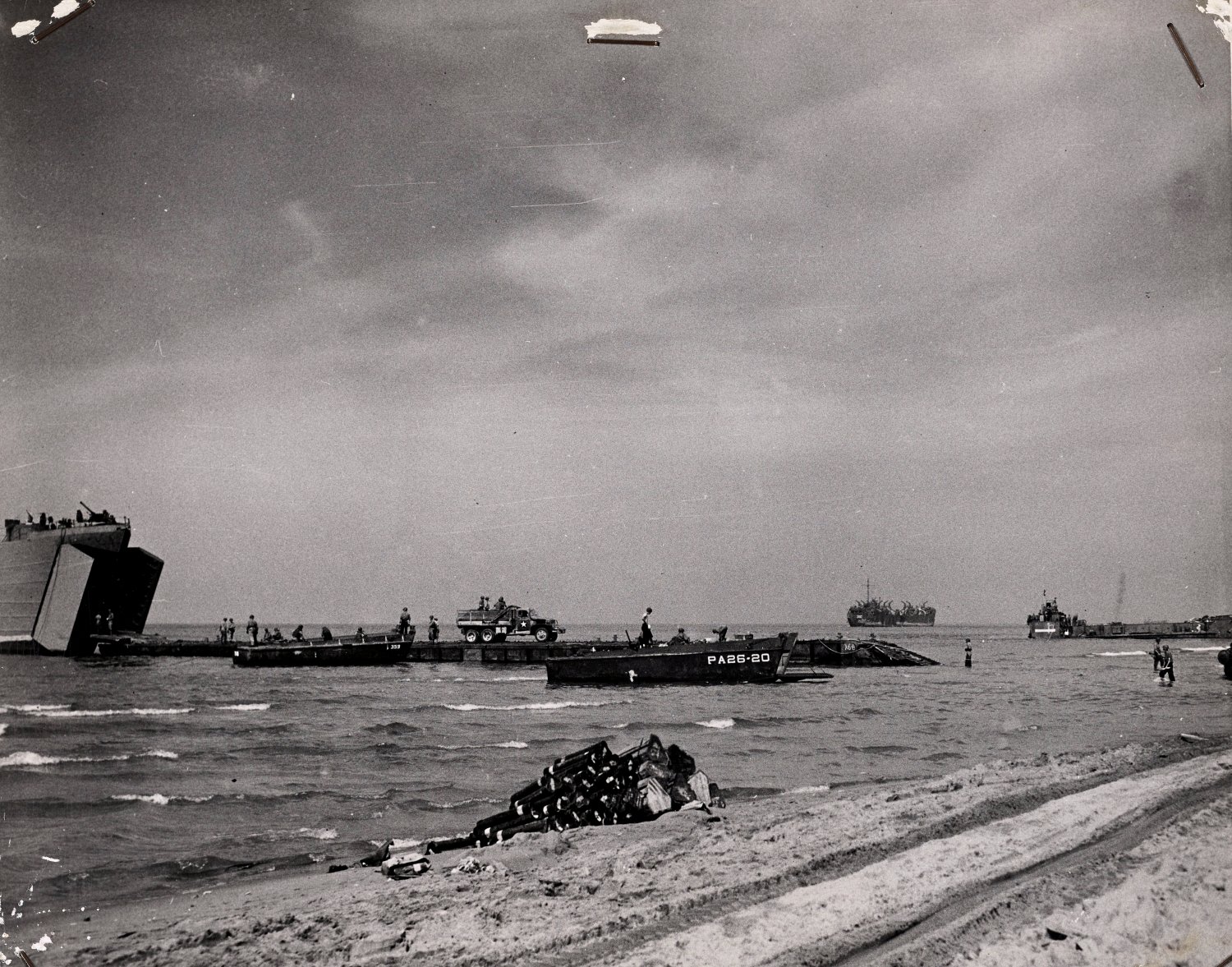
Vehicles unload from USS LST-382 onto a floating causeway at Paestum during the Salerno landings in September 1943.
U.S. Coast Guard / National Archives (26-G-2004) · Public domain · Original recordImage changes
Display copies resized; original downloaded JPEG preserved.
The words
Avalanche
Avalanche’s objectives went beyond the Salerno beaches. Fifth Army was to seize Naples and nearby airfields after establishing its foothold.
Ch. III, mission and planning · Army history: preparing Avalanche (opens a new tab)
Battipaglia
Two companies of the Hampshire Regiment defended a crossroads near Battipaglia. They suffered many casualties during repeated German attacks on the British side of the beachhead.
The 2/4th Battalion at Salerno · Hampshire Museum: the Salerno landings (opens a new tab)
Battleship
British battleships reinforced naval gunfire after the initial landings. Their heavy guns added support for troops facing German counterattacks.
Battleship reinforcement and gunfire · Navy history: Sicily and Salerno (opens a new tab)
Cruiser
Cruisers shelled German positions to support the landings. Guided bombs damaged USS Savannah and HMS Uganda, killing sailors aboard both ships.
Guided-bomb attacks, September 11–13 · Navy history: Sicily and Salerno (opens a new tab)
Destroyer
Destroyers escorted transports and shelled shore targets. A German torpedo boat sank USS Rowan while she escorted departing transports, killing many of her crew.
Escort and gunfire support; Rowan · Navy history: Sicily and Salerno (opens a new tab)
DUKW
Pronounced “duck.”
DUKWs carried artillery toward the beaches, but German fire kept some offshore. Guns that reached land were rushed into position to support the infantry.
Army history: the Salerno landings (opens a new tab) · WWII Museum: supplying troops ashore (opens a new tab)
Invasion Fleet
Convoys sailed from North African and Sicilian ports to converge off Salerno. Minesweepers had to clear routes for the landing craft and ships supporting the assault.
Convoys and minesweeping · Navy history: the Salerno landings (opens a new tab)
Landing Craft
Landing craft carried infantry, engineers and weapons in timed waves. Enemy fire disrupted the schedule, and some waves reached the wrong beaches.
Ch. VI, boat waves and landings · Army history: the Salerno landings (opens a new tab)
Mediterranean
Fighter range limited the choice of landing sites. Salerno lay within reach of Allied land-based air cover and offered an approach to Naples.
Choice of landing area · Navy history: Sicily and Salerno (opens a new tab)
Naples
British troops entered Naples on October 1, 1943. Capturing the city achieved a major objective of Avalanche after weeks of fighting inland.
The Hampshire Brigade; advance to Naples · Hampshire Museum: the Salerno landings (opens a new tab)
Paestum
The American 36th Division landed near Paestum, south of the Sele River. German fire struck the assault waves as they tried to leave the beaches.
Did you know?
Greek temples still stood at Paestum in 1943. The American landing area lay close to the remains of this ancient settlement.
Ch. VI, 36th Division landings · Army history: the Salerno landings (opens a new tab)
Philadelphia
USS Philadelphia fired on German tanks near the beaches. She also faced guided-bomb attacks and near misses that wounded members of her crew.
Gunfire and air attacks · Navy history: Sicily and Salerno (opens a new tab)
Ports
German forces damaged Naples’s harbor before its capture. They also sabotaged water distribution and civilian food supplies, complicating the next stage of the advance.
German withdrawal and damage at Naples · Navy history: Sicily and Salerno (opens a new tab)
Sele River
The Sele River separated the British and American landing areas. The gap between the two corps became dangerous when German forces threatened to split the beachhead.
Navy history: the Salerno landings (opens a new tab) · Army history: the Salerno beachhead (opens a new tab)
Supply Ships
Supply ships brought fuel and stores. Air attacks destroyed SS Bushrod Washington’s gasoline cargo and caused casualties among SS James W. Marshall’s merchant crew.
Air attacks on supply ships · Navy history: Sicily and Salerno (opens a new tab)
Sources
- Salerno to Cassino, Chapter III: The PreparationsMartin Blumenson; US Army Center of Military History, HyperWar transcription
- Salerno to Cassino, Chapter VII: The BeachheadMartin Blumenson; US Army Center of Military History, HyperWar transcription
- Salerno to Cassino, Chapter VI: The LandingsMartin Blumenson; US Army Center of Military History, HyperWar transcription
- H-021-2: Operation Husky, the Invasion of Sicily, and Operation Avalanche, the Invasion of ItalySamuel J. Cox; Naval History and Heritage Command, September 2018
- The U.S. Navy and the Landings at Salerno, Italy, 3–17 September 1943Naval History and Heritage Command
- The Invasion of Italy and the Salerno Landings – September 1943The Royal Hampshire Regiment Museum
- Over-the-Shore Logistics of D-DayThe National WWII Museum, June 10, 2025