
World War II
Puzzle 27 · Sicily to Cassino · Page 46 in print
Messina Strait
Axis forces evacuated over 100,000 troops and much of their equipment across the Strait of Messina to the Italian mainland in mid-August 1943, escaping envelopment as the Sicily campaign ended.
Jump to a word
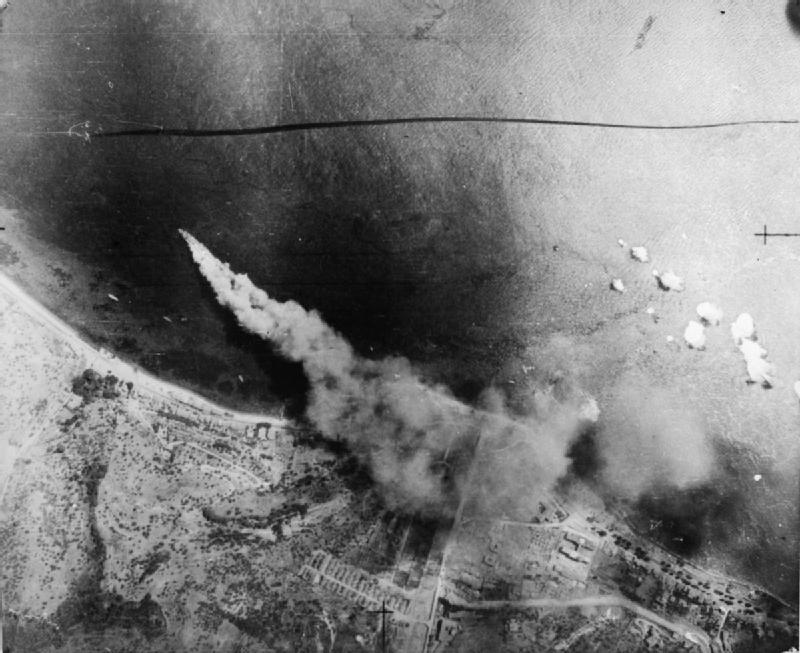
A German ship burning off the Sicilian coast during the evacuation from Messina in 1943.
RAF official photographer / Imperial War Museums (C 3733) · Public domain · Original recordImage changes
Display copies resized; original downloaded JPEG preserved.
The words
Advance
Allied pressure pushed Axis formations into northeastern Sicily. Fighting near Mount Etna and Catania slowed the approach before German forces withdrew across the strait.
Overview, final advance and evacuation · Navy history: the Sicily campaign (opens a new tab)
Capture
Messina formally surrendered on August 17, 1943. American patrols had entered before the last German troops completed their evacuation.
Ch. XXI, entry and surrender of Messina · Army history: the campaign’s end (opens a new tab)
Crossing
The narrow strait allowed vessels to make short trips between Sicily and Calabria. This helped German forces transfer men and equipment despite Allied air attacks.
Did you know?
The Eighth Army followed across the strait on September 3, 1943, landing in the “toe” of mainland Italy.
Air Force history: conquest of Sicily (opens a new tab) · Army Museum: the invasion of Italy (opens a new tab)
Eighth Army
The Eighth Army approached Messina from the south along Sicily’s east coast. It also advanced around Mount Etna as German defenses withdrew toward the strait.
Final advances, pp. 467–470 · Air Force history: conquest of Sicily (opens a new tab)
Evacuate
Wounded soldiers were among the Germans evacuated to the mainland. The Army history includes them in its evacuation total.
Ch. XXI, note 21 · Army history: the campaign’s end (opens a new tab)
Evacuation
The evacuation also carried British prisoners of war to Calabria. Gentile’s exhibition identifies them in archival photographs of the crossing.
Military Operations, photograph captions · Gentile: Sicily and the German withdrawal (opens a new tab)
Ferry
The German service used barges, ferries, landing craft and motorboats. Larger craft could carry vehicles; some motorboats carried only personnel.
Ch. XIX, German ferry service · Army history: evacuation plans (opens a new tab)
Lehrgang
Lehrgang named the German evacuation operation. Formal orders on August 10, 1943, scheduled troop ferrying to begin the following night.
Ch. XIX, formal evacuation order · Army history: evacuation plans (opens a new tab)
Messina
Embarkation extended beyond Messina’s harbor. German ferrying routes also started north of the city, spreading the crossings along the coast.
Ch. XIX, ferrying routes · Army history: evacuation plans (opens a new tab)
Race
The Army history describes American and British officers competing to enter Messina first. Winning that contest did not stop the German evacuation.
Ch. XXI, officers’ accounts of the entry · Army history: the campaign’s end (opens a new tab)
Retreat
The German withdrawal also brought attacks on Sicilian civilians. Retreating troops carried out reprisals and massacres as the Allies advanced across the island.
Opening account, withdrawal and violence · Gentile: Sicily and the German withdrawal (opens a new tab)
Sealift
Military transport by sea.
German crews loaded military vehicles onto barges and rafts for the crossing to Calabria. Antiaircraft guns helped protect the removal of equipment as the island was evacuated.
Military Operations, vehicle transport · Gentile: Sicily and the German withdrawal (opens a new tab)
Seventh Army
The Seventh Army advanced along the northern coast and through the mountains toward Messina. These parallel routes brought roadblocks, demolitions and German rear guards into the path of its troops.
Final advance, pp. 467–471 · Air Force history: conquest of Sicily (opens a new tab)
Strait
Antiaircraft guns on both shores protected the evacuation routes. Their fire made attacks dangerous for Allied aircraft as bombers and fighter-bombers struck ships and embarkation points.
Evacuation and air attacks, pp. 472–473 · Air Force history: conquest of Sicily (opens a new tab)
Withdrawal
German units withdrew through shorter defensive lines. Rear guards delayed the Allies while other troops moved toward the ferrying sites.
Ch. XIX, successive defensive lines · Army history: evacuation plans (opens a new tab)
Sources
- Sicily and the Surrender of Italy, Chapter XXI: The End of the CampaignAlbert N. Garland and Howard McGaw Smyth, assisted by Martin Blumenson; US Army Center of Military History, HyperWar transcription
- Sicily and the Surrender of Italy, Chapter XIX: EvacuationAlbert N. Garland and Howard McGaw Smyth, assisted by Martin Blumenson; US Army Center of Military History, HyperWar transcription
- The Army Air Forces in World War II, Volume II: Europe: TORCH to POINTBLANK, Chapter 14: Conquest of SicilyEdited by Wesley Frank Craven and James Lea Cate; US Air Force official history, HyperWar transcription
- Sicily, Early Summer 1943Carlo Gentile; documentary project The German Massacres in Occupied Italy (1943–45) in the Memory of the Perpetrators
- Sicilian Campaign: Operation HuskyNaval History and Heritage Command
- The battle for ItalyNational Army Museum, London