
World War II
Puzzle 26 · Sicily to Cassino · Page 45 in print
Patton in Sicily
Patton’s Seventh Army captured Palermo on 22 July 1943, securing western Sicily and forcing Axis defenders to concentrate in the northeastern corner of the island.
Jump to a word
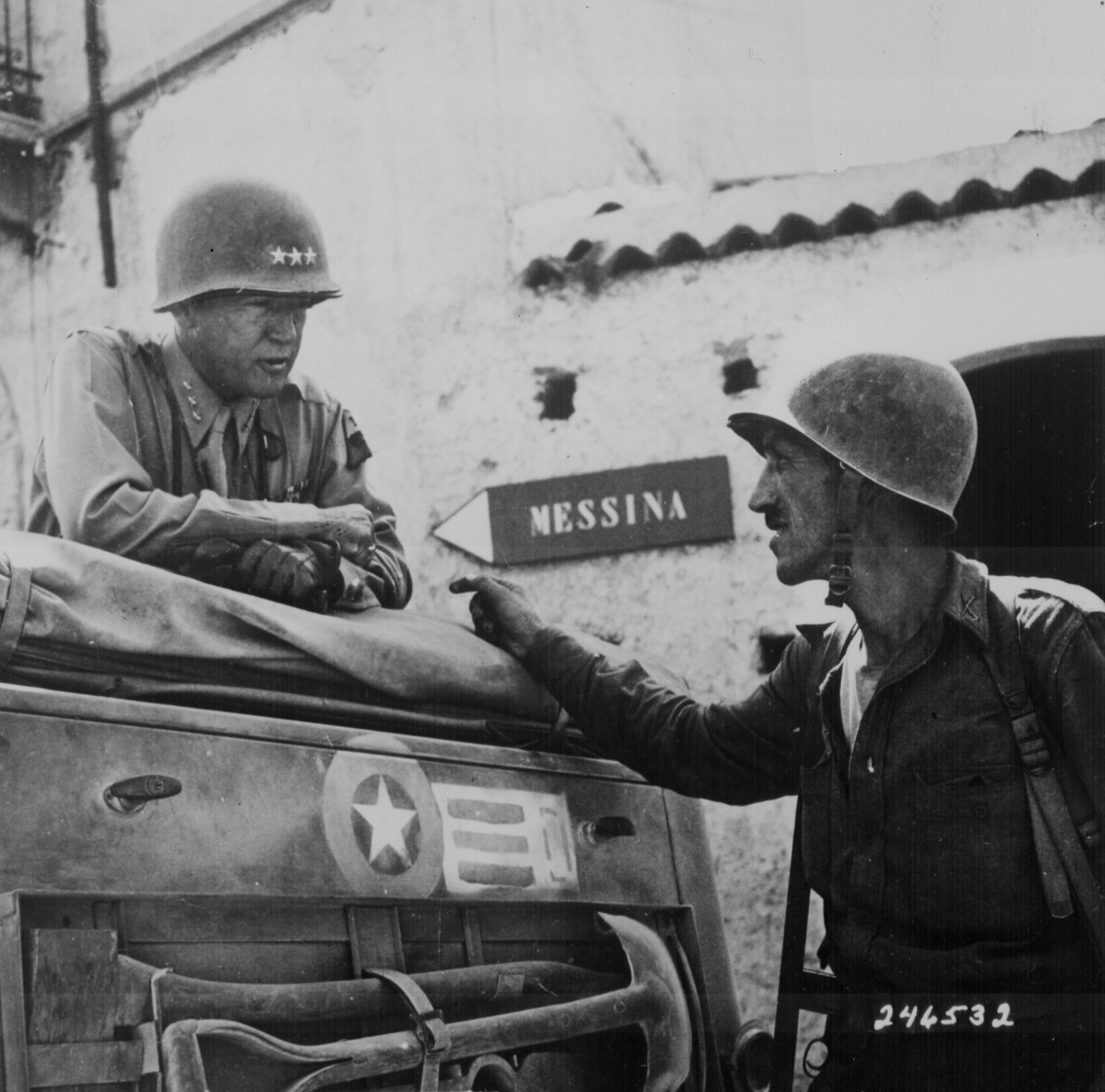
George S. Patton, left, with Lt. Col. Lyle Bernard near Brolo, Sicily, in 1943.
U.S. Army Signal Corps / National Archives (111-SC-246532) · Public domain · Original recordImage changes
Display copies resized; original scan preserved.
The words
Agrigento
Agrigento was a road center on Sicily’s southern coast. Capturing it opened the way for Seventh Army’s westward advance.
Ch. XII, Agrigento · Army history: the westward advance (opens a new tab)
Airfields
Capturing airfields let Allied fighters move onto Sicily and operate closer to the fighting. Transport aircraft brought fuel, ammunition and other supplies needed to keep those bases working.
Did you know?
A pipeline from Gela to Comiso later supplied aviation fuel, easing the problem of keeping forward airfields operating.
Forward airfields, p. 458 · Air Force history: conquest of Sicily (opens a new tab)
Brolo
Americans landed near Brolo on August 11, 1943, to block the coast road. German counterattacks and an Allied bombing error caused casualties; the German escape route reopened.
Did you know?
The officer with Patton in the photograph, Lieutenant Colonel Lyle Bernard, commanded the reinforced battalion that landed at Brolo.
Brolo landing, counterattacks and relief · Australian Army Journal: coastal landings (opens a new tab)
Caltanissetta
Caltanissetta helped anchor the line protecting the British Eighth Army’s rear. American troops secured this central road area before pushing farther north.
Ch. XIII, advance and boundary plans · Army history: the drive toward Palermo (opens a new tab)
Campaign
American, British and Canadian forces advanced across Sicily. After Palermo fell, the main fighting moved toward the island’s northeastern corner and the approaches to Messina.
Reduction of the island, pp. 460–470 · Air Force history: conquest of Sicily (opens a new tab)
End Run
An end run used sea transport to land troops behind a coastal defensive line. At Brolo, the operation failed to cut off the German retreat.
Brolo, results and force size · Australian Army Journal: coastal landings (opens a new tab)
Enna
Enna fell without a fight after nearby Allied advances undermined its defensive value. American forces then pushed north through central Sicily.
Ch. XVI, opening advance · Army history: the drive east (opens a new tab)
Keyes
Major General Geoffrey Keyes led the Provisional Corps toward Palermo. His infantry and airborne divisions advanced from the south and southwest.
Ch. XIII, Provisional Corps plan · Army history: the drive toward Palermo (opens a new tab) · Australian Army Journal: coastal landings (opens a new tab)
Maneuver
Coastal landings could bypass blocked roads, but the troops needed support and a prompt link with the overland advance. At Brolo, limited shipping restricted the force that could be landed.
Brolo, supporting forces and shipping · Australian Army Journal: coastal landings (opens a new tab)
Mussolini
Fascist dictator Benito Mussolini’s regime persecuted Jews through antisemitic laws. He was removed and arrested on July 25, 1943, after the Allied landings in Sicily.
Antisemitic legislation and fall of Mussolini · Holocaust Museum: Italy and Fascism (opens a new tab)
Nicosia
American troops reached Nicosia on July 28, 1943, after the Germans withdrew. The town lay on an inland route toward Messina.
Ch. XVI, withdrawal and American entry · Army history: the drive east (opens a new tab)
Palermo
American troops entered Palermo on July 22, 1943. Taking the port secured an important objective in western Sicily before Seventh Army turned east toward Messina.
Drive to Palermo, p. 462 · Air Force history: conquest of Sicily (opens a new tab)
Patton
Lieutenant General George S. Patton Jr. commanded Seventh Army in Sicily. He struck hospitalized soldiers, and Eisenhower reprimanded him.
Army history: campaign and hospital assaults (opens a new tab) · Australian Army Journal: coastal landings (opens a new tab)
Sicily
The Allies took Sicily, but German forces evacuated men and equipment across the Strait of Messina. Winning the island did not mean trapping all its defenders.
Evacuation across the strait, pp. 472–474 · Air Force history: conquest of Sicily (opens a new tab)
Slapping
Patton slapped two hospitalized soldiers on August 3 and August 10, 1943. Eisenhower rebuked him and required him to make amends.
Ch. XXI, hospital assaults and response · Army history: campaign and hospital assaults (opens a new tab)
Sources
- Sicily and the Surrender of Italy, Chapter XII: Seventh Army Changes DirectionsAlbert N. Garland and Howard McGaw Smyth, assisted by Martin Blumenson; US Army Center of Military History, HyperWar transcription
- Sicily and the Surrender of Italy, Chapter XIII: The Drive to the ClimaxAlbert N. Garland and Howard McGaw Smyth, assisted by Martin Blumenson; US Army Center of Military History, HyperWar transcription
- Sicily and the Surrender of Italy, Chapter XVI: The Drive to the EastAlbert N. Garland and Howard McGaw Smyth, assisted by Martin Blumenson; US Army Center of Military History, HyperWar transcription
- Sicily and the Surrender of Italy, Chapter XXI: The End of the CampaignAlbert N. Garland and Howard McGaw Smyth, assisted by Martin Blumenson; US Army Center of Military History, HyperWar transcription
- The Army Air Forces in World War II, Volume II: Europe: TORCH to POINTBLANK, Chapter 14: Conquest of SicilyEdited by Wesley Frank Craven and James Lea Cate; US Air Force official history, HyperWar transcription
- Amphibious AudacityAustralian Army Research Centre; Australian Army Journal, Volume 20 Number 1
- ItalyUnited States Holocaust Memorial Museum