
World War II
Puzzle 25 · Sicily to Cassino · Page 44 in print
Gela Beaches
Allied troops and naval gunfire defeated Axis counterattacks at Gela on 10-11 July 1943.
Jump to a word
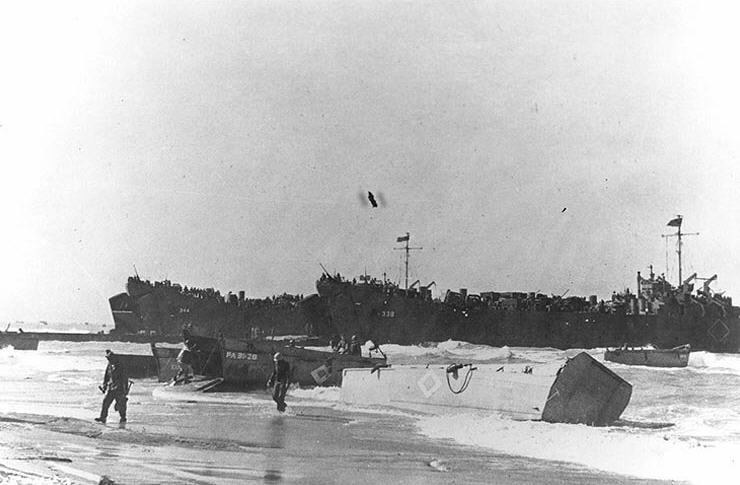
LST-344 and LST-338 unloading at the Gela invasion beaches on July 10, 1943.
Paris / U.S. Army Signal Corps / National Archives (SC 180443) · Public domain · Original recordImage changes
Display copies resized; original downloaded JPEG preserved.
The words
Air Cover
Allied fighters patrolled over the beaches and shipping to protect the landings from enemy aircraft. This differed from close support for soldiers fighting on the ground.
Air cover and support, pp. 450–452 · Air Force history: conquest of Sicily (opens a new tab)
Air Power
Fighter-bombers attacked roads leading toward the landing areas to disrupt Axis movements. These missions supported the beachhead even when aircraft were unavailable for close attacks beside American troops.
Attacks on inland movements, pp. 452–453 · Air Force history: conquest of Sicily (opens a new tab)
Artillery
The 32nd Field Artillery Battalion landed in amphibious trucks. Its guns fired from positions near the dunes at approaching German tanks.
Ch. VIII, defense near the dunes · Army history: the Axis counterattacks (opens a new tab)
Beaches
Heavy surf, soft sand and a damaged pier slowed unloading at Gela. Some tanks became stuck in the dunes as troops ashore faced counterattacks.
Did you know?
Floating pontoon causeways connected the landing ships with the shore, allowing vehicles and equipment to be unloaded.
Navy ship history: USS Savannah (opens a new tab) · Army history: the first day in Sicily (opens a new tab)
Boise
USS Boise and USS Savannah fired on shore batteries before the first assault wave landed. Boise later helped repel counterattacks against the beachhead.
Gela, opening bombardment and counterattacks · Navy ship history: USS Savannah (opens a new tab)
Casualties
Wounded men needed treatment beyond the beaches. A Navy photograph dated July 13, 1943, records American wounded and German prisoners being taken aboard USS Boise off Gela.
Photograph caption, 80-G-74837 · Navy record: treatment aboard USS Boise (opens a new tab)
Conrath
Generalmajor (brigadier general) Paul Conrath commanded the Hermann Göring Division. This German formation was positioned to oppose the American landings near Gela.
Navy ship history: USS Savannah (opens a new tab) · Fisher, Cassino to the Alps, ranks table (opens a new tab)
Defenders
German and Italian defenders tried to regain ground lost in the landings. Their troops counterattacked toward Gela while Axis aircraft struck ships offshore.
Gela, Axis air and ground attacks · Navy ship history: USS Savannah (opens a new tab)
Gela
Rangers and combat engineers held Gela against Italian infantry on July 11, 1943. Field artillery, mortars and naval guns supported them.
Ch. VIII, attacks on Gela · Army history: the Axis counterattacks (opens a new tab)
Infantry
The American 1st Division bore the heaviest German attack near Gela on July 11, 1943. Hard fighting stopped that attack and another major effort the next day.
Counterattacks, pp. 452–453 · Air Force history: conquest of Sicily (opens a new tab)
Livorno
Italy’s Livorno Division attacked toward Gela. Its infantry suffered heavy casualties as Rangers, field artillery and naval guns stopped the advance.
Ch. VIII, Italian counterattacks · Army history: the Axis counterattacks (opens a new tab)
Piano Lupo
The 16th Infantry held Piano Lupo’s road junction despite German tanks entering its lines. This position guarded the route inland from the beaches.
Ch. VIII, fighting at Piano Lupo · Army history: the Axis counterattacks (opens a new tab)
Ponte Olivo
German tanks advanced from Ponte Olivo airfield down Highway 117. Their plan was to join another armored force near Piano Lupo.
Ch. VIII, German attack plan · Army history: the Axis counterattacks (opens a new tab)
Savannah
USS Savannah fired on batteries threatening the landing craft and later engaged tanks near Gela. German fighters shot down its spotting aircraft, killing a pilot.
Gela, fire support and spotter losses · Navy ship history: USS Savannah (opens a new tab)
Sources
- Sicily and the Surrender of Italy, Chapter VIII: The Axis ThreatAlbert N. Garland and Howard McGaw Smyth, assisted by Martin Blumenson; US Army Center of Military History, HyperWar transcription
- Sicily and the Surrender of Italy, Chapter VII: The First DayAlbert N. Garland and Howard McGaw Smyth, assisted by Martin Blumenson; US Army Center of Military History, HyperWar transcription
- The Army Air Forces in World War II, Volume II: Europe: TORCH to POINTBLANK, Chapter 14: Conquest of SicilyEdited by Wesley Frank Craven and James Lea Cate; US Air Force official history, HyperWar transcription
- Savannah IV (CL-42)Naval History and Heritage Command, Dictionary of American Naval Fighting Ships; Mark L. Evans and Robert J. Cressman
- 80-G-74837: Operation Husky, July-August 1943National Museum of the US Navy, Naval History and Heritage Command; National Archives photograph 80-G-74837
- Cassino to the Alps, Appendix A: Table of Equivalent RanksUS Army Center of Military History; Ernest F. Fisher Jr., HyperWar transcription