
World War II
Puzzle 24 · Sicily to Cassino · Page 43 in print
Operation Husky
Operation Husky was the Allied invasion of Sicily on 10 July 1943, with British forces landing near Syracuse and Pachino, American forces at Gela and Scoglitti, and airborne and glider drops inland.
Jump to a word
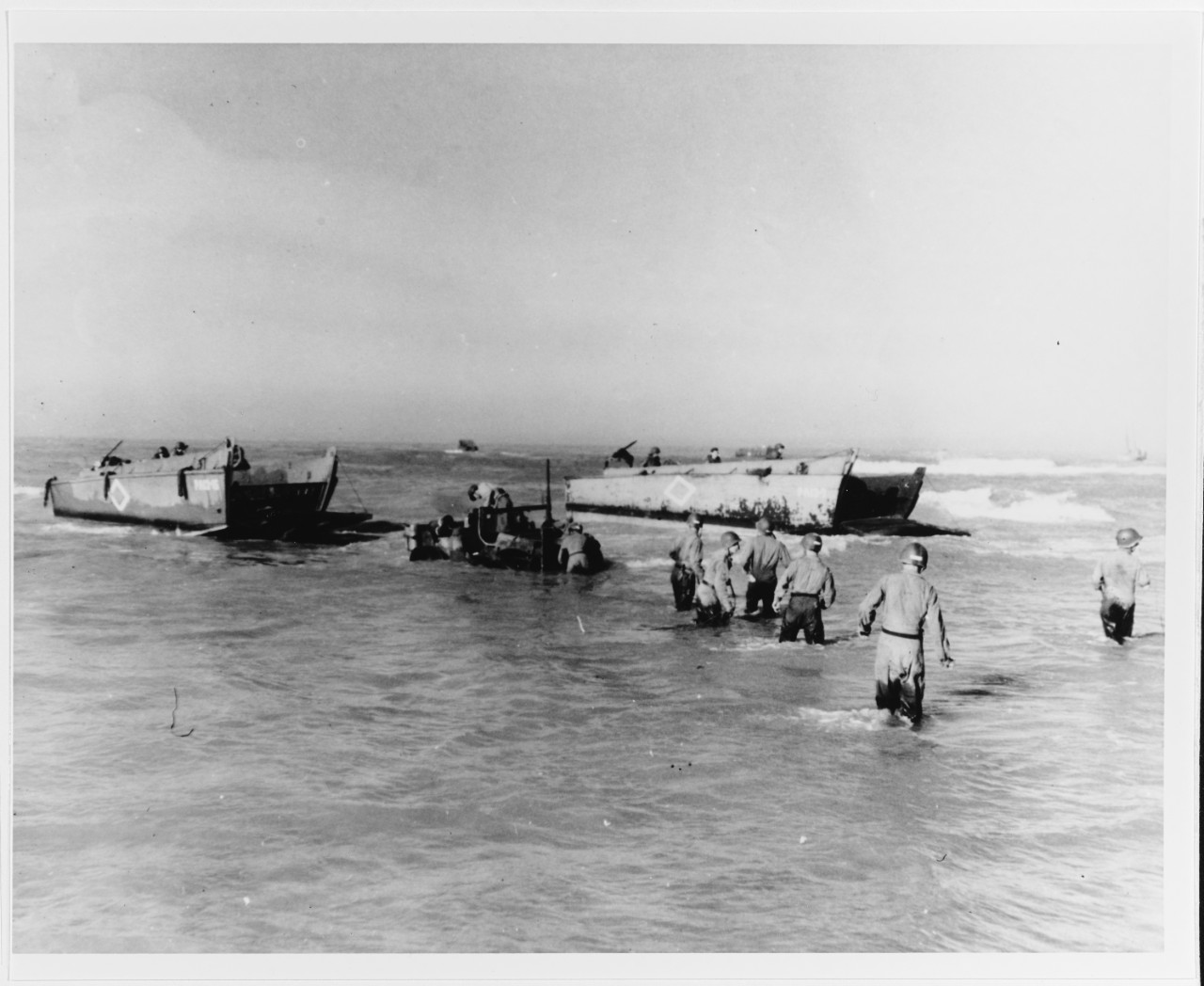
Landing craft from USS Joseph T. Dickman bring vehicles ashore at Gela, Sicily, in July 1943.
U.S. Coast Guard / National Archives (26-G-1788) · Public domain · Original recordImage changes
Display copies resized; original downloaded JPEG preserved.
The words
Airborne
Operation Ladbroke began on the night of July 9, 1943, before the beach landings. British glider troops were sent to seize Ponte Grande bridge on the approach to Syracuse.
Ladbroke, opening night · Army Flying Museum: Operation Husky (opens a new tab)
Allies
The Allies organized Husky under one supreme commander, General Dwight D. Eisenhower. Separate commanders directed the ground, naval and air operations.
Command arrangements · Husky directive, January 1943 (opens a new tab)
American
American forces landed at Licata, Gela and Scoglitti on Sicily’s southern coast. Their first tasks included taking nearby ports, airfields and roads leading inland.
Ch. VI, seaborne operations · Army history: the Sicily assault (opens a new tab)
Assault
The assault did not end at the water’s edge. Infantry pushed inland while artillery, armor and supplies came ashore to strengthen the new beachheads.
Ch. VI, closing assessment · Army history: the Sicily assault (opens a new tab)
Axis
Italian coastal troops guarded the landing beaches. Behind them, Italian and German mobile formations could move against the Allied beachheads, making the roads inland important to both sides.
Ch. VI, defenders near Gela · Army history: the Sicily assault (opens a new tab)
British
The British-led 30th Corps included the 1st Canadian Infantry Division. Canadian troops landed near Pachino on July 10, 1943, then advanced inland and made contact with American forces.
Description, landing and advance · Canadian Defence: landing in Sicily (opens a new tab)
Gliders
During Ladbroke, navigation errors and antiaircraft fire led to early glider releases. Many troops and pilots drowned when their gliders fell into the sea.
Ladbroke, releases and losses · Army Flying Museum: Operation Husky (opens a new tab)
Husky
Husky was the code name for the Sicily invasion. The Combined Chiefs of Staff issued the directive for the operation at Casablanca on January 23, 1943.
Did you know?
The January directive tied the target date to a favorable July moon, with August as a fallback if preparations ran late.
Opening directive · Husky directive, January 1943 (opens a new tab)
Invasion
The invasion combined airborne operations beginning on July 9 with beach landings on July 10, 1943. Troops approached southern and southeastern Sicily while Allied aircraft covered the beaches.
Ch. VI, airborne and seaborne operations · Army history: the Sicily assault (opens a new tab)
Italy
Sicily was Italian territory. Allied planners hoped that capturing the island would force Italy out of the war and draw German forces away from France and the Eastern Front.
Opening aims · Army Flying Museum: Operation Husky (opens a new tab)
Logistics
Planning and organizing military transport and supply.
The American landing areas lacked major port facilities capable of supporting the army. Landing ships and craft brought men and equipment directly across beaches with little infrastructure.
Did you know?
The DUKW, pronounced “duck,” was a truck that could swim to shore and drive its cargo inland.
Sicily and supply across beaches · WWII Museum: supplying armies from the sea (opens a new tab)
Paratroops
Allied ships fired on American paratroop transports approaching Sicily on July 11, 1943. The reinforcements suffered heavy casualties after inadequate warning and an uncleared flight corridor.
Husky No. 2, pp. 453–454 · Air Force history: conquest of Sicily (opens a new tab)
Seaborne
Large landing ships could put their bows onto the shore and lower ramps for vehicles. Smaller landing craft also carried tanks and other heavy cargo.
Landing ships and tank landing craft · WWII Museum: supplying armies from the sea (opens a new tab)
Supplies
The journey to Sicily was itself dangerous. Submarines sank three ships carrying Canadian troops and supplies from Britain; some soldiers were killed before reaching the landing beaches.
Description, losses during the voyage · Canadian Defence: landing in Sicily (opens a new tab)
Syracuse
British ground troops recaptured Ponte Grande bridge after its airborne defenders were overrun. They then entered Syracuse and continued north toward Augusta.
Ch. VI, advance from Ponte Grande · Army history: the Sicily assault (opens a new tab)
Sources
- Sicily and the Surrender of Italy, Chapter VI: The AssaultAlbert N. Garland and Howard McGaw Smyth, assisted by Martin Blumenson; US Army Center of Military History, HyperWar transcription
- Directive to the Commander in Chief, Allied Expeditionary Force in North Africa (Eisenhower), January 23, 1943US Department of State, Office of the Historian; Foreign Relations of the United States, The Conferences at Washington, 1941–1942, and Casablanca, 1943, document 417
- Operation HUSKYArmy Flying Museum
- Landing in SicilyNational Defence, Government of Canada
- The Army Air Forces in World War II, Volume II: Europe: TORCH to POINTBLANK, Chapter 14: Conquest of SicilyEdited by Wesley Frank Craven and James Lea Cate; US Air Force official history, HyperWar transcription
- Over-the-Shore Logistics of D-DayThe National WWII Museum, June 10, 2025