
World War II
Puzzle 23 · Torch and Tunisia · Page 40 in print
Bizerte and Tunis
Tunis and Bizerte fell on 7 May 1943. By 13 May, Axis resistance in North Africa had ended, with more than a quarter of a million German and Italian troops taken prisoner.
Jump to a word
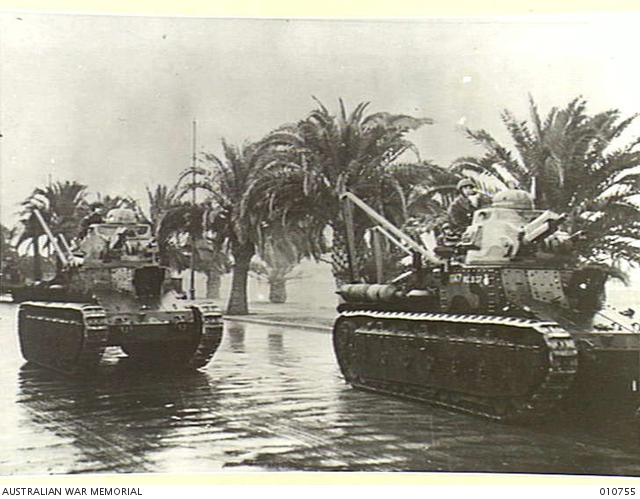
French tanks in an Allied victory parade through Tunis in 1943.
Australian War Memorial (010755) · Public domain · Original recordImage changes
Display copies resized; original downloaded JPEG preserved.
The words
Allied Advance
American armor and infantry worked together in the drive toward Bizerte. British forces entered Tunis as the Allies cut roads linking the remaining Axis positions.
Operations, final offensive · Army campaign history: Tunisia (opens a new tab)
Allied Victory
The Tunisian victory secured North Africa for the Allies. The army next faced another major Mediterranean campaign, the invasion of Sicily.
Analysis, next campaign · Army campaign history: Tunisia (opens a new tab)
Axis Collapse
As the bridgehead shrank, Axis forces lost room to maneuver and could not organize a mass evacuation. The surviving formations surrendered as Allied forces closed in.
Final air operations and evacuation · Air Force history: Tunisia and the blockade (opens a new tab)
Axis Defeat
Allied aircraft and naval forces attacked Axis supply routes across the Mediterranean. Cutting reinforcements, fuel and transport weakened the armies defending Tunisia.
Air blockade of Tunisia · Air Force history: Tunisia and the blockade (opens a new tab)
Axis Powers
Germany and Italy supplied the armies defending Tunisia. Convoy protection also tied down Italian escort vessels and German aircraft that could otherwise have served elsewhere.
Convoy protection and Axis resources · Air Force history: Tunisia and the blockade (opens a new tab)
Bizerte
American troops entered Bizerte on May 7, 1943. Securing the northern port helped split the remaining Axis positions and brought large numbers of prisoners into Allied custody.
Howe, ch. XXXIV, capture of Bizerte · Howe, ch. XXXIV: the end in Tunisia (opens a new tab)
Cap Bon
Axis commanders considered a final stand on Cap Bon peninsula. Shortages of fuel and ammunition prevented a prolonged defense there.
Howe, ch. XXXIV, final collapse · Howe, ch. XXXIV: the end in Tunisia (opens a new tab)
German Troops
German occupation authorities created labor camps in Tunisia. Thousands of Tunisian Jewish men were forced to work in camps, near the front and in cities.
German occupation of Tunisia · Holocaust Museum: forced-labor camps (opens a new tab)
Italian Troops
The Italian First Army continued resisting after the two cities fell. Giovanni Messe surrendered on May 13, 1943, and ordered his troops to give themselves up.
Howe, ch. XXXIV, Italian surrender · Howe, ch. XXXIV: the end in Tunisia (opens a new tab)
Longstop
Longstop Hill commanded the road toward Tunis. Capturing this high ground was part of preparing a route for British armor during the April offensive.
Opening plan for the April advance · London Irish history: the road to Tunis (opens a new tab)
Medjez
The road from Medjez el Bab led toward Tunis. British plans called for infantry to clear nearby heights before armor made its breakthrough.
Opening plan for the April advance · London Irish history: the road to Tunis (opens a new tab)
Prisoners
The mass surrender strained Allied prisoner compounds. Detention areas had to be enlarged as long columns of German and Italian captives arrived on foot and in vehicles.
Howe, ch. XXXIV, prisoner compounds · Howe, ch. XXXIV: the end in Tunisia (opens a new tab)
Tunis
British forces entered Tunis on May 7, 1943. The capital’s capture cut into the Axis bridgehead, but fighting continued in other pockets.
Howe, ch. XXXIV, liberation of Tunis · Howe, ch. XXXIV: the end in Tunisia (opens a new tab)
Von Arnim
Hans-Jürgen von Arnim commanded Axis Army Group Africa. He surrendered on May 12, 1943, while other formations still held out.
Howe, ch. XXXIV, final surrenders · Howe, ch. XXXIV: the end in Tunisia (opens a new tab)
Vulcan
Vulcan was the Allied plan for the final ground offensive in Tunisia. American and British formations advanced on the remaining Axis positions from separate sectors.
Did you know?
The Army glossary uses Husky for the Allied invasion of Sicily in July 1943. That operation appears in puzzle 24.
Army chronology: operation code names (opens a new tab) · Army campaign history: Tunisia (opens a new tab)
Sources
- Northwest Africa: Seizing the Initiative in the West, Chapter XXXIV: The End in TunisiaUS Army Office of the Chief of Military History; George F. Howe (1957), HyperWar transcription
- Chronology 1941–1945: Glossary of Code NamesUS Army Center of Military History, Chronology 1941–1945; HyperWar transcription
- Tunisia, November 17, 1942–May 13, 1943, CMH Publication 72-12Charles R. Anderson; US Army Center of Military History, HyperWar transcription
- The Army Air Forces in World War II, Volume II: Europe: TORCH to POINTBLANK, Chapter 6: Climax in TunisiaThomas J. Mayock; edited by Wesley Frank Craven and James Lea Cate, US Air Force official history, HyperWar transcription
- Labor and Internment Camps in North AfricaUnited States Holocaust Memorial Museum
- Heidous – April 1943London Irish Rifles Association, regimental history