
World War II
Puzzle 22 · Torch and Tunisia · Page 39 in print
Mareth Line
In March 1943, Montgomery’s Eighth Army attacked the Mareth Line in Tunisia. New Zealand, British and French units joined the outflanking operation through Tebaga Gap, where a breakthrough came on 26 March.
Jump to a word
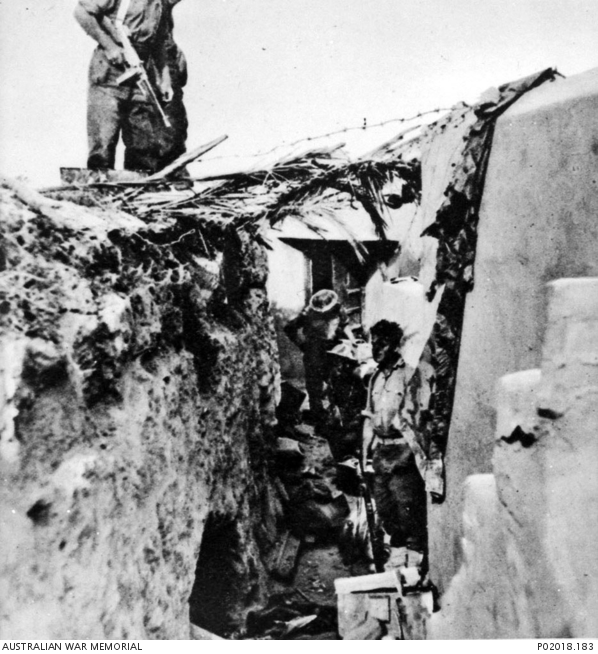
Men of the 1st Battalion, Black Watch, in trenches at the Mareth Line in March 1943.
Australian War Memorial (P02018.183) · Public domain · Original recordImage changes
Display copies resized; original downloaded JPEG preserved.
The words
Desert
The flanking force crossed inland desert beyond the Matmata Hills. Its vehicles had to reach the gap behind Mareth’s fixed defenses.
Howe, ch. XXVII, inland route · Howe, ch. XXVII: Mareth and the pursuit (opens a new tab)
El Hamma
El Hamma lay behind the Mareth position. Reaching its approaches through Tebaga threatened the defenders’ route north toward Gabès.
Howe, ch. XXVII, flank route · Howe, ch. XXVII: Mareth and the pursuit (opens a new tab)
Enfidaville
After the pursuit north, Eighth Army attacked Enfidaville in April 1943. Taking the town still left Axis forces holding strong positions inland, so fighting continued.
April advance and Enfidaville · Highland Division: the advance north (opens a new tab)
Freyberg
Lieutenant General Bernard Freyberg led the provisional New Zealand Corps. It combined New Zealand troops with British armor and other Allied units.
Howe, ch. XXVII, force composition · Howe, ch. XXVII: Mareth and the pursuit (opens a new tab)
Gabes
After the Mareth defenses were abandoned, Highland troops crossed Wadi Zigzaou and advanced toward Gabès. They arrived as the New Zealand flanking force also approached.
Withdrawal from Mareth and advance · Highland Division: Mareth fighting (opens a new tab)
Left Hook
The left hook took forces west of the Matmata Hills, then toward the enemy’s rear. The frontal attack and inland march were intended to divide Axis strength.
Mareth plan, inland corridor · Air Force history: Mareth operations (opens a new tab)
Mareth
French forces built Mareth’s defenses before the war. In 1943, German and Italian troops used the fortified line to block Eighth Army’s advance along the coast.
French fortifications and Axis deployment · Air Force history: Mareth operations (opens a new tab)
Matmata Hills
The Matmata Hills bounded the coastal corridor at Mareth. Going around their southern end offered an inland route behind the defenses.
Howe, ch. XXVII, terrain · Howe, ch. XXVII: Mareth and the pursuit (opens a new tab)
Medenine
Axis forces attacked Eighth Army near Medenine on March 6, 1943. The attack was repelled before Montgomery began the main offensive against the Mareth defenses.
Preparations, March 6 attack · Air Force history: Mareth operations (opens a new tab)
Messe
Giovanni Messe commanded the Italian First Army at Mareth. His defense included German and Italian formations, with armored units held behind the line.
Howe, ch. XXVII, defense plans · Howe, ch. XXVII: Mareth and the pursuit (opens a new tab)
Pugilist
Pugilist combined a frontal attack on Mareth with an inland flank march. Montgomery aimed to force the defenders to divide their strength.
Howe, ch. XXVII, attack plan · Howe, ch. XXVII: Mareth and the pursuit (opens a new tab)
Sfax
The advance reached Sfax after fighting through the Wadi Akarit position. Gordon Highlanders helped open the route by attacking an Axis rearguard that had blocked the tanks.
Wadi Cheffar and entry into Sfax · Highland Division: the advance north (opens a new tab)
Tebaga Gap
At Tebaga Gap, aircraft and artillery supported the infantry and tank assault on March 26, 1943. It opened a route behind the Mareth defenses.
Did you know?
A sandstorm blew over the Allied landing grounds on the morning of March 26. It cleared before the afternoon air assault.
March 26 combined assault · Air Force history: Mareth operations (opens a new tab)
Tripoli
Captured in January 1943, Tripoli became a supply base for Eighth Army’s advance. Getting its port working mattered before more forces could move into Tunisia.
Tripoli and advance into Tunisia · Air Force history: Mareth operations (opens a new tab)
Wadi Zigzaou
A streambed or valley.
Wadi Zigzaou stood immediately before the fortified line. Highland battalions sent to hold its anti-tank ditch suffered heavy casualties during the frontal attack.
The Plan and The Action, wadi fighting · Highland Division: Mareth fighting (opens a new tab)
Sources
- Northwest Africa: Seizing the Initiative in the West, Chapter XXVII: From Mareth to EnfidavilleUS Army Office of the Chief of Military History; George F. Howe (1957), HyperWar transcription
- The Army Air Forces in World War II, Volume II: Europe: TORCH to POINTBLANK, Chapter 6: Climax in TunisiaThomas J. Mayock; edited by Wesley Frank Craven and James Lea Cate, US Air Force official history, HyperWar transcription
- The Mareth Line, March 1943Museum of The Royal Regiment of Scotland; 51st Highland Division history, C. S. Grant
- Concluding Operations, Wadi Akarit, April 1943Museum of The Royal Regiment of Scotland; 51st Highland Division history, C. S. Grant