
World War II
Puzzle 21 · Torch and Tunisia · Page 38 in print
Montgomery at Alamein
General Bernard L. Montgomery assumed command of the British Eighth Army in August 1942, preparing for the Second Battle of El Alamein from 23 October to 4 November.
Jump to a word
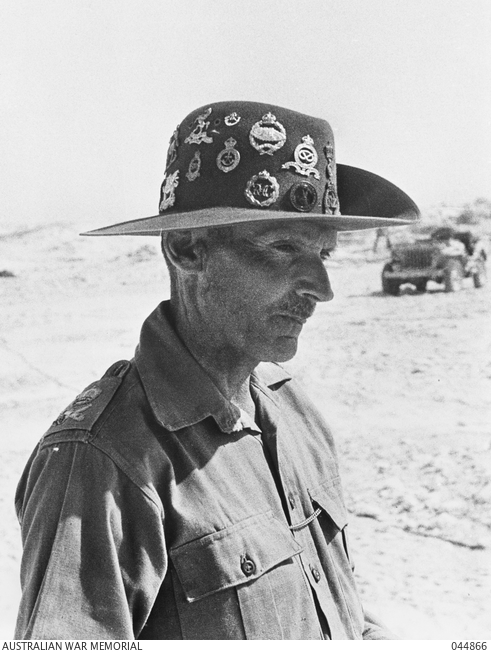
Bernard Montgomery wearing an Australian slouch hat presented to him near El Alamein in August 1942.
Australian War Memorial (044866) · Public domain · Original recordImage changes
Display copies resized; original downloaded JPEG preserved.
The words
Afrika Korps
Germany sent the Afrika Korps to support Italy’s army in North Africa. It became part of the larger German–Italian force that fought the Allies in Egypt.
Opening campaign background · War Memorial: desert campaign (opens a new tab)
Desert Fox
Desert Fox was Erwin Rommel’s nickname. He commanded the German–Italian army opposing Eighth Army, whose attacks and retreats shaped the campaign before Montgomery’s offensive.
Axis army and Rommel · War Memorial: Alamein battles (opens a new tab)
Desert Rats
Britain’s 7th Armoured Division used the jerboa as its divisional sign. The desert animal became the emblem associated with its Desert Rats name.
Did you know?
The Tank Museum dates the jerboa’s addition to the divisional vehicle sign to April 1940. The emblem later appeared on shoulder flashes.
Divisional sign and vehicle markings · Tank Museum: the jerboa badge (opens a new tab)
Desert Victory
Victory at the second El Alamein forced the Axis army to retreat westward. The fighting opened the way for an Allied advance across the desert.
Final battle and withdrawal · War Memorial: Alamein battles (opens a new tab)
Desert War
Desert armies depended on supplies brought through ports and along the coastal road. Advancing made their supply lines longer, while retreat brought them closer to their bases.
Logistics · War Memorial: desert campaign (opens a new tab)
Egypt
Holding Egypt protected the Suez Canal and Britain’s wider Middle Eastern supply routes. The Alamein position stood between the Axis advance and Alexandria and Cairo.
Egypt and the Alamein position · War Memorial: desert campaign (opens a new tab)
El Alamein
The Alamein battlefield narrowed between the Mediterranean and the Qattara Depression. This geography helped Eighth Army hold a line that was difficult for armored forces to outflank.
The defensive position · War Memorial: Alamein battles (opens a new tab)
Gazala
At Gazala in 1942, Axis forces broke through the Allied position in Libya. Eighth Army retreated toward Egypt before making its stand at Alamein.
Gazala to Alamein · War Memorial: desert campaign (opens a new tab)
Kidney Ridge
Kidney Ridge was an objective for the Gordon Highlanders in the October fighting. Their regimental history calls the 1st Battalion’s target Aberdeen.
Did you know?
The Gordons wore white St Andrew’s crosses on their backs during the opening attack, helping the soldiers following them recognize their own men.
El Alamein section · Gordons Museum: El Alamein (opens a new tab)
Miteiriya
Australian troops attacked Miteiriya, or Ruin Ridge, in July 1942. The isolated 2/28th Battalion suffered heavy losses, with men killed, captured or missing before Montgomery took command.
July assault and losses · War Memorial: Ruin Ridge (opens a new tab)
Montgomery
Montgomery took over Eighth Army in August 1942. He trained and prepared its multinational force before launching the major October offensive against the Axis defenses.
Change of command and preparation · War Memorial: Alamein battles (opens a new tab)
Ruweisat
At Ruweisat in July, Allied infantry gains were undermined by poor coordination and inadequate tank support. Many troops became casualties or prisoners before Montgomery’s arrival.
July fighting on the Alamein line · War Memorial: desert campaign (opens a new tab)
Snipe
Snipe was a position targeted during the British advance near Kidney Ridge. Anti-tank guns helped the infantry resist repeated Axis armored attacks on October 27, 1942.
Phase Two, October 26–27 · Rickard: Second Alamein (opens a new tab)
Stumme
Georg Stumme commanded the Axis army while Rommel was away. He died near the front on October 24, 1942, disrupting command early in the battle.
Rommel’s absence and October 24 · Rickard: Second Alamein (opens a new tab)
Tobruk
The Australian 9th Division helped defend Tobruk during the 1941 siege. The port fell to Axis forces in June 1942, during the retreat that preceded Alamein.
Tobruk and the retreat into Egypt · War Memorial: desert campaign (opens a new tab)
Sources
- El Alamein battlesAustralian War Memorial
- El Alamein 80 years onCraig Tibbitts; Australian War Memorial, January 8, 2023
- The Desert RatThe Tank Museum, November 16, 2022
- 1939–1945: Second World WarThe Gordon Highlanders Museum
- First Alamein: Ruin RidgeNicole Townsend; Australian War Memorial, July 1, 2017
- Second battle of El Alamein, 23 October–4 November 1942J. Rickard; History of War, May 1, 2017