
World War II
Puzzle 20 · Torch and Tunisia · Page 37 in print
Kasserine Pass
German advances at Sidi Bou Zid forced an American retreat in February 1943. Rommel then attacked Kasserine Pass, taking it on 20 February before Axis forces withdrew later that month.
Jump to a word
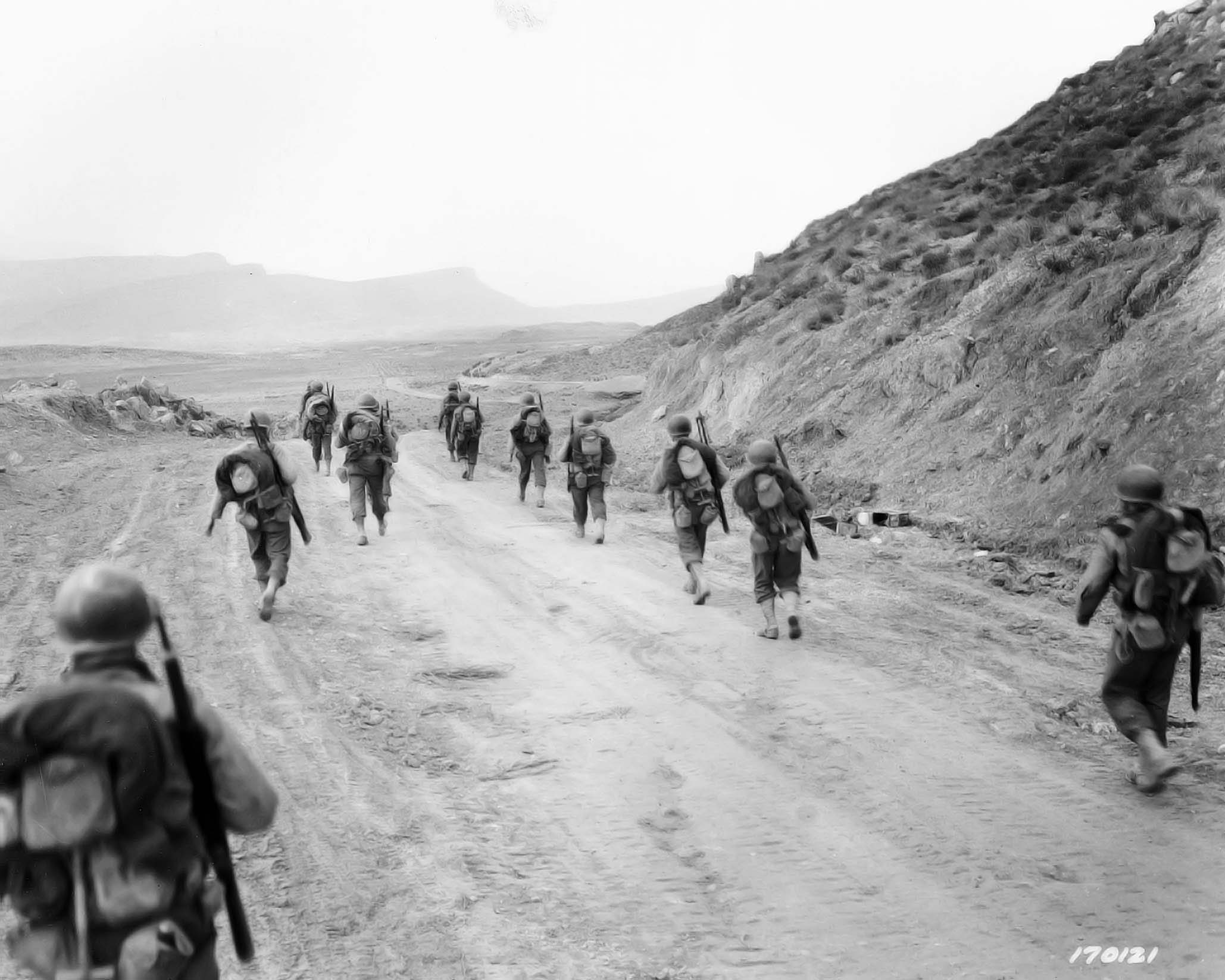
Men of the 2nd Battalion, 16th Infantry, march through Kasserine Pass on February 26, 1943.
U.S. Army Signal Corps / National Archives (SC 170121) · Public domain · Original recordImage changes
Display copies resized; original downloaded JPEG preserved.
The words
Air Forces
In late February 1943, a Mediterranean Air Command brought British and American air forces under Arthur Tedder. The reorganization followed the setbacks in Tunisia.
Operations, Allied command reorganization · Army campaign history: Tunisia (opens a new tab)
Anderson
Lieutenant General Kenneth Anderson commanded British First Army in Tunisia. The February fighting exposed weaknesses in the Allies’ divided command arrangements.
Operations, command and reorganization · Army campaign history: Tunisia (opens a new tab)
Armored
The 1st Armored Division counterattacked near Sidi Bou Zid to relieve isolated infantry. German forces defeated the attack, worsening the American withdrawal.
Howe, ch. XXI, February 15 counterattack · Howe, ch. XXI: Sidi Bou Zid (opens a new tab)
Dorsale
Tunisia’s mountain ridges forced roads through passes. These narrow routes mattered because Allied troops tried to block the movement of Axis forces inland from the coast.
Operations, roads and mountain passes · Army campaign history: Tunisia (opens a new tab)
Faid Pass
German tanks moved through Faïd Pass toward Sidi Bou Zid. The gap gave the 10th Panzer Division a route through the mountains.
Howe, ch. XXI, attack plan · Howe, ch. XXI: Sidi Bou Zid (opens a new tab)
Gafsa
American forces evacuated Gafsa as German columns advanced in southern Tunisia. This retreat formed part of the wider crisis before the battle for Kasserine Pass.
Opening offensive, Gafsa evacuation · WWII Museum: Kasserine fighting (opens a new tab)
Ground Forces
American infantry and armor were scattered too far apart for mutual fire support. At Sidi Bou Zid, German attacks isolated units rather than meeting one concentrated defense.
Opening offensive, dispersed American units · WWII Museum: Kasserine fighting (opens a new tab)
Harmon
Major General Ernest Harmon was sent east as a senior assistant to Fredendall. He arrived during efforts to contain the breakthrough at Kasserine.
Howe, ch. XXIV, Harmon’s assignment · Howe, ch. XXIV: beyond Kasserine (opens a new tab)
II Corps
Under Major General Lloyd Fredendall, U.S. II Corps suffered successive defeats in central Tunisia. Losses of troops and equipment forced its withdrawal toward Kasserine Pass.
Did you know?
In early March 1943, Eisenhower selected George Patton to command II Corps. Omar Bradley became his deputy as the formation was reorganized.
Operations, February reverses · Army campaign history: Tunisia (opens a new tab)
Reverse
The reverse began before the loss of Kasserine Pass. Defeats at Sidi Bou Zid and Sbeïtla forced American troops back and cost them tanks, guns and vehicles.
Operations, Sidi Bou Zid to Kasserine · Army campaign history: Tunisia (opens a new tab)
Sbeitla
The U.S. 1st Armored Division had its headquarters and reserve near Sbeïtla. Roads through Kasserine connected it with Allied forces farther south.
Howe, ch. XXI, Allied dispositions · Howe, ch. XXI: Sidi Bou Zid (opens a new tab)
Sidi Bouzid
At Sidi Bou Zid, German attacks surrounded American infantry on high ground. Attempts to relieve them failed, and many soldiers were captured during the February 1943 fighting.
Opening offensive, surrounded infantry · WWII Museum: Kasserine fighting (opens a new tab)
Tebessa
Tébessa lay beyond Kasserine on a road toward Allied bases. American forces blocked the western advance after Axis troops broke through the pass.
Howe, ch. XXIV, Tébessa road · Howe, ch. XXIV: beyond Kasserine (opens a new tab)
Tenth Panzer
The German 10th Panzer Division attacked near Sidi Bou Zid and later advanced beyond Kasserine. Its tanks faced British defenders on the road toward Thala.
Opening offensive and Thala fighting · WWII Museum: Kasserine fighting (opens a new tab)
Thala
British armor and American artillery defended Thala against the advance beyond Kasserine. The town guarded the northern road out of the pass.
Howe, ch. XXIV, Thala defense · Howe, ch. XXIV: beyond Kasserine (opens a new tab)
Sources
- Northwest Africa: Seizing the Initiative in the West, Chapter XXIV: The Enemy Is Turned BackUS Army Office of the Chief of Military History; George F. Howe (1957), HyperWar transcription
- Northwest Africa: Seizing the Initiative in the West, Chapter XXI: The Enemy Strikes at U.S. II CorpsUS Army Office of the Chief of Military History; George F. Howe (1957), HyperWar transcription
- Tunisia, November 17, 1942–May 13, 1943, CMH Publication 72-12Charles R. Anderson; US Army Center of Military History, HyperWar transcription
- Kasserine Pass: German Offensive, American VictoryMark T. Calhoun; The National WWII Museum, February 14, 2023