
World War II
Puzzle 19 · Torch and Tunisia · Page 36 in print
Eisenhower in Algiers
Eisenhower approved an agreement negotiated by his deputy Mark Clark with Admiral Francois Darlan in Algiers in November 1942. It secured French military cooperation but drew anger because of Darlan’s Vichy role.
Jump to a word
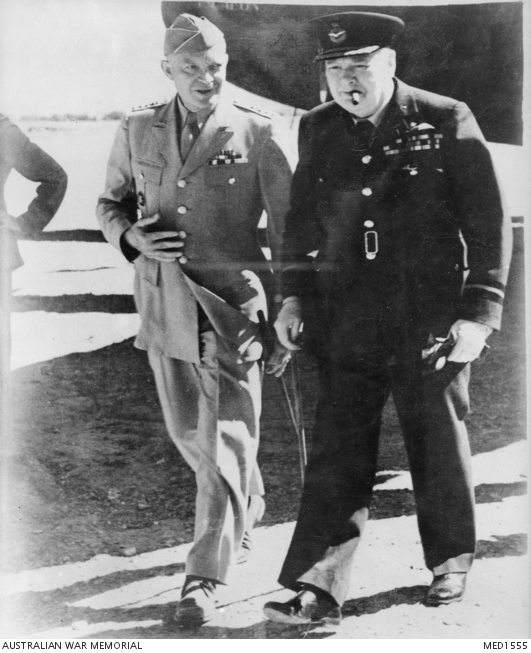
Dwight D. Eisenhower and Winston Churchill at an airfield in Algiers on June 5, 1943.
Australian War Memorial (MED1555) · Public domain · Original recordImage changes
Display copies resized; original downloaded JPEG preserved.
The words
Algeria
Algeria was under French colonial rule. Before Torch, Vichy revoked Algerian Jews’ French citizenship and restricted their work and education.
Vichy legislation in Algeria · Holocaust Museum: Vichy’s racial laws (opens a new tab)
Algiers
Algiers offered a port, rail terminal, airfields and space for an Allied headquarters. These facilities could support the next stage of the campaign toward Tunisia.
Howe, ch. XIII, opening objectives · Howe, ch. XIII: Algiers (opens a new tab)
Anglo-French
British attacks on French ships in 1940 killed French sailors and deepened mistrust. Torch planners emphasized American leadership to reduce French resistance to the landings.
Operations, choice of landing commanders · Army campaign history: Algiers (opens a new tab)
Armistice
Algiers’ local cease-fire stopped fighting there while hostilities continued at Oran and Casablanca. Negotiators still had to seek cooperation across French North Africa.
Howe, ch. XIII, local armistice · Howe, ch. XIII: Algiers (opens a new tab)
Blida
British troops captured Blida airfield after landing west of Algiers. Reaching an airfield inland was an early objective, beyond securing the beaches themselves.
Eastern Task Force, Beach Apples · Army campaign history: Algiers (opens a new tab)
British Troops
British soldiers formed the larger part of the force landing near Algiers. The initial assault combined British and American units under U.S. Major General Charles Ryder.
Eastern Task Force, composition and command · Army campaign history: Algiers (opens a new tab)
Cunningham
Admiral Andrew Cunningham directed Torch’s Allied naval command under Eisenhower. His responsibilities included sea security and amphibious operations, linking the ships with the landings.
Howe, ch. III, naval command · Howe, ch. III: Allied command (opens a new tab)
Diplomacy
The Clark–Darlan agreement, signed November 22, 1942, set rules for French military cooperation and Allied access to ports, airfields and communications in North Africa.
Did you know?
The agreement provided for both English and French texts. Its final article specified that the English text would be authoritative.
Preamble and articles I–VI · State Department: Clark–Darlan agreement (opens a new tab)
Eisenhower
Eisenhower commanded Torch’s British and American forces. His deputy Mark Clark negotiated French cooperation while the Allies sought ports and airfields for the campaign.
The Operation and French negotiations · Holocaust Museum: Torch and its aftermath (opens a new tab)
Giraud
Henri Giraud became commander of French ground and air forces under the November arrangements. Darlan retained political authority as high commissioner and command of naval forces.
Howe, ch. XIV, November 13 arrangement · Howe, ch. XIV: French negotiations (opens a new tab)
Juin
General Alphonse Juin was asked to halt French resistance at Algiers. Darlan limited his authority to an agreement for that city, leaving wider negotiations unresolved.
Howe, ch. XIII, local armistice · Howe, ch. XIII: Algiers (opens a new tab)
Maison Blanche
American troops captured Maison Blanche airfield after landing east of Algiers. Nearby coastal artillery continued fighting, so taking the airfield did not secure the whole area.
Eastern Task Force, Beach Charlie · Army campaign history: Algiers (opens a new tab)
Political
Keeping Darlan in authority gained French cooperation but angered de Gaulle’s Free French movement. Darlan had served Vichy, whose racial laws persecuted North African Jews.
Holocaust Museum: Torch and its aftermath (opens a new tab) · Holocaust Museum: Vichy’s racial laws (opens a new tab)
Saint George
At the Hotel St. Georges in Algiers, Clark met Darlan on November 10, 1942. Their talks concerned ending French resistance and organizing cooperation against Axis forces.
Howe, ch. XIV, November 10 meeting · Howe, ch. XIV: French negotiations (opens a new tab)
Tunisia
Tunisia lay east of the Torch landing areas. The Allied advance faced Axis reinforcements there, so capturing Algiers did not bring the North African campaign to an end.
Consequences of Operation Torch · Holocaust Museum: Torch and its aftermath (opens a new tab)
Sources
- Northwest Africa: Seizing the Initiative in the West, Chapter XIII: The Occupation of AlgiersUS Army Office of the Chief of Military History; George F. Howe (1957), HyperWar transcription
- Northwest Africa: Seizing the Initiative in the West, Chapter XIV: The Axis Reaction and the French DecisionUS Army Office of the Chief of Military History; George F. Howe (1957), HyperWar transcription
- Northwest Africa: Seizing the Initiative in the West, Chapter III: Tactical Plans and Political PreparationsUS Army Office of the Chief of Military History; George F. Howe (1957), HyperWar transcription
- Algeria-French Morocco, November 8–11, 1942, CMH Publication 72-11Charles R. Anderson; US Army Center of Military History, HyperWar transcription
- Anti-Jewish Legislation in North AfricaUnited States Holocaust Memorial Museum
- Operation Torch: The Anglo-American Invasion of French North AfricaUnited States Holocaust Memorial Museum
- Agreement Between General Mark Clark and Admiral François Darlan, Signed at Algiers, November 22, 1942US Department of State, Office of the Historian; Foreign Relations of the United States, 1942, Volume II, document 454