
World War II
Puzzle 18 · Torch and Tunisia · Page 35 in print
Oran Landings
Major General Lloyd Fredendall’s Center Task Force landed on both sides of Oran on 8 November 1942. Beaches X and Y lay west of the city and Beach Z to the east. Oran agreed to a cease-fire on 10 November.
Jump to a word
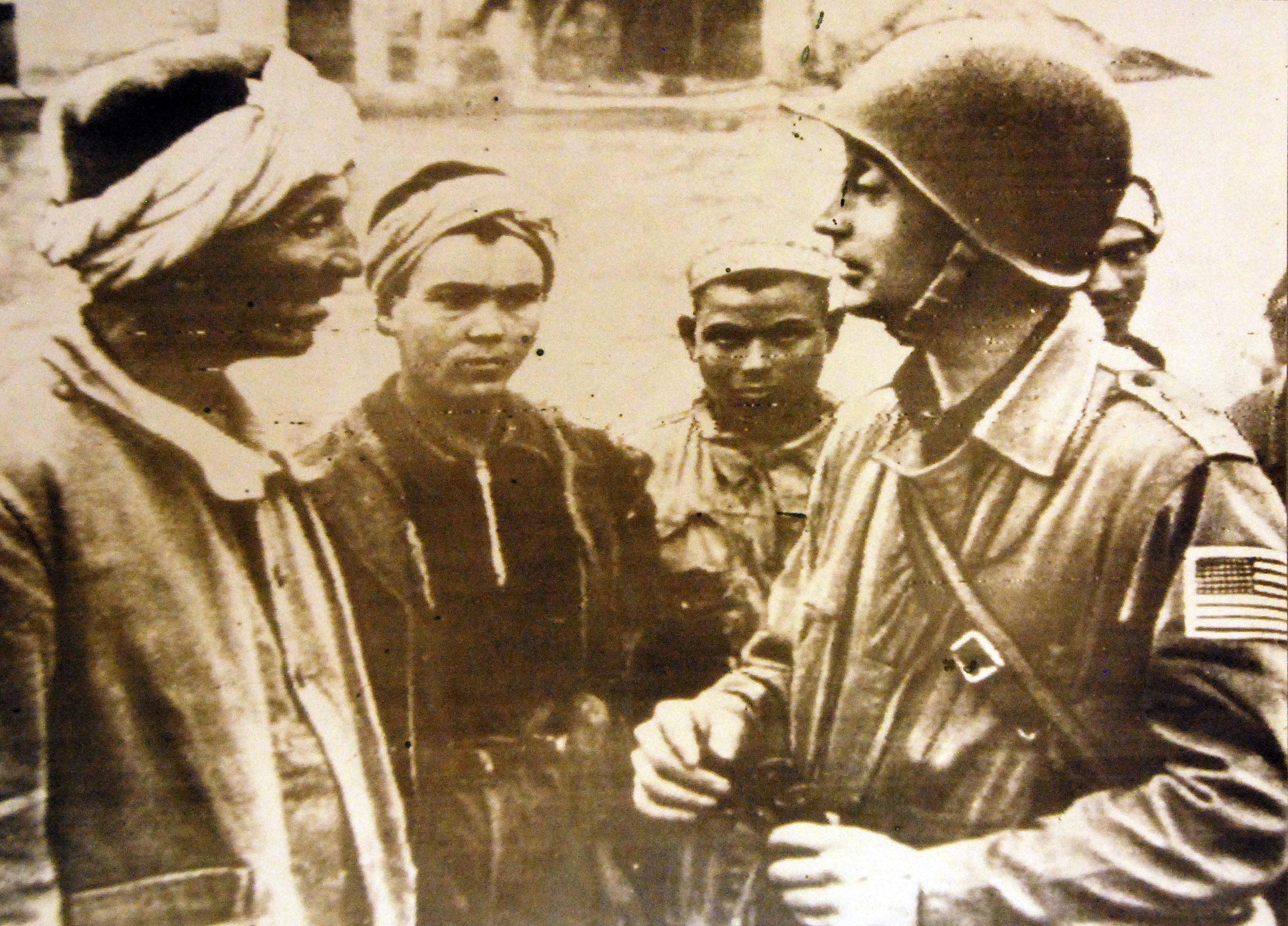
An American officer speaking with villagers near Oran after the landings in November 1942.
Office of War Information / Library of Congress, courtesy National Museum of the U.S. Navy (Lot-11582-18) · Public domain · Original recordImage changes
Display copies resized; original downloaded JPEG preserved.
The words
Admiral
Admiral Andrew Cunningham directed Torch’s Allied naval command. Commodore Thomas Troubridge led the British naval force supporting the landings at Oran.
Howe, ch. III, chain of command · Howe, ch. III: Allied command (opens a new tab)
Arzew
At Arzew, east of Oran, Rangers seized coastal batteries and infantry captured the town. These actions helped establish the eastern approach to Oran.
Center Task Force, eastern landings · Army campaign history: Oran (opens a new tab)
Fleet
The Oran force brought American troops from Britain under British naval escort. Other Torch forces approached Casablanca and Algiers, making Oran one part of the invasion.
Three Task Forces Organized · Coast Guard history: Torch forces (opens a new tab)
Fredendall
U.S. Major General Lloyd Fredendall commanded the Center Task Force. He planned a three-sided attack on Oran after French resistance slowed the initial advance.
Center Task Force, final advance · Army campaign history: Oran (opens a new tab)
Hartland
HMS Hartland carried Allied raiders into Oran harbor during Reservist. French gunfire set the cutter ablaze; it sank, killing many aboard and leaving survivors in captivity.
Did you know?
Hartland began as the U.S. Coast Guard cutter Pontchartrain. Transferred to Britain under Lend-Lease in 1941, it received its new name in Royal Navy service.
Hartland’s loss and survivors · WWII Museum: Operation Reservist (opens a new tab)
La Senia
La Sénia was one of the airfields sought near Oran. French aircraft withdrew before American troops captured it, adding a second airfield to the Allied foothold.
Center Task Force, airfield captures · Army campaign history: Oran (opens a new tab)
Marines
Six U.S. Marines joined the Reservist force alongside Army soldiers and American and British naval personnel. Their harbor mission was separate from the main beach landings.
Howe, ch. XI, Operation Reservist · Howe, ch. XI: Oran landings (opens a new tab)
Oran
The Allies sought Oran’s port and nearby airfields. After fighting around the city, an American armored column entered on November 10, 1942; a cease-fire followed.
Center Task Force, November 10 · Army campaign history: Oran (opens a new tab)
Reservist
Reservist aimed to seize Oran’s harbor intact and stop ships being deliberately sunk to block it. The assault failed, with heavy deaths and injuries among the troops.
Mission and aftermath · WWII Museum: Operation Reservist (opens a new tab)
Sailors
British and American sailors formed part of Reservist’s joint raiding force. Their work included an attempt to secure port facilities needed for later Allied operations.
Joint force and harbor mission · WWII Museum: Operation Reservist (opens a new tab)
Shore Party
At Beach X, an engineer shore party was assigned beach exits, supply dumps, unloading and traffic control. Getting cargo inland required work beyond landing the troops.
Howe, ch. XI, X-Ray Beach · Howe, ch. XI: Oran landings (opens a new tab)
Transports
Transports carried troops offshore before landing craft took them to the beaches. The plan brought ships closer through mineswept channels after the first boats arrived.
Howe, ch. XI, ship-to-shore movement · Howe, ch. XI: Oran landings (opens a new tab)
US Troops
American infantry, Rangers and armored troops took part in the Oran operation. Their separate attacks targeted coastal defenses, inland roads and airfields as well as the city.
Center Task Force, landing units · Army campaign history: Oran (opens a new tab)
Sources
- Northwest Africa: Seizing the Initiative in the West, Chapter III: Tactical Plans and Political PreparationsUS Army Office of the Chief of Military History; George F. Howe (1957), HyperWar transcription
- Northwest Africa: Seizing the Initiative in the West, Chapter XI: The First Day’s Operations Against OranUS Army Office of the Chief of Military History; George F. Howe (1957), HyperWar transcription
- Algeria-French Morocco, November 8–11, 1942, CMH Publication 72-11Charles R. Anderson; US Army Center of Military History, HyperWar transcription
- Gallantry against Great Odds: LTC George Marshall and Operation RESERVISTJohn Curatola; The National WWII Museum, November 15, 2022
- The Coast Guard at War, Volume IX: North African Landings, Part IUS Coast Guard, Historical Section; HyperWar transcription