
World War II
Puzzle 17 · Torch and Tunisia · Page 34 in print
Hewitt's Western Task Force
Rear Admiral Henry Kent Hewitt’s naval force crossed the Atlantic to support Patton’s troops on 8 November 1942. They landed at Fedala, Safi and Mehdia near Port Lyautey, with Casablanca as a main objective.
Jump to a word
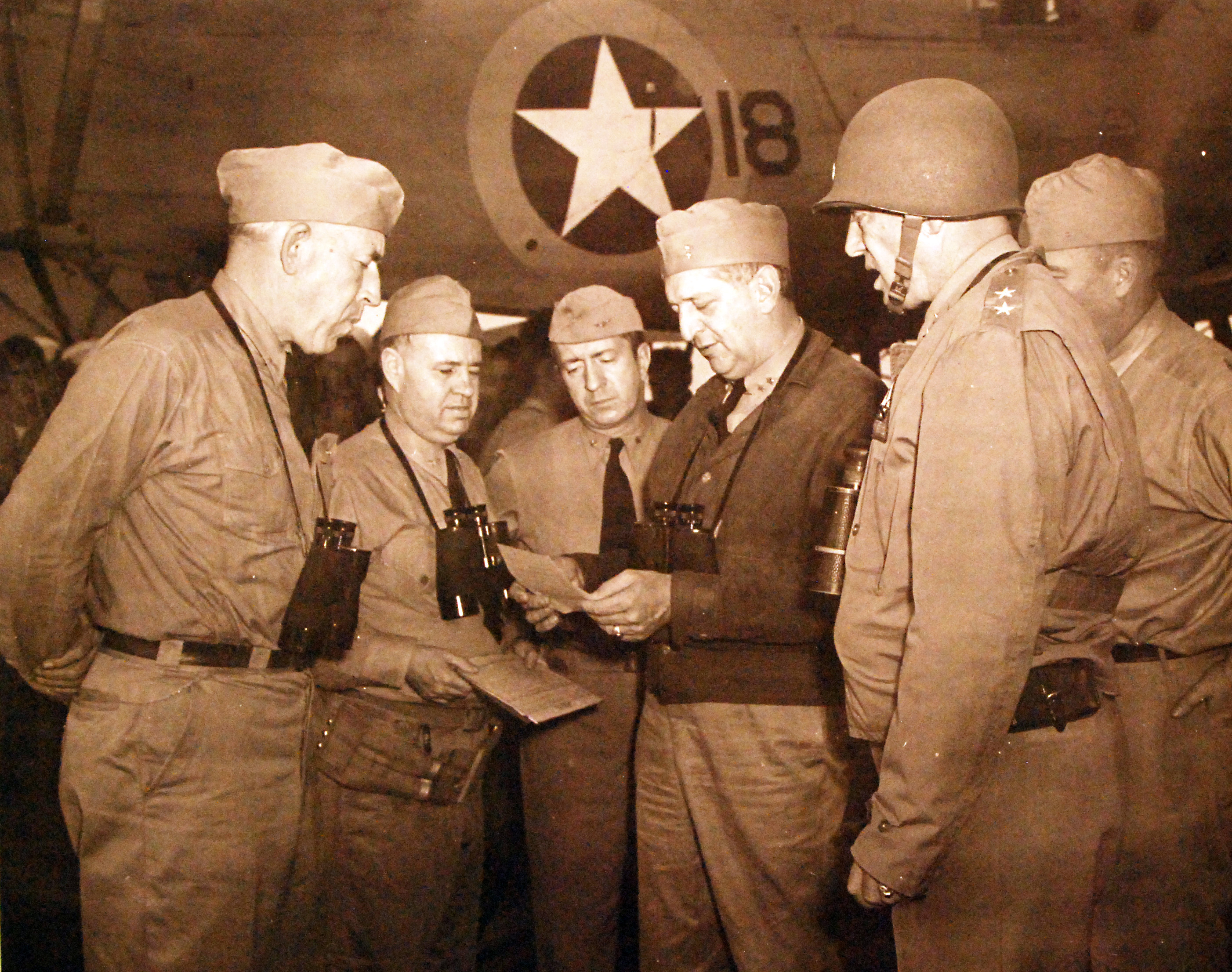
Admirals Hewitt and Hall with staff reading a communiqué aboard USS Augusta during Operation Torch, November 1942.
U.S. Navy / National Museum of the U.S. Navy (80-G-30442) · Public domain · Original recordImage changes
Display copies resized; original downloaded JPEG preserved.
The words
Augusta
Augusta carried Patton off Fedala. The naval battle delayed his journey ashore while American ships maneuvered to avoid French torpedoes and gunfire.
Western Task Force, Augusta passage · Army campaign history: Morocco landings (opens a new tab)
Brooklyn
Brooklyn supported the Fedala landings with naval gunfire. Alongside Augusta and destroyers, it helped shield the landing force during fighting off Casablanca.
Howe, ch. VII, fire-support vessels · Howe, ch. VII: Fedala to Casablanca (opens a new tab)
Convoy Escort
The Atlantic Fleet retained responsibility for ocean escort of later convoys from the United States to North Africa. Protection continued beyond the first landing.
Howe, ch. III, follow-up convoys · Howe, ch. III: naval command and convoys (opens a new tab)
Fedala
Fedala was selected for the main infantry landing north of Casablanca. The plan called for troops to move inland and approach the city from the east.
Western Task Force plan · Army campaign history: Morocco landings (opens a new tab)
Goalpost
Goalpost was the northern landing force’s code name. Its mission centered on obtaining Port-Lyautey’s airfield for aircraft supporting the attack on Casablanca.
Howe, ch. VIII, opening mission · Howe, ch. VIII: Mehdia and the airfield (opens a new tab)
Hewitt
Rear Admiral H. Kent Hewitt commanded the naval force supporting Patton’s Moroccan landings. His command included warships, carriers, troop transports, cargo ships and auxiliaries.
Western Task Force, naval composition · Army campaign history: Morocco landings (opens a new tab)
Massachusetts
The battleship Massachusetts fought the unfinished French battleship Jean Bart off Casablanca on November 8, 1942. Jean Bart was moored at a pier.
Did you know?
Veterans campaigned to preserve Massachusetts after it left service. With help from Massachusetts schoolchildren, the ship was brought to Fall River in June 1965.
Historical Overview · Battleship Cove: Massachusetts (opens a new tab)
Morocco
Morocco was a French protectorate during Torch. Vichy’s resident-general exercised colonial authority and oversaw racial laws that restricted Jewish residents’ lives.
Protectorates and Morocco · Holocaust Museum: Morocco under Vichy (opens a new tab)
Port Lyautey
Port-Lyautey’s airfield stood beside the Sebou River, inland from Mehdia. Its runways and hangars made it a key objective for bringing Allied aircraft ashore.
Howe, ch. VIII, terrain description · Howe, ch. VIII: Mehdia and the airfield (opens a new tab)
Primauguet
The French cruiser Primauguet fought the American force on November 8, 1942. Gunfire and carrier aircraft damaged it; uncontrollable fires forced crew members overboard.
Howe, ch. VII, The Naval Action · Howe, ch. VII: Fedala to Casablanca (opens a new tab)
Safi
Safi’s port was selected for landing armor south of Casablanca. Tanks brought ashore there were intended to join the advance on the city.
Western Task Force, Blackstone · Army campaign history: Morocco landings (opens a new tab)
Supply Convoy
Supply ships could reach the coast before their cargo reached the troops. At Fedala, lost landing craft and limited carrying capacity delayed unloading.
Howe, ch. VII, unloading at Fedala · Howe, ch. VII: Fedala to Casablanca (opens a new tab)
Western
Western identified Torch’s Moroccan Atlantic landings. This American force sailed from the United States, while the other two Torch forces sailed from Britain.
Three Task Forces Organized · Coast Guard history: North African landings (opens a new tab)
Sources
- Northwest Africa: Seizing the Initiative in the West, Chapter VII: Fedala to CasablancaUS Army Office of the Chief of Military History; George F. Howe (1957), HyperWar transcription
- Northwest Africa: Seizing the Initiative in the West, Chapter III: Tactical Plans and Political PreparationsUS Army Office of the Chief of Military History; George F. Howe (1957), HyperWar transcription
- Northwest Africa: Seizing the Initiative in the West, Chapter VIII: Mehdia to Port-LyauteyUS Army Office of the Chief of Military History; George F. Howe (1957), HyperWar transcription
- Algeria-French Morocco, November 8–11, 1942, CMH Publication 72-11Charles R. Anderson; US Army Center of Military History, HyperWar transcription
- USS Massachusetts (BB-59): Historical OverviewBattleship Cove
- The Coast Guard at War, Volume IX: North African Landings, Part IUS Coast Guard, Historical Section; HyperWar transcription
- Anti-Jewish Legislation in North AfricaUnited States Holocaust Memorial Museum