
World War II
Puzzle 16 · Torch and Tunisia · Page 33 in print
Operation Torch
Operation Torch was the Anglo-American invasion of French North Africa on 8 November 1942, involving three task forces targeting Casablanca, Oran, and Algiers.
Jump to a word
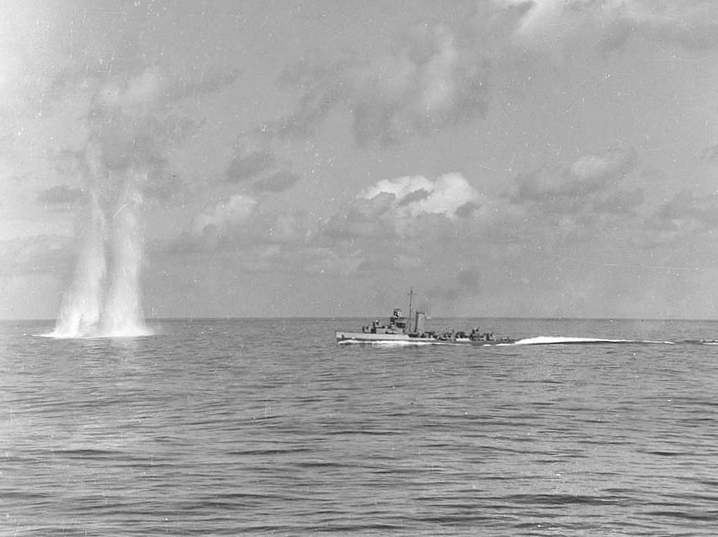
USS Mayrant under fire from the French El Hank Battery off Casablanca on November 8, 1942.
U.S. Navy / National Archives (80-G-30422) · Public domain · Original recordImage changes
Display copies resized; original downloaded JPEG preserved.
The words
Allied Powers
Britain and the United States hoped Torch would relieve pressure on the Soviet Union by threatening Axis positions in North Africa.
The Operation · Holocaust Museum: Torch and its aftermath (opens a new tab)
Anglo-American
Torch combined American and British forces under Dwight D. Eisenhower. The Moroccan landings were American; the Algerian landings included both countries.
The Operation · Holocaust Museum: Torch and its aftermath (opens a new tab)
Cherchell
Near Cherchell, Mark Clark met French officers in October 1942 to seek cooperation with Torch. His party reached the coast by submarine from Gibraltar.
Howe, ch. IV, Cherchel meeting · Howe, ch. IV: final preparations (opens a new tab)
Darlan
Admiral François Darlan agreed to cooperate with the Allies and remained head of the French administration. Keeping a Vichy leader in power angered de Gaulle’s Free French movement.
Consequences of Operation Torch · Holocaust Museum: Torch and its aftermath (opens a new tab)
French Troops
Vichy-controlled French forces resisted several Allied landings. Other French officers and resistance groups helped the invasion, giving French participation different military and political roles.
The Operation · Holocaust Museum: Torch and its aftermath (opens a new tab)
Gibraltar
Eisenhower and his principal staff established an advanced command post inside the Rock before Torch. Gibraltar also supported aircraft, shipping and communications for the invasion.
Did you know?
Stone excavated by British and Canadian tunnelers helped extend Gibraltar’s runway into the bay. Underground work supplied material for another part of the base.
Howe, ch. IV, final command preparations · Howe, ch. IV: final preparations (opens a new tab)
Invade
Torch’s troops landed from the sea to seize ports and airfields. These footholds supported the planned advance eastward toward Tunisia.
The Operation · Holocaust Museum: Torch and its aftermath (opens a new tab)
Mehdia
At Mehdia, Force Goalpost sought Port-Lyautey’s airfield. Its runways lay inland beside the Sebou River, linking the beach landings with a specific air-support objective.
Howe, ch. VIII, mission and terrain · Howe, ch. VIII: Mehdia and the airfield (opens a new tab)
Murphy
American diplomat Robert Murphy organized political contacts before Torch. Eisenhower brought this work into military planning, where negotiations and local cooperation could affect the landings.
Howe, ch. III, Political Preparations · Howe, ch. III: plans and political contacts (opens a new tab)
Nogues
Noguès was the French resident-general in Morocco. The Holocaust Museum records that he oversaw Vichy racial laws, restricting Jewish residents’ work, education and housing.
Morocco, anti-Jewish laws · Holocaust Museum: Vichy’s racial laws (opens a new tab)
Petain
Philippe Pétain headed the Vichy government, which retained control over French North Africa. Its racial laws stripped Algerian Jews of citizenship and excluded many Jews from public employment.
Vichy administration and racial laws · Holocaust Museum: Vichy’s racial laws (opens a new tab)
Ryder
U.S. Major General Charles W. Ryder commanded the Eastern Assault Force for Algiers. He also led the U.S. 34th Infantry Division.
Howe, ch. III, chain of command · Howe, ch. III: plans and political contacts (opens a new tab)
Task Force
Torch’s three task forces targeted Casablanca, Oran and Algiers. Their objectives included ports and airfields needed to establish the Allied foothold.
The Operation · Holocaust Museum: Torch and its aftermath (opens a new tab)
Torch
The November 1942 landings opened an Allied campaign in French North Africa. The next advance aimed at Tunisia, where Axis forces were gathering.
The Operation; Consequences · Holocaust Museum: Torch and its aftermath (opens a new tab)
Vichy
Vichy’s colonial authorities operated labor and internment camps across North Africa. They imprisoned Jewish and non-Jewish refugees and political opponents, making repression part of the regime the Allies confronted.
Camp system and displaced populations · Holocaust Museum: North African camps (opens a new tab)
Sources
- Northwest Africa: Seizing the Initiative in the West, Chapter III: Tactical Plans and Political PreparationsUS Army Office of the Chief of Military History; George F. Howe (1957), HyperWar transcription
- Northwest Africa: Seizing the Initiative in the West, Chapter IV: Completing the PreparationsUS Army Office of the Chief of Military History; George F. Howe (1957), HyperWar transcription
- Northwest Africa: Seizing the Initiative in the West, Chapter VIII: Mehdia to Port-LyauteyUS Army Office of the Chief of Military History; George F. Howe (1957), HyperWar transcription
- Operation Torch: The Anglo-American Invasion of French North AfricaUnited States Holocaust Memorial Museum
- Anti-Jewish Legislation in North AfricaUnited States Holocaust Memorial Museum
- Labor and Internment Camps in North AfricaUnited States Holocaust Memorial Museum