
World War II
Puzzle 15 · Atlantic Lifeline · Page 29 in print
Iceland Air Gap
Very Long Range Liberators were flying from Iceland by 1942, but too few were available to close the mid-Atlantic ‘air gap’. More Liberators and escort carriers helped close it by May 1943.
Jump to a word
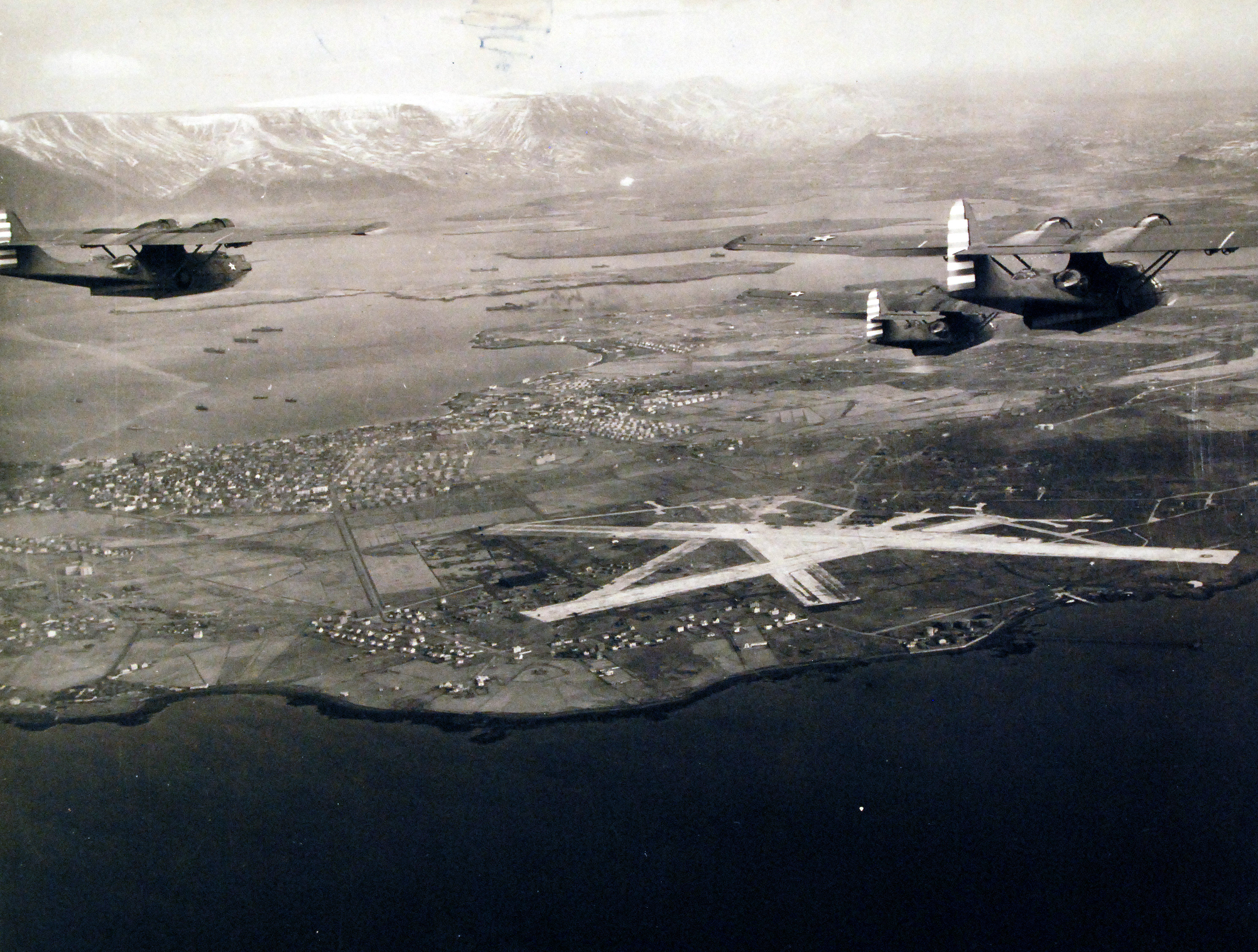
VP-73 Catalina patrol planes returning over Reykjavik, Iceland, on March 23, 1942.
U.S. Navy / National Museum of the U.S. Navy (80-G-27350) · Public domain · Original recordImage changes
Display copies resized; original downloaded JPEG preserved.
The words
Air Gap
The air gap lay beyond the reach of shore-based patrol aircraft. Convoys crossing it lacked the additional protection that aircraft could provide against submarines, making longer-range cover an urgent need.
Air cover and the mid-Atlantic gap · Canadian Navy: air cover and convoys (opens a new tab)
Air Patrol
Maritime patrols located ships and reported their positions to naval forces. The May 1941 Coastal Command account also records flights canceled or recalled because weather prevented useful observation.
Coastal Command appendix, pp. 4865–4866 · Coastal Command report, pp. 4865–4867 (opens a new tab)
Atlantic
Britain depended on imported food and war materials crossing the Atlantic. Air patrols and convoy escorts protected a supply system whose success depended on merchant ships reaching port.
How did it start? · Canadian Navy: air cover and convoys (opens a new tab)
Black Pit
Sailors called the uncovered mid-Atlantic the Black Pit. Escort ships still guarded the convoys there, but aircraft from shore bases could not provide continuous cover.
Convoys and the mid-Atlantic gap · Canadian Navy: air cover and convoys (opens a new tab)
Catalina
The photograph identifies the aircraft as VP-73’s PBY Catalinas returning from patrol in March 1942. It places an American patrol squadron within Iceland’s Allied air network.
Photograph 80-G-27350 · US Navy Museum: Iceland patrol photograph (opens a new tab)
Escort Carrier
Escort carriers brought an airfield to sea, extending protection beyond the reach of coastal bases. Their aircraft worked alongside Very Long Range Liberators as Allied coverage improved in 1943.
Air cover and the mid-Atlantic gap · Canadian Navy: air cover and convoys (opens a new tab)
Gander
Gander was a Newfoundland base for maritime aircraft. Its usefulness depended on facilities and trained crews as well as its position beside the Atlantic routes.
Did you know?
Plans to send RAF Liberators to Newfoundland in 1941 faced a practical obstacle: Gander lacked suitable hangars, while other air commitments had priority for construction.
Douglas, p. 478 · Douglas: the North Atlantic air campaign (opens a new tab)
Greenland
Convoy SC 42 was attacked south of Greenland in September 1941. Newfoundland’s Catalinas could not reach it, and bad weather had also disrupted air cover.
Douglas, pp. 480–481 · Douglas: the North Atlantic air campaign (opens a new tab)
Hvalfjord
Hvalfjord was a departure point for Arctic supply convoys. PQ-17 sailed from there on June 27, 1942; German aircraft and submarines later sank most of its merchant ships.
Expanded video transcript · IWM: PQ-17’s departure from Iceland (opens a new tab)
Iceland
RAF Liberators from Iceland helped convoy HX 217 in December 1942. The escorts and aircraft worked together, but weather still interrupted flying and limited reliable coverage.
Douglas, p. 532 · Douglas: the North Atlantic air campaign (opens a new tab)
Kaldadarnes
Kaldadarnes served as an Icelandic staging base during the Bismarck operation in May 1941. The published report records aircraft of No. 22 Squadron arriving from Wick in Scotland.
Coastal Command appendix, p. 4866 · Coastal Command report, pp. 4865–4867 (opens a new tab)
Liberator
Very Long Range Liberators were specially modified to extend endurance. Extra fuel and reduced equipment helped them patrol farther from shore than standard versions.
Douglas, p. 522 · Douglas: the North Atlantic air campaign (opens a new tab)
Mid-Ocean
The central Atlantic stretched beyond the coverage of early patrol aircraft. Longer-range aircraft and escort carriers helped cover this part of the route as Allied air support expanded.
Air cover and the mid-Atlantic gap · Canadian Navy: air cover and convoys (opens a new tab)
Reykjavik
Reykjavik supported maritime aircraft before the air gap was closed. A No. 240 Squadron Catalina flew from there to track Bismarck in May 1941.
Coastal Command appendix, p. 4866 · Coastal Command report, pp. 4865–4867 (opens a new tab)
Sunderland
Sunderland flying boats formed part of the northern patrol network. In May 1941, No. 201 Squadron patrolled between Iceland and the Faroe Islands, with fog interrupting some operations.
Coastal Command appendix, pp. 4865–4866 · Coastal Command report, pp. 4865–4867 (opens a new tab)
Sources
- The Creation of a National Air Force: The Official History of the Royal Canadian Air Force, Volume II, Part Four: The North Atlantic LifelineW. A. B. Douglas; Canadian Department of National Defence
- The Battle of the Atlantic, 1939-1945Royal Canadian Navy
- Coastal Command Operations in Connection with the Bismarck and Prinz Eugen, May 21–27, 1941; appendix, The London Gazette, October 16, 1947, pp. 4865–4867Royal Air Force report published in The London Gazette
- Why convoy PQ-17 was doomed to destructionImperial War Museums
- 80-G-27350: Fleet Air Base, Iceland, March 23, 1942National Museum of the U.S. Navy