
World War II
Puzzle 14 · Atlantic Lifeline · Page 28 in print
Frederic Walker
Captain Frederic Walker developed the ‘creeping attack’ against U-boats. His 2nd Escort Group sank six submarines on a January-February 1944 patrol. He died from a stroke that July.
Jump to a word
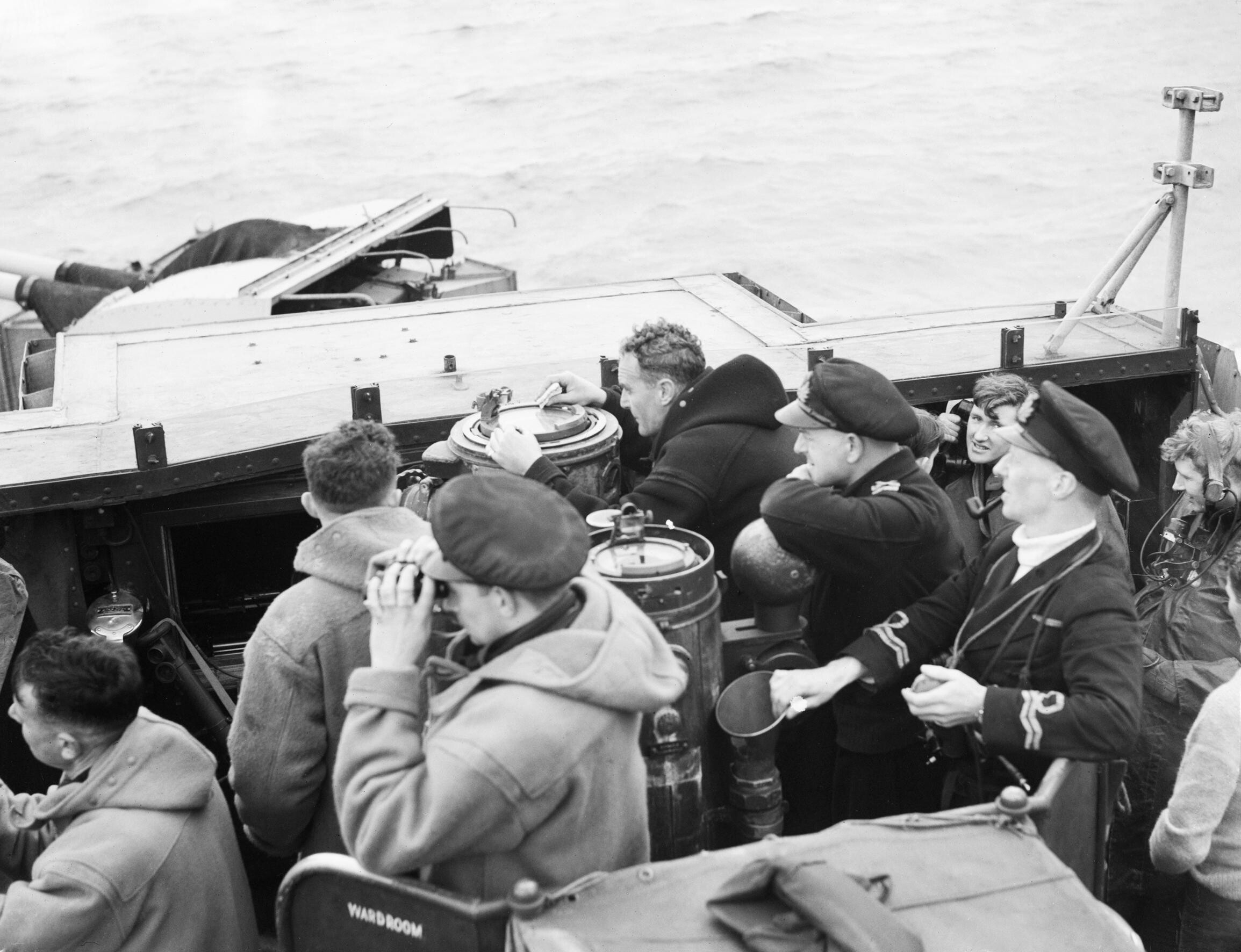
Captain Frederic Walker on the bridge of HMS Starling during the 2nd Escort Group's January–February 1944 patrol.
C. H. Parnall, Royal Navy official photographer / Imperial War Museums (A 21986) · Public domain · Original recordImage changes
Display copies resized; original downloaded JPEG preserved.
The words
Bootle
Bootle’s Gladstone Dock was the base of both the 36th Escort Group and the later 2nd Support Group, linking the two stages of Walker’s command.
Did you know?
Starling’s bell was presented to Bootle’s council on October 21, 1964. Sefton records its use to open council meetings, carrying a shipboard object into civic life.
Group bases and legacy · Sefton Council: Walker and Bootle (opens a new tab)
Captain
Captain was Walker’s naval rank in the Admiralty’s June 1944 award notice. The same document announced his third Bar to the Distinguished Service Order, recognizing repeated distinguished service.
Admiralty awards, p. 2817 · Admiralty awards, June 1944, p. 2817 (opens a new tab)
HMS Stork
Walker commanded Stork with the 36th Escort Group in 1941. Escorting merchant ships put his anti-submarine training to work protecting Britain’s supplies.
Walker’s early career · Liverpool Museums: Walker and his crews (opens a new tab)
Kite
Kite served in the 2nd Support Group. Its signal flags and battle flag were handed to Bootle’s council at a ceremony on January 5, 1944.
Group history, flag presentation · Sefton Council: Walker and Bootle (opens a new tab)
Liverpool
Liverpool’s Western Approaches headquarters monitored Atlantic activity from Exchange Flags. Naval and air services worked there to coordinate protection for the merchant convoys approaching Britain.
Western Approaches Command · Liverpool Museums: Walker and his crews (opens a new tab)
Sloops
Stork and Deptford were the two sloops in Walker’s 36th Escort Group, serving alongside corvettes. His earlier force therefore brought different types of escort together.
36th Escort Group · Sefton Council: Walker and Bootle (opens a new tab)
Starling
Walker led the Second Support Group from Starling in 1943. The photograph shows him on its bridge during the January–February 1944 patrol described in the printed introduction.
Protecting the convoys · Liverpool Museums: Walker and his crews (opens a new tab)
Support Group
Support groups could reinforce convoy protection and pursue submarines beyond the immediate escort screen. Walker’s Second Support Group applied this more mobile role from 1943.
Protecting the convoys · Liverpool Museums: Walker and his crews (opens a new tab)
Tactician
Walker trained at Portland’s anti-submarine school after the First World War. His later command drew on that specialist background and experience escorting convoys.
Walker’s early career · Liverpool Museums: Walker and his crews (opens a new tab)
Type VII
Type VII was a family of German U-boats, included here as wider submarine context. The preserved U 995 belonged to its VIIC branch and entered service in Hamburg in 1943.
Did you know?
U 995 later served with Norway as Kaura from December 1952. It was moved ashore at Laboe as a museum vessel in March 1972.
Opening history and S-309 · Deutscher Marinebund: U 995 (opens a new tab)
U-Boat Hunters
The June 1944 awards list names officers and Warrant Mechanician Alfred Clegg. Recognition extended beyond Walker to specialists whose work supported the group’s operations.
Admiralty awards, p. 2817 · Admiralty awards, June 1944, p. 2817 (opens a new tab)
Walker
Frederic John Walker commanded both the 36th Escort Group and the 2nd Support Group. He died on July 9, 1944, after suffering a stroke.
Group commands and hospital account · Sefton Council: Walker and Bootle (opens a new tab)
Woodpecker
Woodpecker appears with Starling, Wild Goose, Kite and Magpie in the Admiralty’s June 1944 citation. Their North Atlantic operations covered convoy passages and sank six U-boats.
Admiralty citation, p. 2817 · Admiralty awards, June 1944, p. 2817 (opens a new tab)
Wren
Photographs taken aboard Wren by its medical officer, Gordon Canti, recorded the group’s work. His shipboard viewpoint adds the experience of an individual crew member to Walker’s command story.
Did you know?
Canti served aboard Wren from May 1943 to September 1944. In 2009, he donated his photographs to Liverpool’s Archives Centre, preserving this personal record of naval service.
Photos from the Battle of the Atlantic · Liverpool Museums: Walker and his crews (opens a new tab)
Sources
- Captain F.J. Walker and the Battle of the AtlanticSefton Council; Sefton Library Service and Walker family
- Captain Johnnie Walker – hero of the Second World WarNational Museums Liverpool
- The London Gazette, Fifth Supplement, June 13, 1944, p. 2817Admiralty; The London Gazette
- Technisches Museum U 995Deutscher Marinebund