
World War II
Puzzle 13 · Atlantic Lifeline · Page 27 in print
ASDIC and Hedgehog
Hedgehog fired 24 contact-fuzed bombs ahead of an escort, preserving ASDIC contact during approach.
Jump to a word
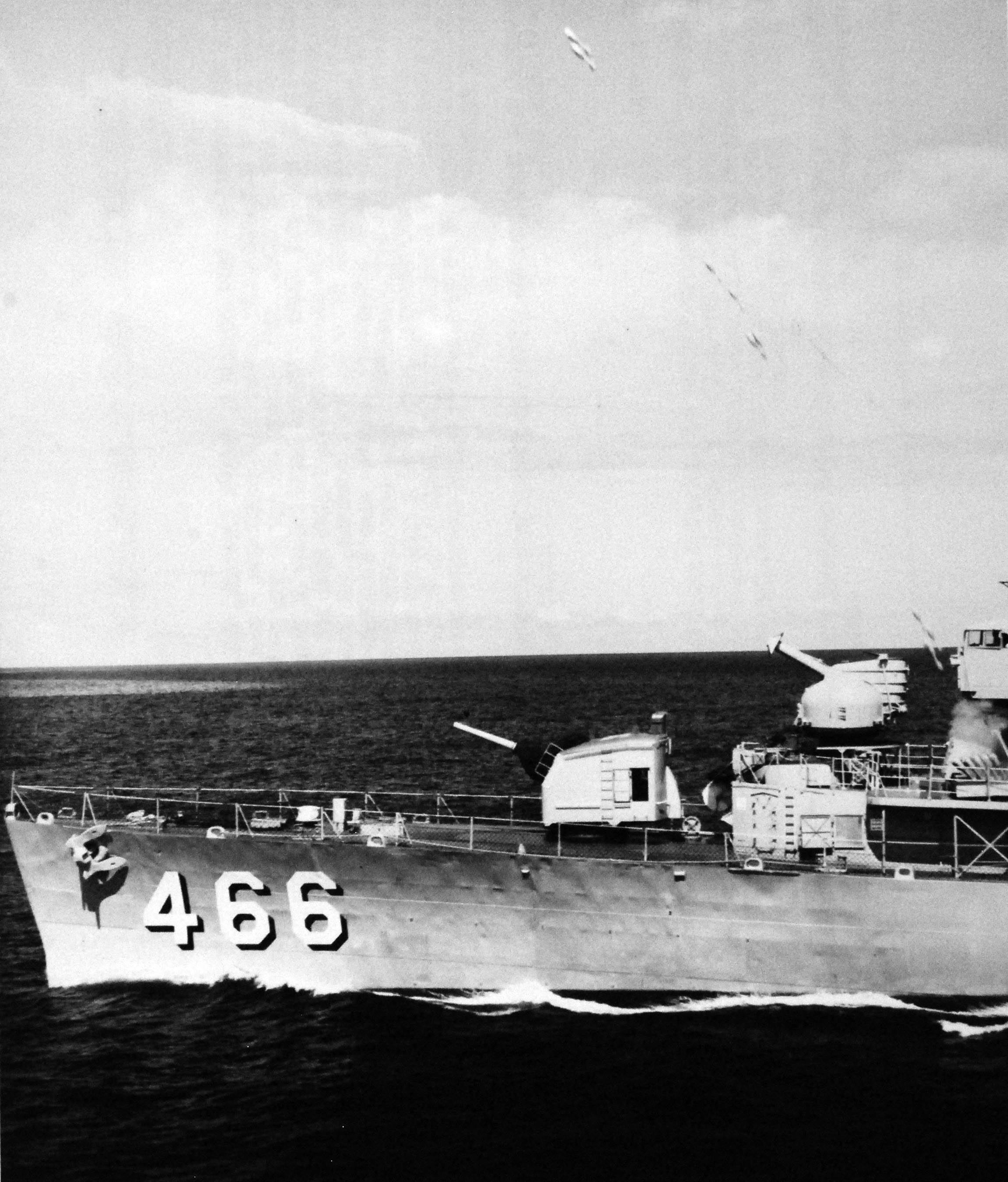
A postwar Hedgehog firing exercise aboard USS Waller on August 3, 1959.
U.S. Navy / National Museum of the U.S. Navy (428-GX-USN 1043096) · Public domain · Original recordImage changes
Display copies resized; original downloaded JPEG preserved.
The words
ASDIC
Wartime active sonar used to locate submerged targets.
Before the war, naval officers hoped ASDIC and depth charges would make submarines easier to defeat. Atlantic convoy battles exposed limits in equipment, training and coordination.
1939 and 1941 sections · Milner: detection and convoy defense (opens a new tab)
Contact Fuze
Hedgehog projectiles exploded on striking a submerged object. This contact trigger distinguished them from conventional depth charges, which were set to explode at a selected depth.
Missiles and depth-charge blind times · USS Slater: Hedgehog and sonar contact (opens a new tab)
Depth Charge
An escort could lose sonar contact before dropping depth charges from its stern. Their explosions also disturbed underwater listening, helping explain why ahead-throwing weapons were developed.
Opening description of depth-charge limits · USS Slater: Hedgehog and sonar contact (opens a new tab)
Echo
An echo is sound reflected back from an object. In active sonar, the time between sending a pulse and receiving its echo helps establish how far away the object is.
Active Sonar · NOAA: active and passive sonar (opens a new tab)
Hedgehog
Hedgehog projected a pattern of bombs ahead of an escort while the submarine remained in sonar contact. Its position near the bow helped address the blind interval associated with stern-dropped depth charges.
Opening description and bow position · USS Slater: Hedgehog and sonar contact (opens a new tab)
Hydrophone
A hydrophone works as an underwater microphone, converting incoming sounds into electrical signals. It belongs to the listening side of underwater detection, alongside the pulse-and-echo equipment elsewhere in this puzzle.
Did you know?
Hydrophones also record the sounds of underwater volcanoes, earthquakes and icequakes. NOAA uses these recordings to study natural ocean processes as well as noise caused by people.
How hydrophones work · NOAA: underwater microphones (opens a new tab)
Mortar
Naval mortars projected bombs ahead of escort ships. Hedgehog used projecting rods; Squid used three barrels, giving the puzzle two examples of the same broad weapon type.
USS Slater: Hedgehog and sonar contact (opens a new tab) · Canadian War Museum: Squid mortar (opens a new tab)
Sonar
Sonar uses sound to find objects underwater. Active systems transmit a pulse and listen for its reflection; passive systems detect sounds already present, including noise from ships or marine animals.
Did you know?
Sonar also helps make nautical charts, locate underwater hazards and map shipwrecks. The same use of sound connects naval detection with scientific exploration and safer navigation.
Active Sonar and Passive Sonar · NOAA: active and passive sonar (opens a new tab)
Sound Waves
Sound waves travel farther through water than radar or light waves. This physical difference explains why underwater sound was central to detecting submerged objects, while radar served a different part of the search.
Opening explanation of underwater sound · NOAA: active and passive sonar (opens a new tab)
Spigot
Spigots were cylindrical bars on which Hedgehog’s projectiles rested. The bars were grouped on cradles in the projector, giving the weapon its distinctive array of projecting supports.
Projector description · USS Slater: Hedgehog and sonar contact (opens a new tab)
Squid
Squid used three barrels to project bombs ahead of a ship and required advanced ASDIC equipment. The Canadian War Museum records that relatively few Canadian ships carried it during the war.
Artifact CWM 19760561-026 · Canadian War Museum: Squid mortar (opens a new tab)
Surface Search
Surface search concerned targets above the water, including surfaced submarines. Milner’s account of convoy ON-115 in 1942 describes fog and inadequate radar, showing how poor visibility complicated the escorts’ work.
1942, ON-115 passage · Milner: detection and convoy defense (opens a new tab)
Transducer
A transducer converts energy from one form to another. In active sonar it sends an electrical system’s signal into the water as sound, and receiving equipment turns the returning echo into a detectable signal.
Active Sonar · NOAA: active and passive sonar (opens a new tab)
Weapon
Finding a submarine and protecting a convoy were linked problems. Milner emphasizes that effective defense required intelligence, leadership, teamwork and communications alongside the escorts’ equipment and armament.
1941, The challenges · Milner: detection and convoy defense (opens a new tab)
Sources
- The Battle of the Atlantic, 1939 to 1945Royal Canadian Navy
- HedgehogDestroyer Escort Historical Museum, USS Slater
- What is sonar?NOAA, National Ocean Service
- What is a hydrophone?NOAA, National Ocean Service
- Squid Anti-submarine MortarCanadian War Museum