
World War II
Puzzle 12 · Atlantic Lifeline · Page 26 in print
Flower Corvettes
The Flower corvette design came from William Reed of Smith’s Dock, who used the 1936 whale-catcher Southern Pride as his model. Built for coastal escort, these small ships were soon guarding ocean convoys.
Jump to a word
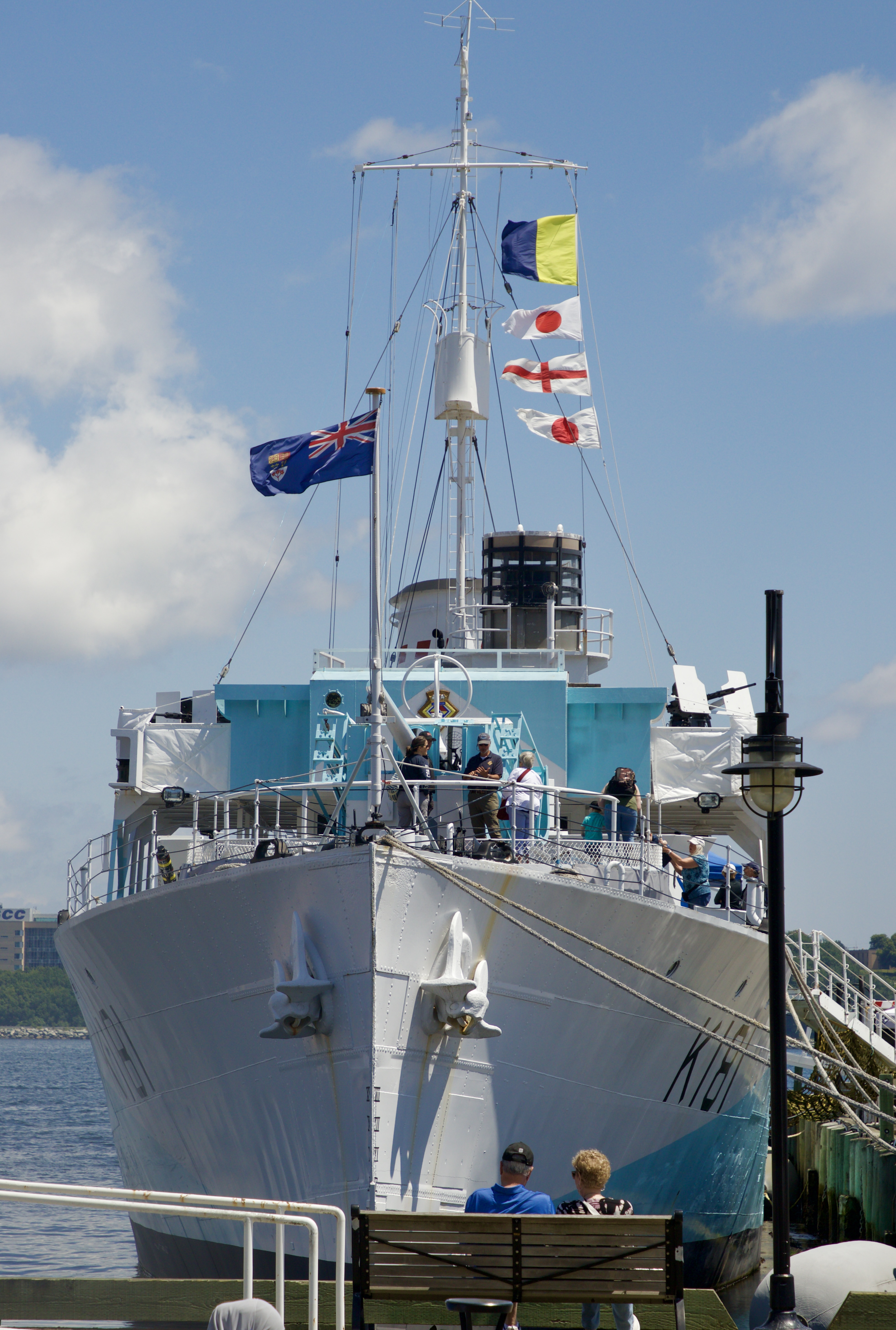
HMCS Sackville, preserved as a museum ship, photographed in July 2025.
Hayden Soloviev / HMCS Sackville with Flags · CC BY 4.0 · Original recordImage changes
Display copies resized; original downloaded JPEG preserved.
The words
Canadian
Canadian planners valued a ship small enough to pass through the St. Lawrence canals. That opened corvette construction to Great Lakes yards, connecting inland industry with the Atlantic escort fleet.
Opening design paragraph · Canadian Navy: Flower design and canals (opens a new tab)
Convoy
Merchant ships sailed together under naval protection to bring food and war materials to Britain. The corvettes in this puzzle helped protect those cargoes against German submarine attacks.
How did it start? Why was it necessary? · Canadian Navy: convoys and supplies (opens a new tab)
Corvette
The Flower corvette was designed for coastal escort work. A shortage of ocean escorts pushed these small ships into Atlantic convoy duty, a larger task than their original assignment.
Opening design paragraphs · Canadian Navy: Flower design and canals (opens a new tab)
Escort Group
A group gave several escorts a shared convoy assignment. On May 26, 1942, Sackville left St. John’s, Newfoundland, with convoy HX.191 as part of the newly formed C-3 group.
First service paragraph, HX.191 and C-3 · Canadian Navy: Sackville’s service (opens a new tab)
Escort Ships
Convoy defense depended on communication between ships. In 1941, Canadian corvettes often lacked radiotelephones and adequate signaling equipment, making teamwork difficult even when escorts were close to the merchant vessels.
1941, The challenges: leadership, intel, teamwork, communications · Milner: the Canadian Atlantic campaign (opens a new tab)
Escort Vessels
Escort assignments changed as ships joined different groups. Sackville moved to C-1 in April 1943, briefly served with Group 9, and joined C-2 that October for the remaining war years.
Did you know?
Sackville’s 1944 refit at Galveston, Texas, included an extended forecastle. The same vessel could change its appearance during the war, so dates matter when comparing corvette photographs.
Second service paragraph, group transfers and refits · Canadian Navy: Sackville’s service (opens a new tab)
Flower
British corvettes received flower names, giving the class its familiar name. Canadian ships often bore community names instead, while the Flower class name remained in use.
Did you know?
HMCS Arrowhead kept its flower name when loaned to the Canadian navy in June 1941. Canadian service did not mean that every corvette received a community name.
Printed p. 19, naming paragraph and Arrowhead photograph caption · Gimblett: Canadian corvettes, pp. 18–19 (opens a new tab)
HMCS Sackville
Sackville was transferred to a preservation trust in 1983 and restored to its 1944 appearance. The July 2025 photograph shows the preserved ship, connecting a later museum view with its wartime service.
Did you know?
Before preservation, Sackville served in another role: as a Canadian Naval Auxiliary Vessel, it began a survey of the Gulf of St. Lawrence in 1953.
Postwar survey and preservation paragraphs · Canadian Navy: Sackville’s service (opens a new tab)
Shipbuilding
The corvette’s commercial origins suited emergency production in smaller yards. Richard Gimblett’s history explains that major warship types already filling British yards were beyond Canadian shipyards’ capacity in 1939.
Did you know?
Great Lakes yards could continue building through winter, but ice prevented completed ships from traveling down the St. Lawrence for fitting out until the spring breakup.
Printed pp. 18–19, production capacity and St. Lawrence passage · Gimblett: Canadian corvettes, pp. 18–19 (opens a new tab)
Smiths Dock
Smith’s Dock, near Middlesbrough in Yorkshire, developed the Flower design from its whale-catcher Southern Pride. The firm links the puzzle’s designer, William Reed, with the commercial vessel behind the wartime ship.
Opening design paragraph · Canadian Navy: Flower design and canals (opens a new tab)
Southern Pride
Reed’s original corvette proposal reused Southern Pride’s engine design while adapting the hull for naval service. Added compartments, armament and equipment made the proposed warship more than a copy of the whale-catcher.
Printed p. 27, final paragraph; p. 28, explanation of added length · Tucker: corvette design, pp. 26–28 (opens a new tab)
Warship
The corvette was one type of warship protecting civilian shipping. Canadian convoy escorts also included frigates and destroyers, placing the Flower class within a wider fleet defending the supply routes.
Convoys, escort types; How did it start?, merchant shipping · Canadian Navy: convoys and supplies (opens a new tab)
Whaler
A whaler was a whale-catching vessel. Tucker’s official history explains that Reed saw useful qualities in both roles: quick acceleration, maneuverability and seaworthiness could also suit an anti-submarine ship.
Printed pp. 26–27, commercial origins and Reed’s earlier work · Tucker: corvette design, pp. 26–28 (opens a new tab)
William Reed
Reed discussed an anti-submarine vessel with the Admiralty in February 1939 and returned with his corvette design in early April. His work translated experience designing whale-catchers into a proposal for naval construction.
Printed p. 27, Reed’s Admiralty interviews · Tucker: corvette design, pp. 26–28 (opens a new tab)
Sources
- HMCS StrathroyRoyal Canadian Navy
- The Battle of the Atlantic, 1939-1945Royal Canadian Navy
- The Battle of the Atlantic, 1939 to 1945Royal Canadian Navy
- HMCS SackvilleRoyal Canadian Navy
- The Naval Service of Canada, Volume II: Activities on Shore During the Second World WarGilbert Norman Tucker; Department of National Defence (Library and Archives Canada copy)
- Canadian Corvettes in the Second World War – A General History, Action Stations, Fall 2023Richard H. Gimblett; Canadian Naval Memorial Trust