
World War II
Puzzle 11 · Atlantic Lifeline · Page 25 in print
Lorient U-Boat Pens
At Lorient, German U-boats sheltered in concrete bunkers with roofs several yards thick. The Keroman base suffered little damage from the heavy bombing of 1943, while much of the surrounding city was destroyed.
Jump to a word
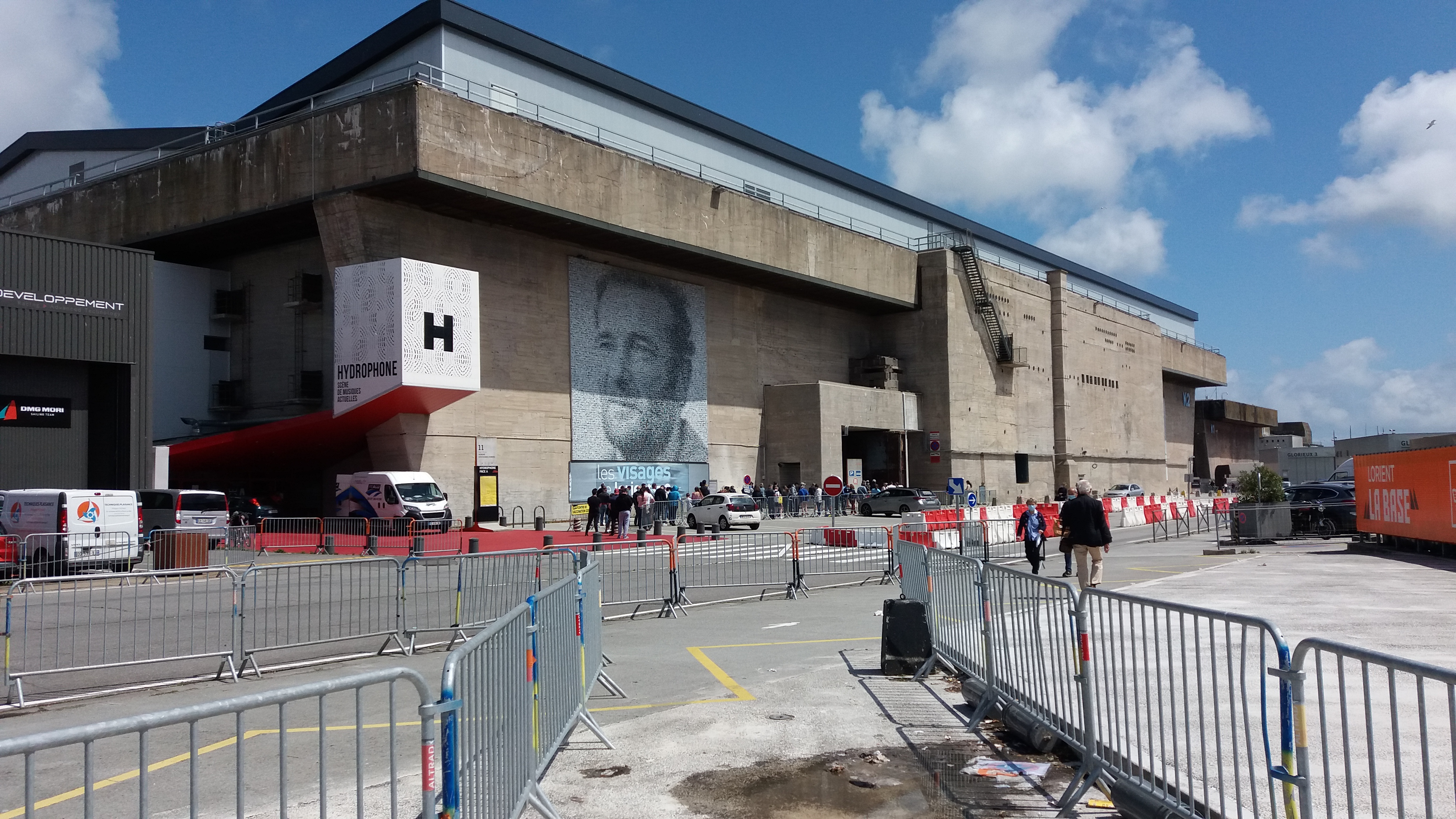
Keroman II at the former Lorient submarine base, photographed in July 2021.
Romainbehar / Bâtiment Keroman II et entrée de l’Hydrophone · CC0 · Original recordImage changes
Display copies resized; original downloaded JPEG preserved.
The words
Bunkers
Lorient’s submarine base combined several types of protective structures. The Keroman blocks stood alongside dome-shaped shelters near the fishing-port slipway and a smaller base on the Scorff.
IA56001938, Présentation and Historique · Brittany Inventory: Lorient base (opens a new tab)
Concrete
Concrete gave the shelters their massive protective shells. The regional inventory records reinforced-concrete walls and concrete roofs, linking this ordinary building material with the scale of Lorient’s military construction.
IA56001938, Présentation and Description · Brittany Inventory: Lorient base (opens a new tab)
Donitz
Vizeadmiral (vice admiral) Karl Dönitz directed U-boat operations from Lorient in 1941. The Nuremberg tribunal later convicted him of waging aggressive war and war crimes.
Brittany Inventory: Villa Kerlilon (opens a new tab) · Nuremberg judgment: Dönitz (opens a new tab)
Kernevel
Kernevel, at Larmor-Plage, held the submarine command headquarters across from the base. The Germans requisitioned Villa Kerlilon in 1940, using the property for command work until 1942.
IA56005500, Historique · Brittany Inventory: Villa Kerlilon (opens a new tab)
Keroman
Keroman was the site of the main bunker blocks and their handling machinery. The museum describes protected offices, workshops, stores and accommodation, showing how the base supported submarines between patrols.
Did you know?
The K in KI, KII and KIII stood for Keroman. The numbers followed the order of construction, making the bunker names a compact guide to the site.
Resource document, p. 6 · Flore Museum: base history, pp. 5–7 (opens a new tab)
Kriegsmarine
Kriegsmarine was the name of Nazi Germany’s navy. Its submarine campaign aimed to disrupt Britain’s seaborne supplies, which made Lorient’s Atlantic position important to the war at sea.
Resource document, p. 6 · Flore Museum: base history, pp. 5–7 (opens a new tab)
Lorient
Allied bombing devastated Lorient in 1943, while the submarine shelters survived. Morbihan’s archives describe the evacuation of residents and a city reduced to ruins around the still-functioning base.
Quatre blocs, bombing and evacuation · Morbihan Archives: base and workers (opens a new tab)
Pens
Pens were separate sheltered compartments inside the bunker blocks. Keroman I and II used machinery to move submarines into their berths, tying this word to Slipway and Winch.
IA56001938, Historique, Keroman I and II · Brittany Inventory: Lorient base (opens a new tab)
Scorff
The Scorff shelter stood on the river’s eastern bank at Lanester. It formed a separate part of the Lorient base, so the puzzle includes a river as well as bunker names.
IA56001938, Présentation and petite base du Scorff · Brittany Inventory: Lorient base (opens a new tab)
Slipway
At Keroman I and II, submarines were hauled out of the water on a slipway, an inclined rail ramp. This system allowed boats to be moved into protected dry shelters.
Did you know?
Keroman’s fishing port already had a slipway before the war. The museum explains that the German base adapted a similar rail-mounted trolley system for submarines.
Resource document, pp. 5 and 7 · Flore Museum: base history, pp. 5–7 (opens a new tab)
Submarine
Lorient’s bunkers were built for German submarines, but their use continued after the occupation. The French Navy took over in May 1945 and operated the base for decades.
Postwar takeover and reuse · Morbihan Archives: base and workers (opens a new tab)
Todt
Organisation Todt organized the building work. Morbihan’s archives describe volunteers, Spanish refugees brought from camps, and the later use of compulsory labor as voluntary recruitment declined.
Une mobilisation économique, recruitment and compulsory labor · Morbihan Archives: base and workers (opens a new tab)
U-Boat
U-boats were Germany’s submarines. Lorient housed the second flotilla from 1940 and the tenth from 1942, grouping vessels and crews at an Atlantic base for patrol and maintenance.
IA56001938, Historique, submarine flotillas · Brittany Inventory: Lorient base (opens a new tab)
Winch
The winch pulled the rail-mounted trolley carrying a submarine up Keroman I’s slipway. This hauling machinery made the dry shelters of Keroman I and II usable.
Did you know?
Keroman’s slipway remained useful after the war. In July 1995 it hauled the French submarine Flore out of the water, connecting the wartime machinery with the base’s postwar history.
IA56132205, winch and trolley · Brittany Inventory: the Keroman winch (opens a new tab)
Sources
- Base de sous-marins de Keroman – Lorient: Document Ressources pour les enseignantsLa Flore submarine museum
- Base navale allemande de Lorient dite « base de sous-marins de Keroman » puis Port de La Base de LorientRégion Bretagne, Inventaire général du patrimoine culturel
- Salle du treuil du slipway du bunker « KI » avec son treuil de hissage (Lorient)Région Bretagne, Inventaire général du patrimoine culturel
- Maison de villégiature Kerlilon dite château de l’Amirauté, le KernevelRégion Bretagne, Inventaire général du patrimoine culturel
- La base de sous-marins de LorientArchives départementales du Morbihan
- Judgment: DoenitzInternational Military Tribunal (Yale Law School, Avalon Project)