
World War II
Puzzle 10 · Atlantic Lifeline · Page 24 in print
Halifax HX Convoys
The HX convoy series began at Halifax and later sailed from New York. HX 300, in July-August 1944, carried more than 160 ships across the Atlantic and arrived without losing a ship.
Jump to a word
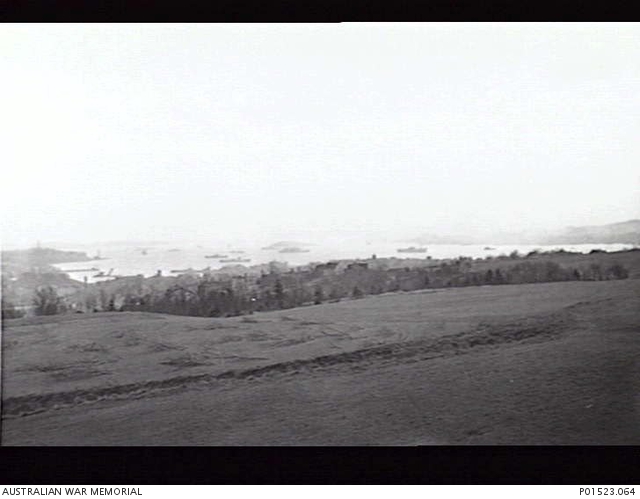
Merchant ships gathering in Halifax harbor for a transatlantic convoy around May 1943.
Ronald Maxwell Hines / Australian War Memorial (P01523.064) · Public domain · Original recordImage changes
Display copies resized; original downloaded JPEG preserved.
The words
Atlantic War
From September 1939 to May 1945, the Atlantic campaign tested Britain’s overseas supply connections. HX convoys formed part of the Allied response to Germany’s attacks on merchant shipping.
What was the Battle of the Atlantic?; How did it start? · Canadian Navy: convoys and supplies (opens a new tab)
Convoy Battles
The Canadian naval history describes convoy defense in 1941 as a problem of intelligence, teamwork and communications. Escorts needed to find attackers while keeping the merchant ships protected.
1941, The challenges: leadership, intel, teamwork, communications · Milner: the Canadian Atlantic campaign (opens a new tab)
Convoys
Grouping merchant ships brought their cargoes under naval escort. Convoy arrangements concentrated defenders around ships traveling together, making protection a shared task across the dangerous ocean passage.
Did you know?
HX identified the faster convoy series, which began at Halifax. Slower SC convoys began at Sydney, Nova Scotia, giving ships with different speeds separate sailing groups.
How did it start? Why was it necessary? · Canadian Navy: convoys and supplies (opens a new tab)
Halifax
HX 1 sailed from Halifax on September 16, 1939. The port gathered ships, loaded supplies and repaired damaged vessels, connecting the harbor photograph with the work behind each Atlantic crossing.
Did you know?
Press censors called Halifax a “Canadian Eastern Coast Port” for security. One censor, H. B. Jefferson, also kept a daily journal and made photographs of the wartime harbor.
‘An East Coast Port’ At War, convoy departure and port work · Nova Scotia Archives: wartime Halifax (opens a new tab)
Liberty Ships
Liberty ships expanded the cargo fleet as wartime losses strained British shipping. The Maritime Administration traces their design to a British emergency program, followed by much larger American construction efforts.
Did you know?
The American ships burned oil, while their British Ocean-class predecessors burned coal. The American design grouped crew quarters in a single structure amidships, near the ship’s middle.
British trade mission and the American emergency design · Maritime Administration: Liberty ships (opens a new tab)
Lifeline
Britain needed imported food and war materials to sustain its war effort. The Atlantic lifeline linked overseas supplies with the ports where those goods could be unloaded.
How did it start? Why was it necessary? · Canadian Navy: convoys and supplies (opens a new tab)
Merchant Fleet
The merchant fleet carried the supplies the warships were protecting. Germany’s unrestricted submarine campaign targeted civilian merchant vessels as well as naval ships, making cargo transport part of the battle.
How did it start? Why was it necessary? · Canadian Navy: convoys and supplies (opens a new tab)
Rudeltaktik
Rudeltaktik was the German term for coordinated pack attacks. From French bases after June 1940, U-boats could reach the Atlantic approaches more easily, increasing pressure on the convoy routes.
The Atlantic Campaign 1940–41, p. 186 · Buckley: Coastal Command, pp. 186–187 (opens a new tab)
Sea Routes
The Atlantic routes also depended on air cover. Aircraft could force U-boats to submerge and lose contact with convoys, but limited aircraft range left ships exposed in mid-ocean.
The Atlantic Campaign 1940–41, p. 187 · Buckley: Coastal Command, pp. 186–187 (opens a new tab)
Tanker
Tankers carried the oil needed by the Allied war effort. The simple T2-SE-A1 design allowed yards to reuse mass-production techniques also employed for Liberty cargo ships.
Did you know?
These tankers used turbo-electric propulsion. Steam power drove a generator, which supplied an electric motor that turned the ship’s single propeller.
Opening design account · Maritime Administration: T2 tankers (opens a new tab)
Torpedo
German torpedoes threatened convoy escorts as well as merchant ships. In September 1943, acoustic homing torpedoes damaged or sank several Allied escorts, prompting rapid Canadian production of countermeasure equipment.
1943, U-boats fight back: acoustic torpedoes · Milner: the Canadian Atlantic campaign (opens a new tab)
U-Boat Threat
In late 1942, U-boats again concentrated in mid-ocean. Escorts faced that pressure with equipment shortages, while the Allies lacked the codebreaking intelligence that had helped them avoid submarine concentrations.
1942, Mid-ocean now the only convoy route to Britain · Milner: the Canadian Atlantic campaign (opens a new tab)
U-Boat Warfare
German submarine operations spread farther west in 1941. The widening campaign drew Canadian escorts into the gap between the Grand Banks and Iceland, extending their responsibility for transatlantic trade.
1941, Packs move westward, RCN fills the gap · Milner: the Canadian Atlantic campaign (opens a new tab)
Wolfpack
A wolfpack brought several U-boats against a convoy’s escorts. Buckley describes attacks made on the surface at night, when visual detection was harder and sonar offered less protection.
The Atlantic Campaign 1940–41, p. 186 · Buckley: Coastal Command, pp. 186–187 (opens a new tab)
Sources
- The Battle of the Atlantic, 1939 to 1945Royal Canadian Navy
- The Battle of the Atlantic, 1939-1945Royal Canadian Navy
- T2-SE-A1 TypeUS Maritime Administration
- Coastal Command in the Second World WarRoyal Air Force, Air Power Review
- The Emergency Shipbuilding ProgramUS Maritime Administration
- ‘An East Coast Port’: Halifax in Wartime, 1939-1945Nova Scotia Archives