
Wildlife of the World
Puzzle 70 · Ocean Giants and Reef Life · Page 104 in print
Leatherback Migration
The leatherback is the largest living sea turtle, crossing oceans between tropical nesting beaches and cooler feeding grounds; fishing lines and nets can threaten it far from the shore.
Jump to a word
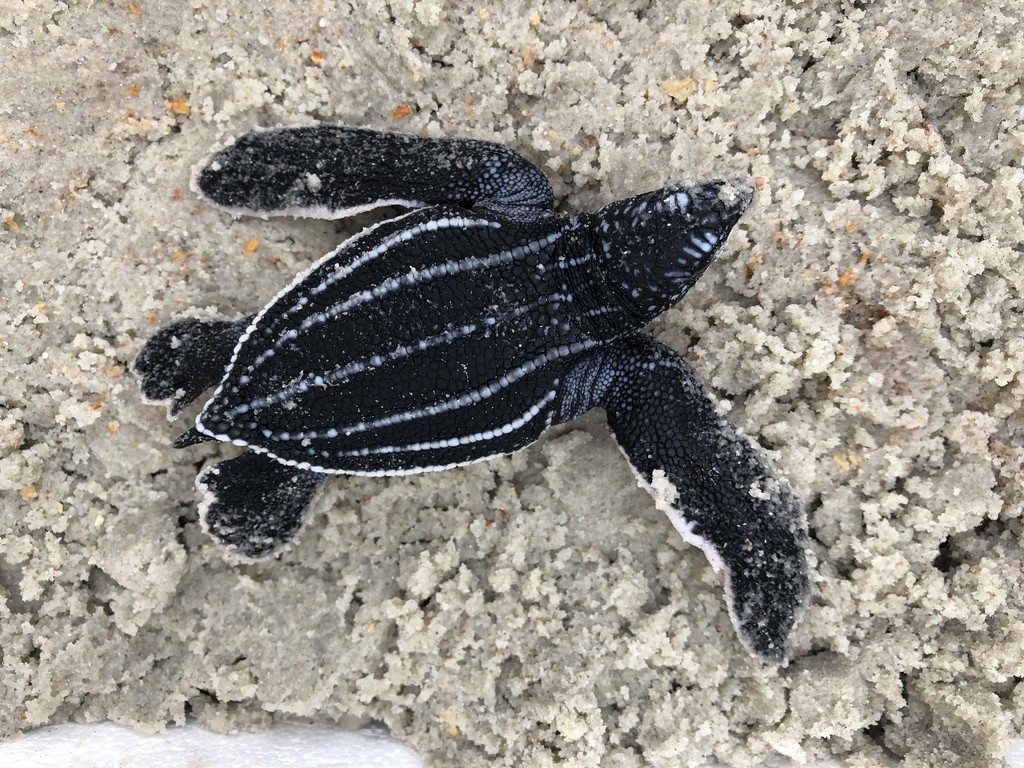
A leatherback hatchling rests on pale sand in Florida.
Species reference for Leatherback Migration. The photograph does not necessarily show the population or place named in the puzzle.
(c) Pam Kleinsasser, some rights reserved (CC BY) · CC BY 4.0 · Original recordImage changes
Resized and converted to JPEG for display; no subject alteration.
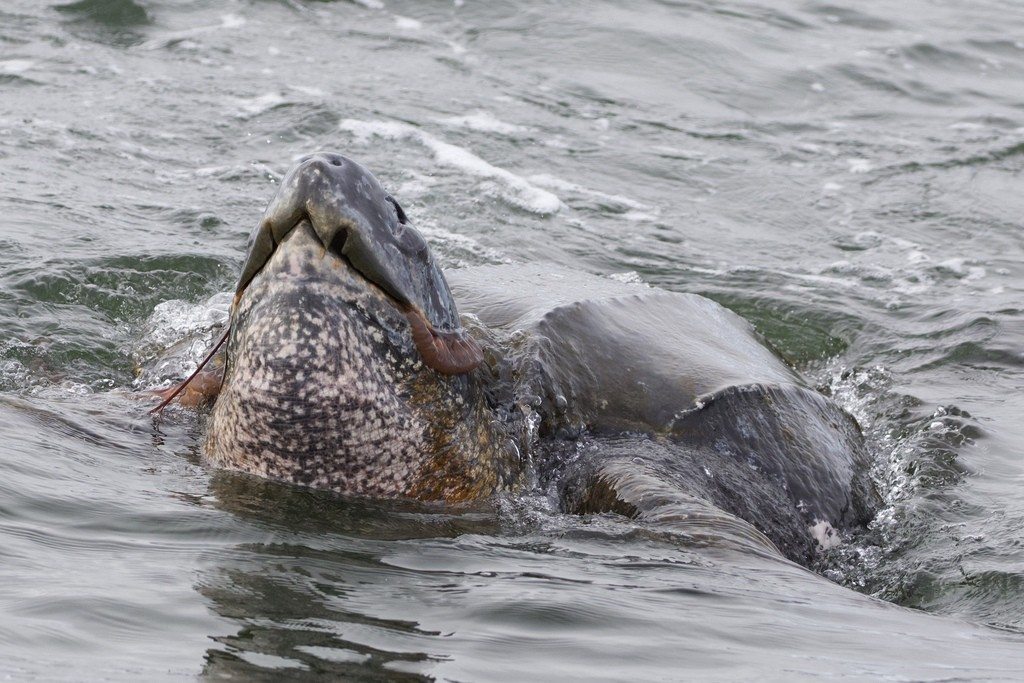
An adult leatherback raises its head above the water.
Species reference for Leatherback Migration. The photograph does not necessarily show the population or place named in the puzzle.
(c) RJ Baltierra, some rights reserved (CC BY) · CC BY 4.0 · Original recordImage changes
Resized and converted to JPEG for display; no subject alteration.
The words
Beaches
Leatherbacks nest on tropical and subtropical beaches.
Dermochelys
The leatherback is Dermochelys coriacea.
Fisheries
Bycatch in fisheries threatens leatherbacks.
Hatchlings
Leatherback hatchlings are mostly black.
Jellyfish
Leatherbacks eat jellyfish.
Lion's Mane
Lion's mane jellyfish were the leatherbacks' main prey off Nova Scotia.
Longline
Longlines are among the gear that catch leatherbacks.
Matura Beach
Matura Beach in Trinidad is a leatherback nesting site connected with long ocean migrations.
Papillae
Backward-pointing spines in the throat and esophagus are called papillae.
Plastic
Leatherbacks sometimes eat plastic, mistaking it for jellyfish.
Pollution
Marine pollution is a threat to leatherbacks and the habitats through which they migrate.
Rubbery Skin
Leatherbacks are named for their tough, rubbery skin.
Salps
Leatherbacks eat jellyfish and salps.
Seven Ridges
The leatherback's carapace has seven ridges.
Turtle
Leatherbacks are the largest turtle.
Sources
- leatherbackwww.fisheries.noaa.gov
- Leatherback Migration (source capture)Animal Diversity Web, University of Michigan Museum of Zoology
- Leatherback Migration (source capture)PLOS ONE (peer-reviewed article, Heaslip et al. 2012), full text via Europe PMC
- Leatherback Migration (source capture)Ecology and Evolution (peer-reviewed review, 2025), full text via Europe PMC