
Wildlife of the World
Puzzle 50 · Islands of Evolution · Page 78 in print
Aye-Aye
The aye-aye, a nocturnal Madagascar lemur, taps hollow wood with its long middle finger and listens for grubs beneath the bark, then gnaws through and hooks them out with the same finger.
Jump to a word
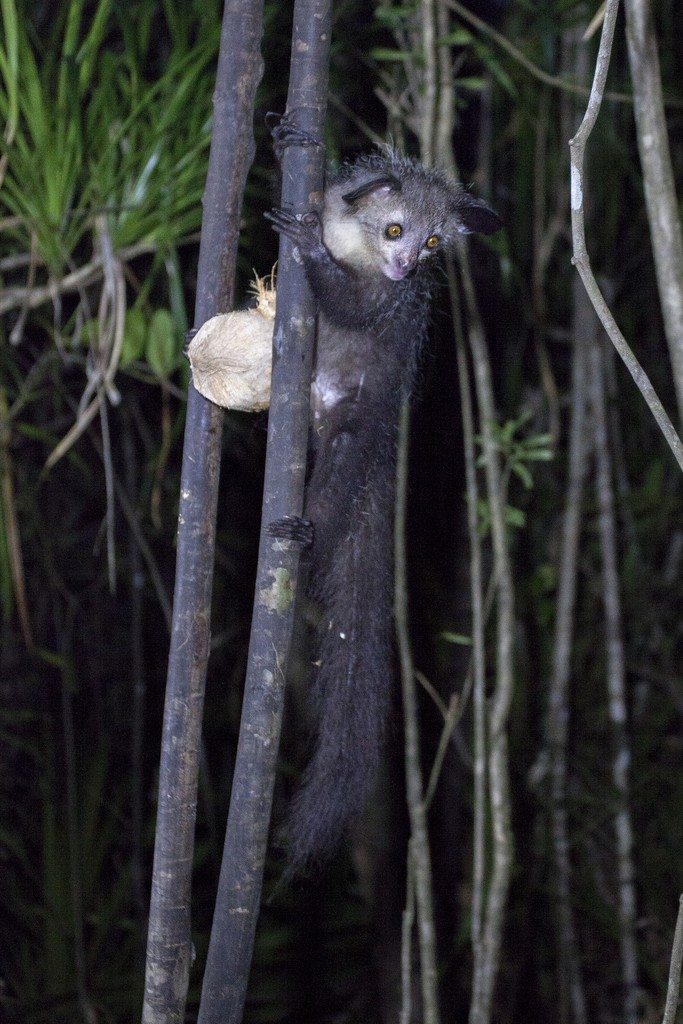
An aye-aye climbs among slender branches after dark.
Species reference for Aye-Aye. The photograph does not necessarily show the population or place named in the puzzle.
(c) Кирилл, some rights reserved (CC BY) · CC BY 4.0 · Original recordImage changes
Resized and converted to JPEG for display; no subject alteration.
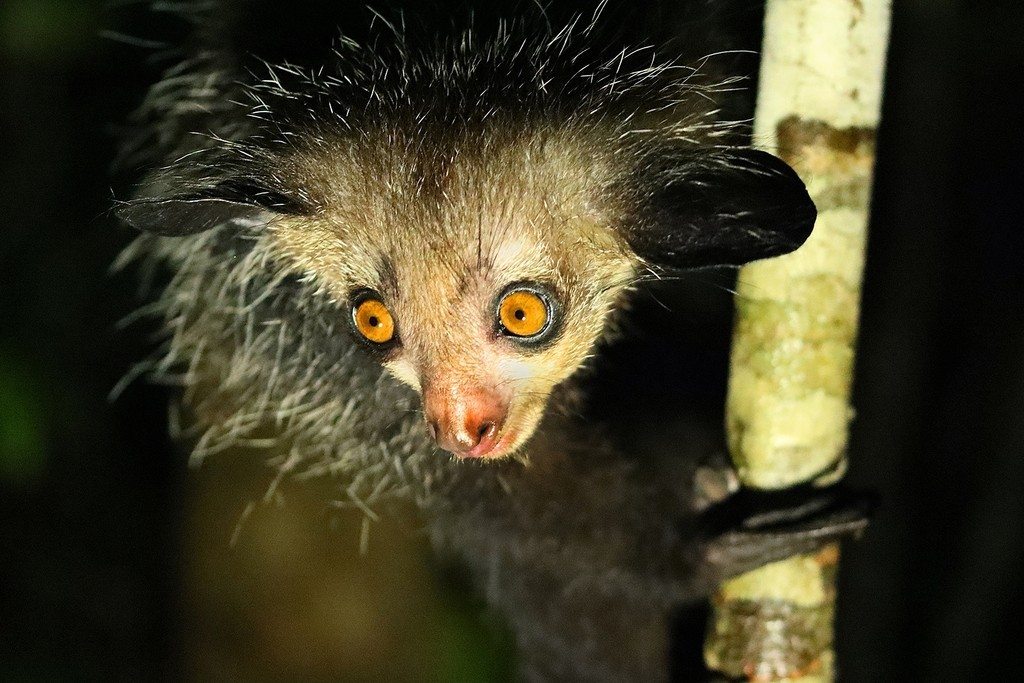
An aye-aye's large eyes and ears are visible in this night photograph.
Species reference for Aye-Aye. The photograph does not necessarily show the population or place named in the puzzle.
(c) Barry Stewart, some rights reserved (CC BY) · CC BY 4.0 · Original recordImage changes
Resized and converted to JPEG for display; no subject alteration.
The words
Aye-Aye
A nocturnal Madagascan lemur that taps wood and listens while searching for food inside.
Bad Omen
The belief that leads people to kill it.
In some local beliefs, an aye-aye is regarded as an omen; this belief has contributed to persecution of the animal.
Beetle
Wood-boring beetle larvae are an important part of its diet.
Coconuts
Coconuts are among its favoured foods.
Echoes
The aye-aye listens to sounds produced as it taps wood, helping it locate hidden cavities and food.
Finger
The flexible middle finger is inserted into insect tunnels.
Front Teeth
The aye-aye has continuously growing front teeth, or incisors, that help it gnaw into wood and hard foods.
Grub
The middle finger hooks insect larvae out of wood.
Lemur
The aye-aye is a lemur of Madagascar.
Madagascar
Aye-ayes live in the forests of eastern and western Madagascar.
Mangoes
Aye-ayes also eat mangoes, lychees and coconuts.
Nosy Mangabe
Nine aye-ayes were released on the Nosy Mangabe reserve in 1967.
Ramy Nut
Ramy nuts are among the aye-aye's favoured foods.
Tapping
Aye-ayes find tunnels by tapping on wood.
Woodpecker
The aye-aye fills the niche of woodpeckers, which are absent from Madagascar.
Sources
- ayeayelemur.duke.edu
- Daubentonia Aye-Aye (source capture)Animal Diversity Web, University of Michigan Museum of Zoology
- Daubentonia Aye-Aye (source capture)Tropical Resources Institute, Yale School of the Environment
- Daubentonia Aye-Aye (source capture)Dublin Zoo