
Wildlife of the World
Puzzle 51 · Islands of Evolution · Page 79 in print
Komodo Dragon
The Komodo dragon is the largest living lizard and inhabits a small group of Indonesian islands. Wild adults commonly weigh around 70 kilograms, and particularly large animals can be much heavier.
Jump to a word
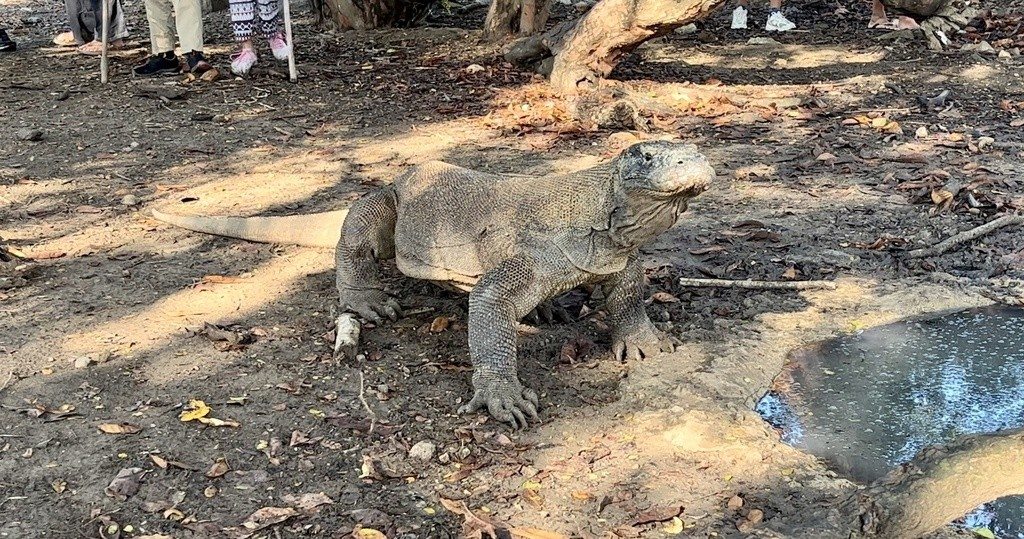
A Komodo dragon rests on open ground.
Species reference for Komodo Dragon. The photograph does not necessarily show the population or place named in the puzzle.
Aiken Lau / iNaturalist (CC0) · CC0 1.0 · Original recordImage changes
Resized and converted to JPEG for display; no subject alteration.
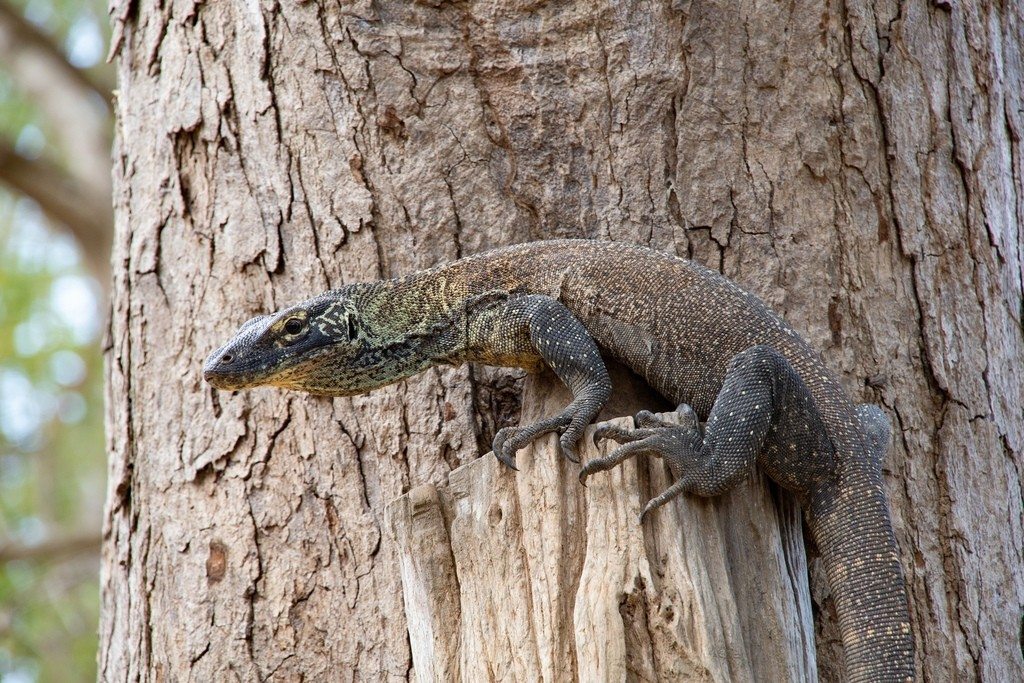
A young Komodo dragon climbs a tree trunk.
Species reference for Komodo Dragon. The photograph does not necessarily show the population or place named in the puzzle.
(c) Adam Mark Lucas-Krol, some rights reserved (CC BY) · CC BY 4.0 · Original recordImage changes
Resized and converted to JPEG for display; no subject alteration.
The words
Dragon
The Komodo dragon is the largest living lizard.
Smithsonian's National Zoo and Conservation Biology Institute (opens a new tab)
Flores
Three dragon subpopulations live on Flores.
Forked Tongue
It samples the air with its long, yellow, forked tongue.
Smithsonian's National Zoo and Conservation Biology Institute (opens a new tab)
Gili Motang
Gili Motang is one of the six dragon islands.
Komodo
Komodo is the largest of the dragon's islands.
Smithsonian's National Zoo and Conservation Biology Institute (opens a new tab)
Lesser Sunda
Komodo dragons live on a few islands of the Lesser Sunda group.
Smithsonian's National Zoo and Conservation Biology Institute (opens a new tab)
Monitor
The Komodo dragon is a type of monitor lizard.
Nusa Kode
Nusa Kode is one of the six dragon islands.
Rinca
Almost 70% of dragons live on Komodo and Rinca.
Rough Scales
The skin is reinforced with osteoderms (bony plates).
Animal Diversity Web (opens a new tab) · San Diego Zoo Wildlife Alliance (opens a new tab)
Saliva
The Komodo dragon's saliva was long said to carry deadly bacteria. A 2009 study rejected that, pointing to venom that keeps blood from clotting and sends prey into shock; a 2013 study of captive dragons found no virulent species.
Fry et al. 2009, PNAS: Komodo venom (opens a new tab) · Goldstein et al. 2013: Komodo oral bacteria (opens a new tab)
Timor Deer
Adult dragons eat Timor deer, water buffalo and wild pigs.
Varanus
Varanus, the monitor-lizard genus.
The Komodo dragon is Varanus komodoensis.
Venom Glands
Researchers have documented a venom gland in the dragon's lower jaw.
Smithsonian's National Zoo and Conservation Biology Institute (opens a new tab)
Water Buffalo
Large prey it can tackle.
Adult dragons eat water buffalo.
Sources
- Komodo Dragon (source capture)Smithsonian's National Zoo and Conservation Biology Institute
- Komodo Dragon (source capture)San Diego Zoo Wildlife Alliance
- Komodo Dragon (source capture)Animal Diversity Web, University of Michigan Museum of Zoology
- A central role for venom in predation by Varanus komodoensis (Komodo Dragon) and the extinct giant Varanus (Megalania) priscusProceedings of the National Academy of Sciences (Fry et al. 2009), via Europe PMC
- Anaerobic and aerobic bacteriology of the saliva and gingiva from 16 captive Komodo dragons (Varanus komodoensis): new implications for the "bacteria as venom" modelJournal of Zoo and Wildlife Medicine (Goldstein et al. 2013), via Europe PMC