
Wildlife of the World
Puzzle 40 · Monsoon Asia and Sundaland · Page 64 in print
Tarsier Twilight
A Philippine tarsier turns its head through about 180 degrees to scan the forest; large eyes and sharp hearing help this small nocturnal primate locate insects and other prey.
Jump to a word
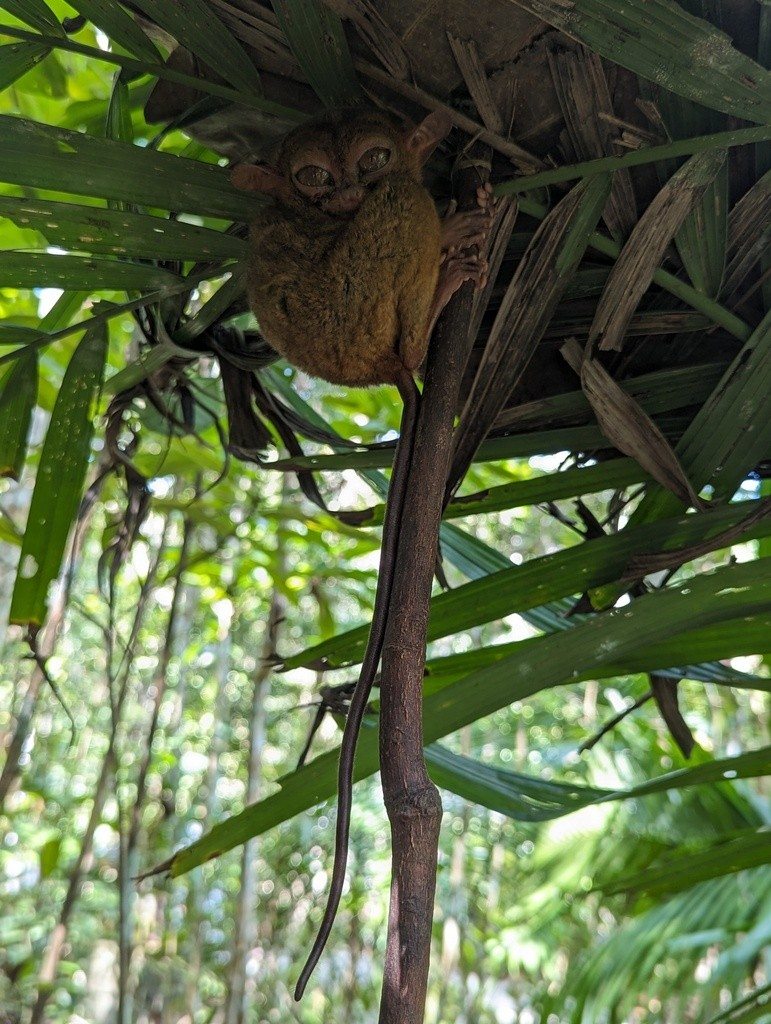
A Philippine tarsier clings among leaves and stems.
Species reference for Tarsier Twilight. The photograph does not necessarily show the population or place named in the puzzle.
Zoltán Stekkelpak / iNaturalist (CC0) · CC0 1.0 · Original recordImage changes
Resized and converted to JPEG for display; no subject alteration.
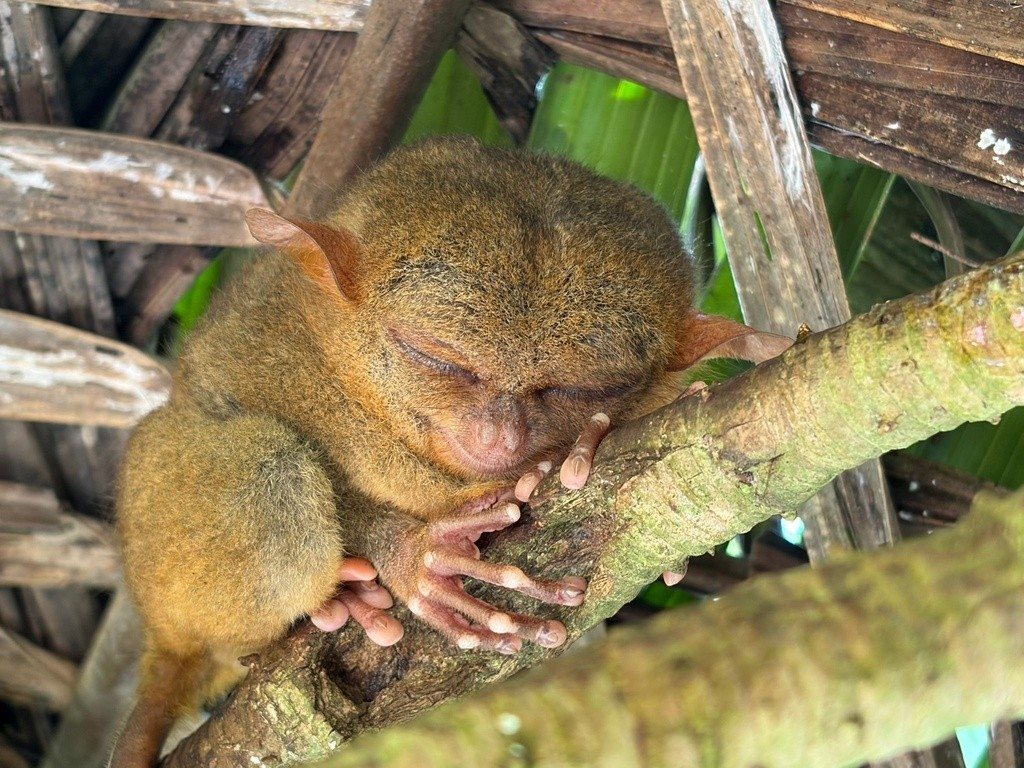
A tarsier rests against a branch, its long fingers curled around the wood.
Species reference for Tarsier Twilight. The photograph does not necessarily show the population or place named in the puzzle.
(c) Selim Türeli, some rights reserved (CC BY) · CC BY 4.0 · Original recordImage changes
Resized and converted to JPEG for display; no subject alteration.
The words
Bohol
Researchers recorded wild tarsiers on Bohol and Leyte.
Carlito
The Philippine tarsier is classified as Carlito syrichta; older sources placed it in Tarsius.
University of the Philippines (opens a new tab) · Mammal Diversity Database (opens a new tab) · Australian National University research portal: record of Groves and Shekelle 2010 (opens a new tab)
Eyes
For its body size the tarsier has the largest eyes of any mammal.
Fingers
Pads on the fingers help tarsiers cling to branches.
Grooming Claws
Tarsiers have two grooming claws on their feet.
Head Swivel
Turning the head half way round.
Tarsiers can rotate their heads 180 degrees.
Leyte
Leyte, a Philippine island in its range.
Tarsiers live on Leyte.
Animal Diversity Web (opens a new tab) · home.dartmouth.edu (opens a new tab)
Mindanao
Mindanao, a large Philippine island.
Tarsiers are found on Mindanao.
Philippines
The Philippine tarsier lives in the rainforests of the Philippines.
Prosimian
A member of the lemur-like primate group.
Tarsiers are among the smallest prosimians.
Spiders
Prey it catches at night.
Tarsiers eat insects, spiders and lizards.
Tarsals
The tarsier's heel bones (tarsals) are longer than any primate's and give the genus its name.
Tarsier
Philippine tarsiers live among tall grasses, bushes, bamboo and small trees.
Toes
Pads on the toes help tarsiers cling to branches.
Ultrasound
Its calls too high for people to hear.
Philippine tarsiers give a purely ultrasonic call at about 70 kHz.
Sources
- Tarsier ultrasoundhome.dartmouth.edu
- Tarsier Twilight (source capture)University of the Philippines, Office of the Vice President for Academic Affairs (research news)
- Tarsier Twilight (source capture)Mammal Diversity Database, American Society of Mammalogists
- Tarsier Twilight (source capture)Australian National University research portal: record of Groves and Shekelle 2010, International Journal of Primatology (peer-reviewed)
- Tarsier Twilight (source capture)Animal Diversity Web, University of Michigan Museum of Zoology
- Tarsier Twilight (source capture)Primate Info Net, Wisconsin National Primate Research Center, University of Wisconsin–Madison