
The Space Race
Puzzle 09 · Rockets and Launch Pads · Page 23 in print
The Redstone Rocket
A modified Redstone launched both crewed Mercury suborbital flights in 1961.
Jump to a word
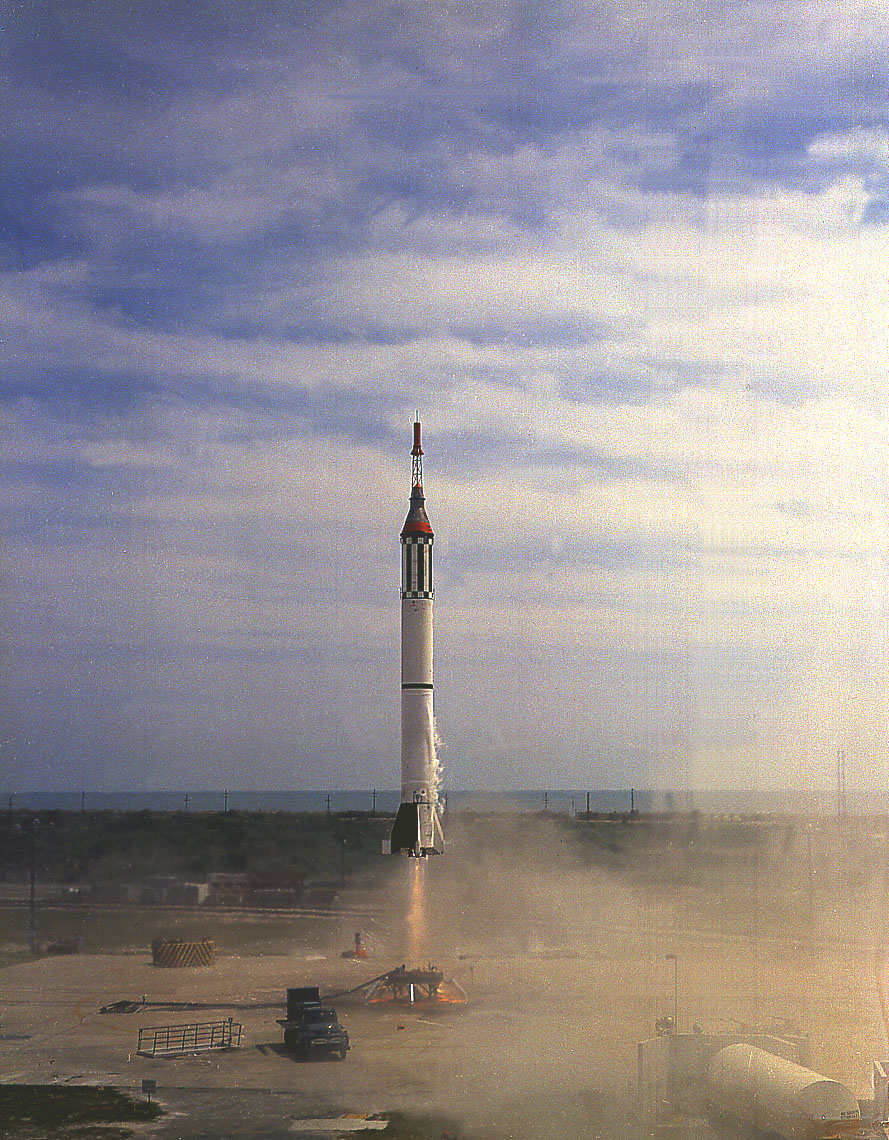
The Mercury-Redstone booster-development test lifts off from Cape Canaveral on March 24, 1961.
NASA / Marshall Space Flight Center (9801802) · NASA media-use guidelines · Original recordThe words
Arsenal
The Redstone rocket took its name from Redstone Arsenal in Huntsville, Alabama. The Army’s missile-development center there began work on the new rocket in 1950.
Carbon
The Redstone’s tail used carbon jet vanes that projected into the engine exhaust. The vanes helped steer the rocket during powered flight.
Chrysler
Chrysler served as prime contractor for Redstone production. The company later assembled six Mercury-Redstone launch vehicles, while the first two were assembled by NASA’s Marshall center.
Ethyl Alcohol
Ethyl alcohol mixed with water was the Army Redstone’s fuel, while liquid oxygen supplied its oxidizer. This propellant pairing powered the missile’s liquid-fueled engine.
Fort Bliss
Fort Bliss, Texas, housed von Braun’s German rocket specialists after World War II. They worked for the Army before moving to Huntsville in 1950.
Freedom Seven
Alan Shepard’s Mercury capsule was named Freedom 7. A modified Redstone launched him on May 5, 1961, making him the first American in space on a suborbital flight.
Did you know?
After its flight and initial inspections, Freedom 7 traveled to Paris for exhibition at the International Aeronautical Show on May 25, 1961.
Hermes
Redstone grew from the Army’s earlier Hermes C-1 project. The missile also drew on German V-2 experience and an engine developed for the separate Navaho program.
Jet Vanes
Jet vanes were steering surfaces placed in the rocket’s exhaust stream. The Redstone used them alongside four stabilizing fins and external air rudders.
Mercury
NASA adapted Redstone for short Mercury flights into space without entering orbit. Longer tanks and other changes prepared the former Army missile for carrying a spacecraft and astronaut.
Ordnance
Military weapons and equipment.
The Army’s Ordnance Guided Missile Center at Redstone Arsenal began developing the rocket in 1950. Redstone started as an Army weapons project before its later adaptation for human spaceflight.
NASA: Redstone’s origins and later uses (opens a new tab) · US Army: Holger Toftoy (opens a new tab)
Paperclip
Operation Paperclip brought von Braun, a former Nazi Party and SS member, to the United States for Army missile work. His V-2 program used enslaved concentration-camp labor, and many prisoners died.
Peenemunde
Peenemünde was Nazi Germany’s V-2 development center. The missile was used against European cities; its later production at Mittelwerk relied on enslaved concentration-camp labor, and many prisoners died.
Redstone
The Army’s Redstone missile became a launch vehicle for spaceflight. Modified versions carried Alan Shepard and Gus Grissom on Mercury’s two crewed suborbital flights in 1961.
Did you know?
Early Saturn I development reused Redstone technology and tooling. Eight Redstone-derived tanks were grouped around a central core, helping build a much larger launch vehicle.
Toftoy
Major General Holger N. Toftoy helped recruit German rocket specialists for the Army after World War II. He later directed the Ordnance Missile Laboratories and commanded Redstone Arsenal.
White Sands
White Sands Proving Ground in New Mexico hosted launches of captured German V-2 rockets after World War II. This was part of the Army work preceding Redstone’s development in Huntsville.
Sources
- 70 Years Ago: First Redstone Launch From Cape CanaveralJohn Uri; NASA Johnson Space Center, August 21, 2023
- Mercury-Redstone Launch VehicleLee Mohon; NASA Marshall Space Flight Center, September 16, 2016
- Wernher von BraunNASA; historical biography of the former Marshall Space Flight Center director
- Major General Holger N. ToftoyUS Army; Redstone Arsenal Historical Information, institutional biography before the separate classmate remembrance
- Alan Shepard Becomes the First American in SpaceNASA; historical image article, May 5, 2021