
The Space Race
Puzzle 10 · Rockets and Launch Pads · Page 24 in print
The Atlas Booster
Atlas was a one-and-a-half-stage rocket: it shed only its booster engines.
Jump to a word
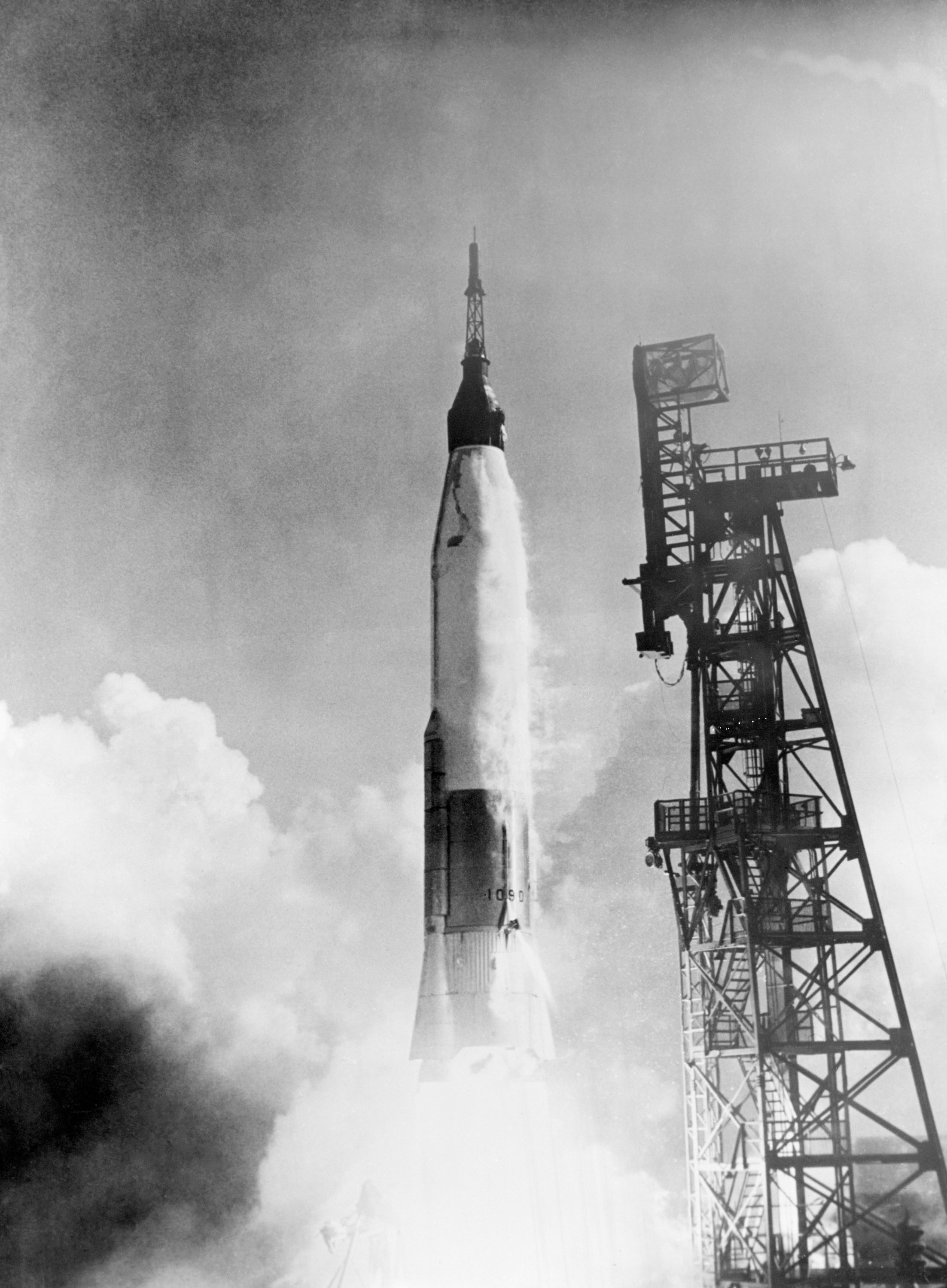
Mercury-Atlas 6, carrying Friendship 7, lifts off from Cape Canaveral on February 20, 1962.
NASA / Johnson Space Center (S62-00954) · NASA media-use guidelines · Original recordThe words
Abort Sensing
Mercury-Atlas carried equipment to trigger a spacecraft escape when the booster went wrong. During the uncrewed MA-3 test on April 25, 1961, the system activated the escape rockets and the capsule was recovered.
April 25, 1961 entry · NASA chronology: Atlas escape test (opens a new tab)
Atlas
NASA selected a modified Atlas D missile for Mercury’s orbital missions. Mercury-Atlas launched all four crewed orbital Mercury flights in 1962 and 1963, following the earlier Redstone suborbital flights.
Balloon Tank
The early Atlas and Centaur vehicles used balloon-like propellant tanks supported by internal pressure. Engineers tested their strength under simulated launch vibrations and loads.
Big Joe
Big Joe launched an uncrewed Mercury test capsule on an Atlas on September 9, 1959. Although booster-engine separation failed, the flight returned useful data for the spacecraft’s heat-shield design.
September 9 and 16, 1959 entries · NASA chronology: Big Joe test (opens a new tab)
Bossart
Karel Jan Bossart led the Atlas engineering work at Convair. Appointed chief engineer in 1955, he brought a background in aircraft structures to the missile’s lightweight stainless-steel design.
Did you know?
Bossart named Atlas for both the figure in Greek mythology and Convair’s parent company, the Atlas Corporation, according to the museum’s photograph caption.
Centaur
Centaur was a separate upper stage fitted above Atlas for missions needing more energy. Its liquid-hydrogen-fueled engines extended the launcher’s capabilities beyond the Mercury flights.
Did you know?
An Atlas-Centaur launched the first Surveyor spacecraft in 1966. The robotic lander investigated the Moon before the Apollo crews arrived.
Convair
General Dynamics/Convair led Atlas airframe design, assembly and testing. North American Aviation developed the propulsion system, so the finished vehicle combined work from more than one company.
Pad Fourteen
John Glenn’s Friendship 7 lifted off from Launch Complex 14 at Cape Canaveral on February 20, 1962. Its Atlas booster carried him into orbit for the Mercury-Atlas 6 mission.
Project Score
An Atlas carried Project SCORE into orbit on December 18, 1958. The communications experiment relayed Eisenhower’s recorded message of peace from space the following day.
Did you know?
Eisenhower’s message was a late addition to SCORE. With the Atlas already sealed, the stored recording was changed by radio before launch.
San Diego
Convair’s Atlas program expanded in San Diego during the 1950s. Its Astronautics division opened a new plant on Kearny Mesa in May 1958 to build the missile.
Schriever
Air Force General Bernard Schriever directed the Atlas missile program through the Western Development Division. His role was military program leadership, while Bossart led the contractor’s engineering work.
Stage and a Half
Atlas dropped its two booster engines during flight while keeping the main propellant tanks. The central sustainer continued firing, giving the vehicle its distinctive stage-and-a-half description.
Sustainer
Atlas’s central sustainer engine ignited with the two booster engines at launch. After the boosters fell away, it continued burning fuel from the tanks that stayed with the rocket.
Tank Walls
Atlas’s propellant tanks formed most of its main structure. The same tanks supplied all three main engines and stayed with the rocket after the two booster engines were discarded.
Vernier
Early Atlas rockets used small vernier engines near the base of the main vehicle. These additional engines helped control the rocket’s direction during flight.
Sources
- 60 Years Ago: John Glenn, the First American to Orbit the Earth aboard Friendship 7John Uri; NASA Johnson Space Center, February 18, 2022
- Model, Rocket, Mercury Atlas, 1:25Smithsonian National Air and Space Museum; collection record A19800162000
- Rocket Systems Area – Centaur ProgramNASA Glenn Research Center; Historic Facilities, Centaur program and structural-dynamics sections
- Programs – Santa Susana Field LaboratoryNASA Marshall Space Flight Center; SSFL historical programs, Atlas section
- Project Mercury – A Chronology, Part II (B)NASA History; NASA SP-4001, April 25, 1961 entry and cited MA-3 engineering report
- Project Mercury – A Chronology, Part II (A)NASA History; NASA SP-4001, September 9 and 16, 1959 entries and cited project memoranda
- A Trio of Atlas “Launch Pioneers”San Diego Air & Space Museum; Atlas online exhibit, Bossart and Schriever biographies and archival photograph captions
- Project MX-1593—from Concept to RealitySan Diego Air & Space Museum; Atlas online exhibit, Convair Astronautics plant history
- Merry Christmas from Space!US National Archives; Pieces of History, December 19, 2012, with Eisenhower Presidential Library records
- Rocket ControlNASA Glenn Research Center; Beginner’s Guide to Aeronautics, Older Rockets section