
The Space Race
Puzzle 11 · Rockets and Launch Pads · Page 25 in print
The Titan II
Titan II’s hypergolic propellants ignited on contact, making its engine starts reliable.
Jump to a word
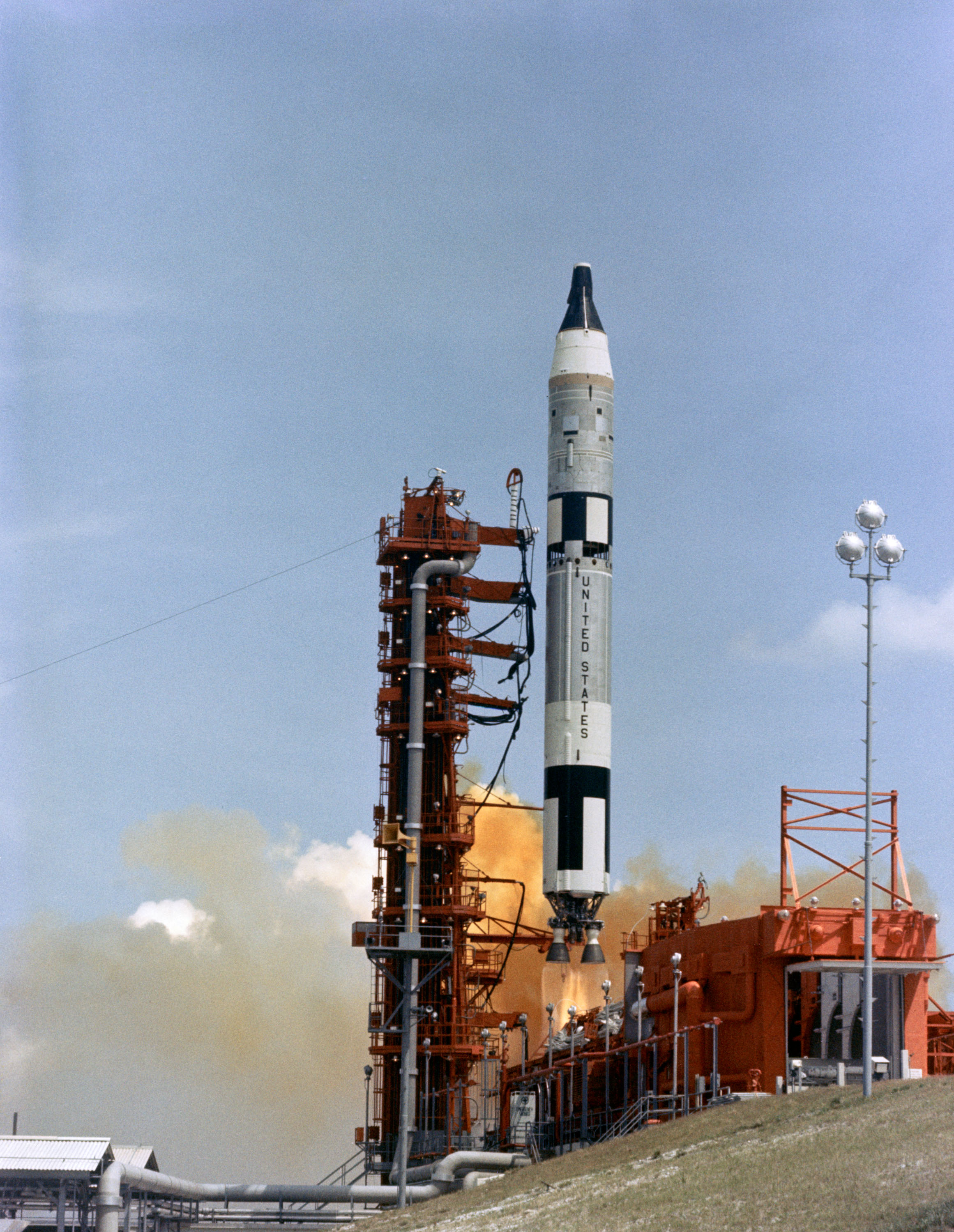
A Titan II launches Gemini 1 from Cape Kennedy on April 8, 1964.
NASA / Johnson Space Center (S64-21560) · NASA media-use guidelines · Original recordThe words
Aerojet
Aerojet-General supplied the engines for Gemini’s Titan II rockets. The first flight engines were installed at Martin’s Baltimore plant in May 1963, followed by wiring checks and ground testing.
NASA chronology: Titan manufacture and tests (opens a new tab)
Baltimore
Martin’s Baltimore operation assembled and tested Gemini launch vehicles. A vertical test tower opened there in May 1963, allowing checks before the rockets were sent to Cape Kennedy.
NASA chronology: Titan manufacture and tests (opens a new tab)
Denver
Martin’s Denver plant manufactured and checked the propellant tanks and skirt assemblies for Gemini’s Titan II rockets. The hardware then went to Baltimore for launch-vehicle assembly.
NASA chronology: Titan manufacture and tests (opens a new tab)
Gemini
Gemini was NASA’s two-person program between Mercury and Apollo. Its crews practiced changing orbit, staying in space for longer missions, spacewalking, rendezvous and docking.
Did you know?
The name Gemini came from the Latin word for twins. It reflected the program’s two-person spacecraft and the pilots who would fly together.
Hydrazine
Hydrazine was one ingredient in Titan II’s fuel blend, which ignited on contact with its oxidizer. The chemical’s toxicity made propellant handling a serious hazard.
NASA history: qualifying Titan for Gemini (opens a new tab) · NIOSH: hydrazine’s health hazards (opens a new tab)
Hypergolic
Titan II’s fuel and oxidizer burned when they met, so the rocket needed no separate ignition system. Both liquids could be stored at ordinary temperatures.
p. 41 · NASA history: qualifying Titan for Gemini (opens a new tab)
Interstage
The interstage was the joining section between Titan II’s first and second stages. It formed part of the rocket structure around the stage-separation area.
Cutaway, p. 43 · NASA history: qualifying Titan for Gemini (opens a new tab)
Man Rating
Qualifying a rocket to carry people.
Man-rating Titan II meant meeting stricter requirements for vibration, engine stability and reliability. Tests supported the first crewed flights, while some engine improvements were introduced later in Gemini.
pp. 167–169 · NASA history: qualifying Titan for Gemini (opens a new tab)
Martin
Martin’s Denver and Baltimore operations shared the work of building Gemini’s Titan II rockets. Denver supplied tank assemblies, while Baltimore combined the hardware and tested the launch vehicles.
NASA chronology: Titan manufacture and tests (opens a new tab)
Pad Nineteen
Titan II launched the Gemini crews from Launch Pad 19 at Cape Kennedy. Gus Grissom and John Young began the crewed series there on March 23, 1965.
Pogo
Titan II vibrated lengthwise during early test flights. This pogo motion threatened astronauts’ ability to respond in an emergency and had to be reduced for Gemini.
p. 104 · NASA history: qualifying Titan for Gemini (opens a new tab)
Standpipe
A standpipe was part of the Titan II fix for pogo vibration. Together with a fuel surge chamber, it reduced pressure pulses in the propellant system.
NASA chronology: Titan manufacture and tests (opens a new tab)
Static Test
Before revised Titan II hardware flew, engineers tested it in ground firings. These static tests helped investigate the link between the rocket’s structure and its propulsion system.
NASA chronology: Titan manufacture and tests (opens a new tab)
Titan
An Air Force Titan II missile design was adapted for Gemini. The modified launcher carried all ten crewed missions in 1965 and 1966.
Did you know?
The photograph shows Gemini 1, an uncrewed test. It flew in April 1964, before a second uncrewed mission in January 1965 and the first astronaut crew.
Smithsonian: Gemini-Titan II history (opens a new tab) · NASA: Gemini’s program and Pad 19 (opens a new tab)
Two Stage
Titan II had a lower first stage and an upper second stage. After the stages separated, the upper stage continued carrying Gemini toward orbit.
Smithsonian: Gemini-Titan II history (opens a new tab) · NASA history: qualifying Titan for Gemini (opens a new tab)
Sources
- Gemini Pioneered the Technology Driving Today’s ExplorationBob Granath; NASA Kennedy Space Center, page dated March 27, 2023; text originally marking Gemini’s fiftieth anniversary
- Model, Rocket, Gemini Titan II, 1:48Smithsonian National Air and Space Museum; collection record A19721000000
- Project Gemini – A Chronology, Part II (A)NASA History; NASA SP-4002, 1963 manufacturing, qualification and pogo-suppression entries with cited project records
- On the Shoulders of Titans: A History of Project GeminiBarton C. Hacker and James M. Grimwood; NASA SP-4203, 1977, printed pp. 41, 43, 104 and 167–169; related notes p. 447
- NIOSH Pocket Guide to Chemical Hazards – HydrazineCDC / National Institute for Occupational Safety and Health; exposure routes, symptoms and target organs; read in Chrome on October 24, 2026