
The Space Race
Puzzle 12 · Rockets and Launch Pads · Page 26 in print
The Saturn V
The Saturn V stood 363 feet tall, 60 feet taller than the Statue of Liberty.
Jump to a word
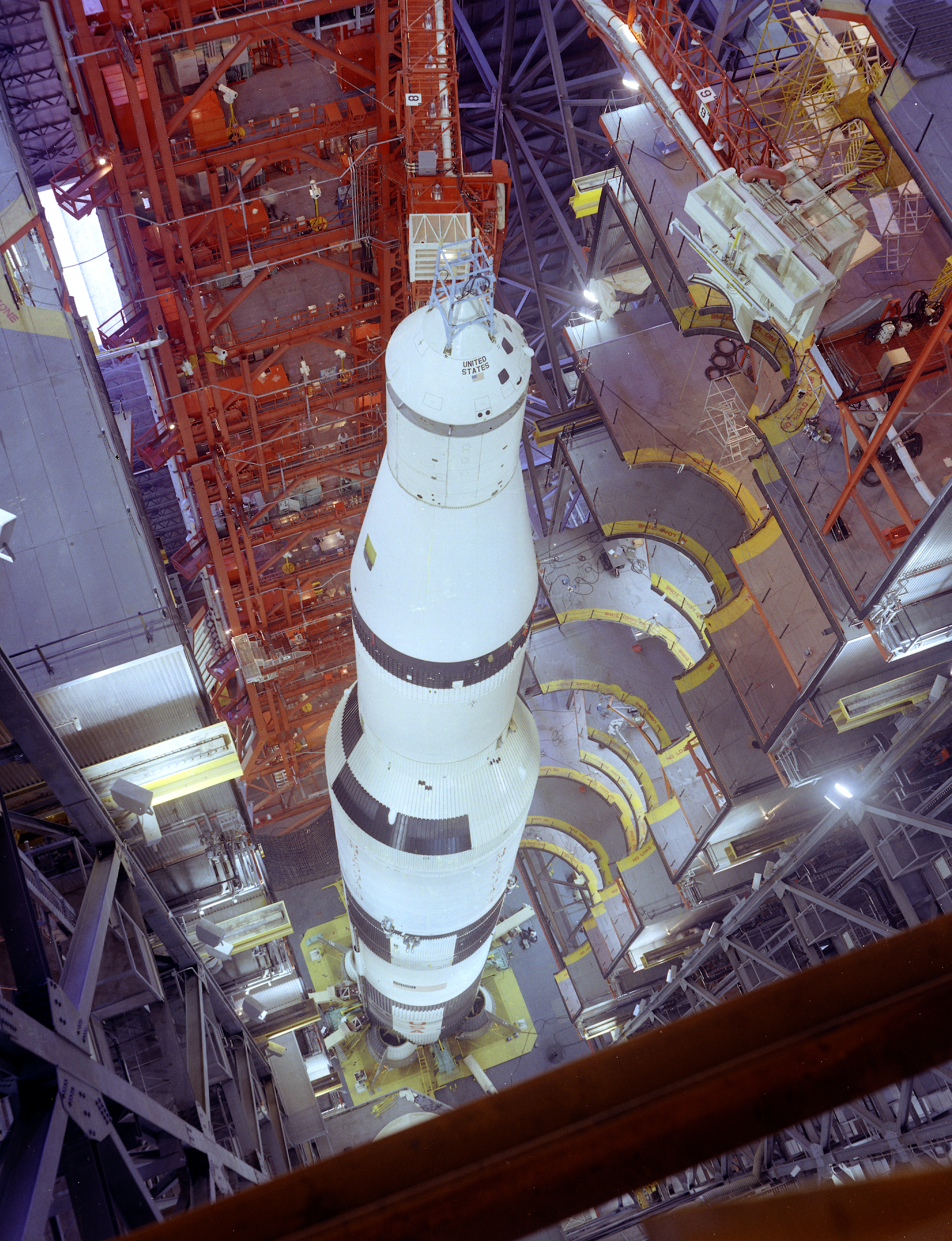
The Saturn V for Apollo 4 inside Kennedy Space Center’s Vehicle Assembly Building.
NASA / Marshall Space Flight Center (6754387) · NASA media-use guidelines · Original recordThe words
All Up Testing
Apollo 4 tested all three Saturn V stages in one flight on November 9, 1967. The uncrewed mission also checked the third stage’s ability to restart in orbit.
Did you know?
Apollo 4 also carried an uncrewed Apollo command and service module, plus a lunar-lander test article. NASA tested spacecraft hardware along with the rocket.
Boeing
Boeing was Saturn V’s first-stage contractor at Michoud. NASA assigned the plant to rocket production in 1961 as the Apollo program expanded.
Bulkhead
Saturn V’s upper stages used common bulkheads between their propellant tanks. A single insulated partition separated the liquid hydrogen and liquid oxygen.
pp. 167, 211–214 · Bilstein: Saturn stages and testing (opens a new tab)
Cryogenic
Saturn V’s liquid hydrogen and oxygen were cryogenic propellants, kept extremely cold. Leaks of cryogenic fuel could create an explosion hazard.
pp. 90, 165 · Bilstein: Saturn stages and testing (opens a new tab)
Douglas
Douglas built the S-IVB, Saturn V’s third stage. Its single J-2 engine could restart after the rocket reached Earth orbit.
pp. 160, 163–164 · Bilstein: Saturn stages and testing (opens a new tab)
Hydrogen
Liquid hydrogen fueled the J-2 engines in Saturn V’s upper two stages. Liquid oxygen supplied the oxidizer for their combustion.
pp. 90, 160–164, 211–212 · Bilstein: Saturn stages and testing (opens a new tab)
Marshall
Saturn V was developed at Marshall Space Flight Center in Huntsville, Alabama. It belonged to a family that also included the smaller Saturn I and Saturn IB.
Did you know?
Saturn V’s final launch in 1973 carried Skylab into Earth orbit. That version used two powered stages instead of the three used for Apollo.
Michoud
NASA took over Michoud in 1961 for large launch-vehicle production. The existing factory became a manufacturing base for Saturn V’s first stage.
Did you know?
Before the rocket era, the Michoud plant manufactured Army tank engines under a contract awarded to Chrysler in 1951.
Mississippi
NASA’s Mississippi Test Facility began firing Saturn V stages in 1966. These ground tests checked the large rocket hardware needed for the Apollo Moon missions.
Mueller
George E. Mueller led NASA’s human spaceflight office. He pressed for all-up Saturn V testing to meet the Moon-landing schedule.
pp. 348–350 · Bilstein: Saturn stages and testing (opens a new tab)
New Orleans
New Orleans housed Michoud, where Saturn V’s first stages were manufactured. Water access helped NASA choose the site for handling such large rocket hardware.
North American
North American Aviation built Saturn V’s S-II second stage. It used five J-2 engines and liquid-hydrogen fuel.
pp. 211–212 · Bilstein: Saturn stages and testing (opens a new tab)
Nova
Nova was a proposed rocket for landing a large spacecraft directly on the Moon. NASA chose lunar-orbit rendezvous, using a smaller lander carried by Saturn V.
Third Stage
The S-IVB first placed Apollo into Earth orbit, then restarted for the journey toward the Moon. Apollo 4 tested that restart during an uncrewed Earth-orbit mission.
Ullage
The unfilled space in a tank containing liquid.
The S-IVB’s auxiliary rockets helped settle liquid propellants toward the tank bottoms before its engine restarted in orbit.
p. 163 · Bilstein: Saturn stages and testing (opens a new tab)
Sources
- 55 Years Ago: Apollo 4, the First Flight of the Saturn VJohn Uri; NASA Johnson Space Center, November 9, 2022
- What Was the Saturn V? (Grades 5–8)NASA STEM Team; September 17, 2010
- History of MAFNASA Michoud Assembly Facility; institutional history and 1951 and 1961 timeline entries
- Stages to Saturn: A Technological History of the Apollo/Saturn Launch VehiclesRoger E. Bilstein; NASA History Series, NASA SP-4206, 1980; printed pp. 90, 160–167, 211–214 and 348–350
- 60 years ago: NASA Decides on Lunar Orbit Rendezvous for Moon LandingJohn Uri; NASA Johnson Space Center, July 11, 2022
- NASA Stennis Powers Nation’s Space Efforts – Past, Present, FutureNASA Stennis Communications; November 13, 2024, historical Apollo section and 1966 photograph caption