
The Space Race
Puzzle 08 · Dawn of the Space Age · Page 20 in print
The First Moon Probes
Luna 2 became the first spacecraft to hit the Moon in September 1959.
Jump to a word
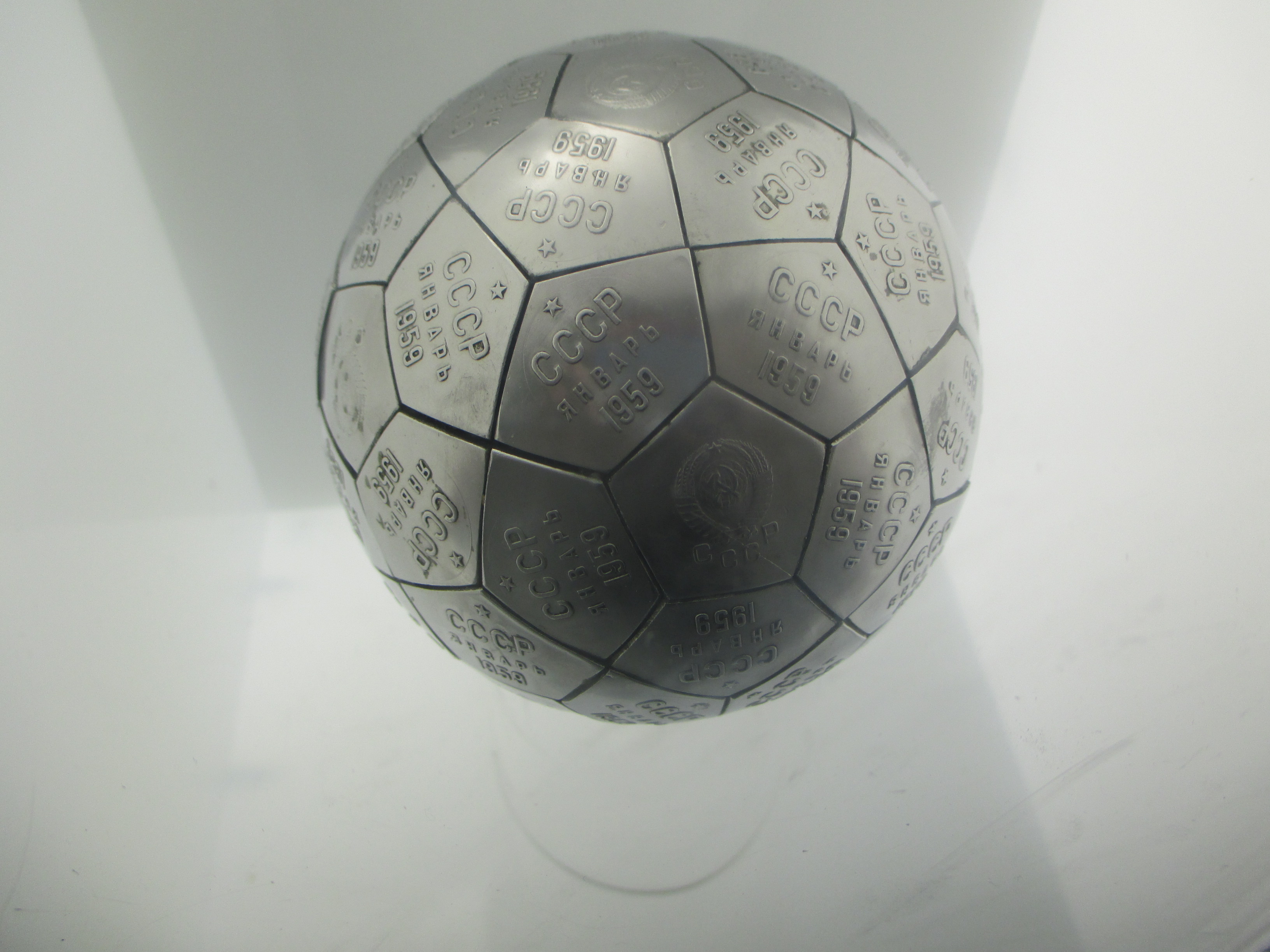
A museum copy of a Soviet lunar pennant at the Kansas Cosmosphere.
Patrick Pelletier · CC BY-SA 3.0 · Original recordImage changes
Display copies resized; original preserved.
The words
Contact
Controllers kept radio contact with Luna 1 until its batteries ran down, about 62 hours after launch. By then, the probe had passed the Moon and entered solar orbit.
Davies
John G. Davies worked in Jodrell Bank’s control building during Luna 2’s approach. His radio-frequency measurements helped the observatory assess the Soviet spacecraft’s arrival at the Moon.
Space Tracking, p. 55 · Jodrell Bank: Davies and lunar gravity (opens a new tab)
Facsimile
An image copied by scanning and transmitting it electronically.
Luna 3’s photographs were scanned aboard the spacecraft and sent to Earth by radio. The pictures could be reconstructed without bringing the camera or its film home.
Film
Luna 3 used photographic film rather than a modern digital camera. The spacecraft developed, fixed and dried the film on board before its pictures could be scanned for transmission.
Flyby
Passing a target without landing on it.
Luna 3 swept past the Moon’s south pole in October 1959 and photographed its far side. It passed the Moon rather than landing on it.
Gravity
The Moon’s pull changed Luna 2’s speed during its final approach. Astronomers measured a corresponding change in its radio frequency, helping them establish that the spacecraft reached the Moon.
Space Tracking, p. 55 · Jodrell Bank: Davies and lunar gravity (opens a new tab)
Heliocentric
Orbiting the Sun.
Luna 1 was intended to strike the Moon but missed after an incorrectly timed rocket burn. It continued into orbit around the Sun, becoming the first spacecraft to do so.
Impact
Luna 2 struck the Moon on September 13, 1959, becoming the first spacecraft to reach another celestial body. It was an impact mission, not a soft landing.
Jodrell Bank
At Britain’s Jodrell Bank observatory, a large radio telescope followed Luna 2’s signals. Soviet scientists supplied the pointing information needed to locate the probe on its way to the Moon.
Luna
The names Luna 1, 2 and 3 were assigned after the 1959 flights. The probes had originally been announced as Cosmic Rockets and an Automatic Interplanetary Station.
Pennant
Luna 2 carried Soviet emblems inside two metal spheres. Their arrival on the Moon marked the mission’s intended impact.
Did you know?
Days after Luna 2’s flight, Nikita Khrushchev gave Eisenhower a replica of its spherical pennant during the Soviet leader’s visit to the United States.
Photographs
Luna 3 returned the first pictures of the Moon’s far side in 1959. Though indistinct, they showed a lunar landscape that observers on Earth had never seen.
Did you know?
The far-side pictures showed far fewer large, dark lava plains than the familiar near side. The far side was instead densely covered with impact craters.
Pioneer
The American Pioneer 3 and 4 probes were designed to fly past the Moon and measure radiation. Pioneer 3 fell short; Pioneer 4 passed the Moon in March 1959.
Sodium Cloud
Luna 1’s upper rocket stage released sodium gas on the journey to the Moon. Astronomers on Earth photographed the cloud as a visible marker of the flight.
Thor-Able
A Thor-Able rocket launched Pioneer 1 from Cape Canaveral on October 11, 1958. The launch failed to give the probe enough speed to reach its intended lunar orbit.
Sources
- 60 Years Ago: Luna 2 Makes Impact in Moon RaceJohn Uri; NASA Johnson Space Center, September 12, 2019
- Pioneer 4 Marked NASA’s First Exploration Mission Beyond EarthBob Granath; NASA, February 20, 2014
- Jodrell Bank’s role in early space tracking activities – Part 1Sven Grahn; archive-based history hosted by the University of Manchester, Jodrell Bank Centre for Astrophysics, updated September 16, 2008
- Jodrell Bank Observatory: World Heritage Nomination DossierJodrell Bank Observatory / University of Manchester; institutional nomination dossier, Space Tracking, printed p. 55
- First Photo of the Lunar Far SideNASA Science; August 15, 2025
- Able 2 (Pioneer 1)NASA Science; mission account based on Asif A. Siddiqi, Beyond Earth, 2018