
The Space Race
Puzzle 07 · Dawn of the Space Age · Page 19 in print
The Birth of NASA
NASA began in 1958.
Jump to a word
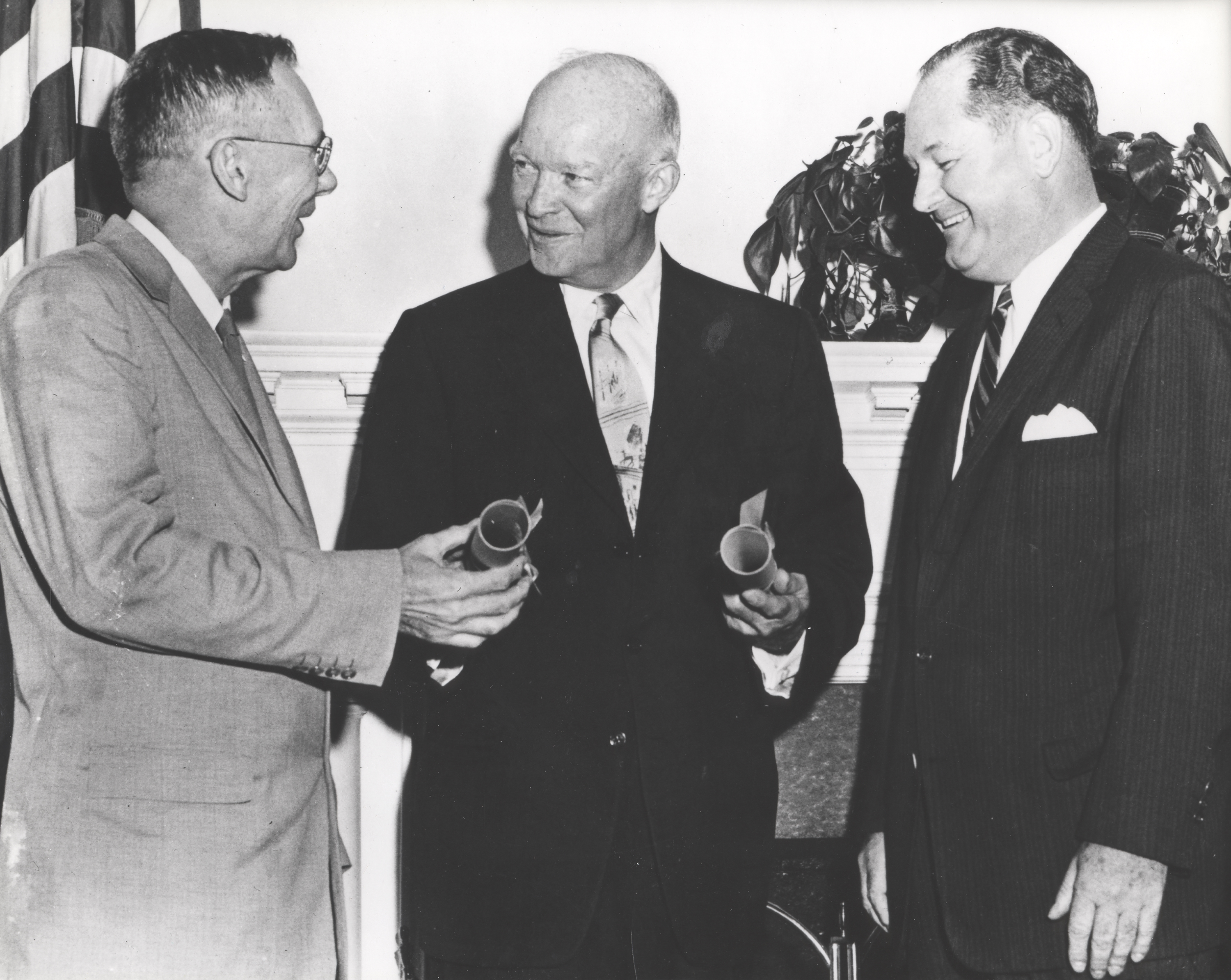
President Dwight Eisenhower with Hugh Dryden, left, and T. Keith Glennan, right, NASA’s first deputy administrator and administrator.
NASA / Marshall Space Flight Center (9248169) · NASA media-use guidelines · Original recordImage changes
Display copies resized; original preserved.
The words
Administrator
T. Keith Glennan became NASA’s first administrator, with Hugh Dryden as his deputy. They were sworn in on August 19, 1958, before the agency opened.
Aeronautics
Research into flight.
NASA inherited the National Advisory Committee for Aeronautics, or NACA, founded in 1915. Its laboratories brought decades of flight research into an organization that also took on space exploration.
Ames
The Ames Aeronautical Laboratory in Mountain View, California, was one of three large NACA laboratories transferred to NASA on October 1, 1958. The new agency inherited existing research facilities.
Civilian
Under nonmilitary government leadership.
The 1958 legislation made NASA a civilian organization overseeing nonmilitary space activities. It gave scientific space exploration a federal home distinct from the armed services.
Dryden
Hugh Dryden had directed NACA before becoming NASA’s first deputy administrator. Glennan wanted him as deputy so that the new organization would retain continuity with its predecessor.
Eisenhower
President Dwight D. Eisenhower asked Congress for a civilian space agency in April 1958. He signed the law creating NASA on July 29, following negotiations with congressional leaders.
Glennan
T. Keith Glennan was president of Case Institute of Technology in Cleveland when Eisenhower chose him to lead NASA. He took charge as the agency absorbed NACA and expanded into spaceflight.
Did you know?
NASA’s first headquarters occupied the Dolley Madison House in Washington. On opening day, Glennan addressed the headquarters staff gathered in its courtyard.
First headquarters and opening-day address · NASA: Glennan and Dryden (opens a new tab)
Goddard
On May 1, 1959, Glennan announced that the Beltsville Space Center would become Goddard Space Flight Center. Project Vanguard staff helped form its scientific and engineering core.
Killian
James R. Killian Jr. took leave from MIT to serve as Eisenhower’s science adviser after Sputnik. He chaired the President’s Science Advisory Committee during this period of space-policy debate.
Lewis
The Lewis Flight Propulsion Laboratory in Cleveland became part of NASA in October 1958. Its inclusion brought an established propulsion research laboratory into the new space agency.
Lyndon Johnson
Senate Majority Leader Lyndon B. Johnson led hearings after Sputnik and chaired a bipartisan panel to reconcile the House and Senate NASA bills. He negotiated remaining issues with Eisenhower.
Silverstein
Abe Silverstein moved from Lewis research leadership to headquarters in 1958 to help organize NASA. As Chief of Space Flight Programs, he planned satellite, probe and human space missions.
Space Act
The National Aeronautics and Space Act of 1958 created NASA when Eisenhower signed it on July 29. The agency began operating on October 1, a separate step from its legal creation.
Space Agency
NASA united civilian aeronautics and space research in a new federal organization. Its full name became the National Aeronautics and Space Administration.
Did you know?
Legislative analyst Eilene Galloway urged Congress to use Administration instead of Agency, giving the new organization broader authority to coordinate with other government bodies.
April proposal and congressional drafting · NASA: creating the civilian agency (opens a new tab)
Wallops Island
The sounding-rocket test facility at Wallops Island, Virginia, transferred from NACA to NASA on October 1, 1958. It joined the research laboratories and high-speed flight test site in the new agency.
Sources
- 65 Years Ago: Eisenhower Nominates Glennan and Dryden to Top NASA PositionsJohn Uri; NASA Johnson Space Center, August 8, 2023
- 65 Years Ago: The National Aeronautics and Space Act of 1958 Creates NASAJohn Uri; NASA Johnson Space Center, July 26, 2023
- 65 Years Ago: NASA Begins OperationsJohn Uri; NASA Johnson Space Center, October 2, 2023
- James R. Killian, Jr. (1904–1988)NASA History Division; Sputnik biographies, updated February 8, 2005
- Abe SilversteinRobert S. Arrighi; NASA Glenn Research Center, July 4, 2019
- NASA Goddard’s Beginnings in Project VanguardChristine Stevens, NASA Chief Archivist; NASA Goddard Space Flight Center, 2024