
The Space Race
Puzzle 06 · Dawn of the Space Age · Page 18 in print
Korolev and the R-7
On August 21, 1957, the R-7 flew a dummy H-bomb warhead to Kamchatka.
Jump to a word
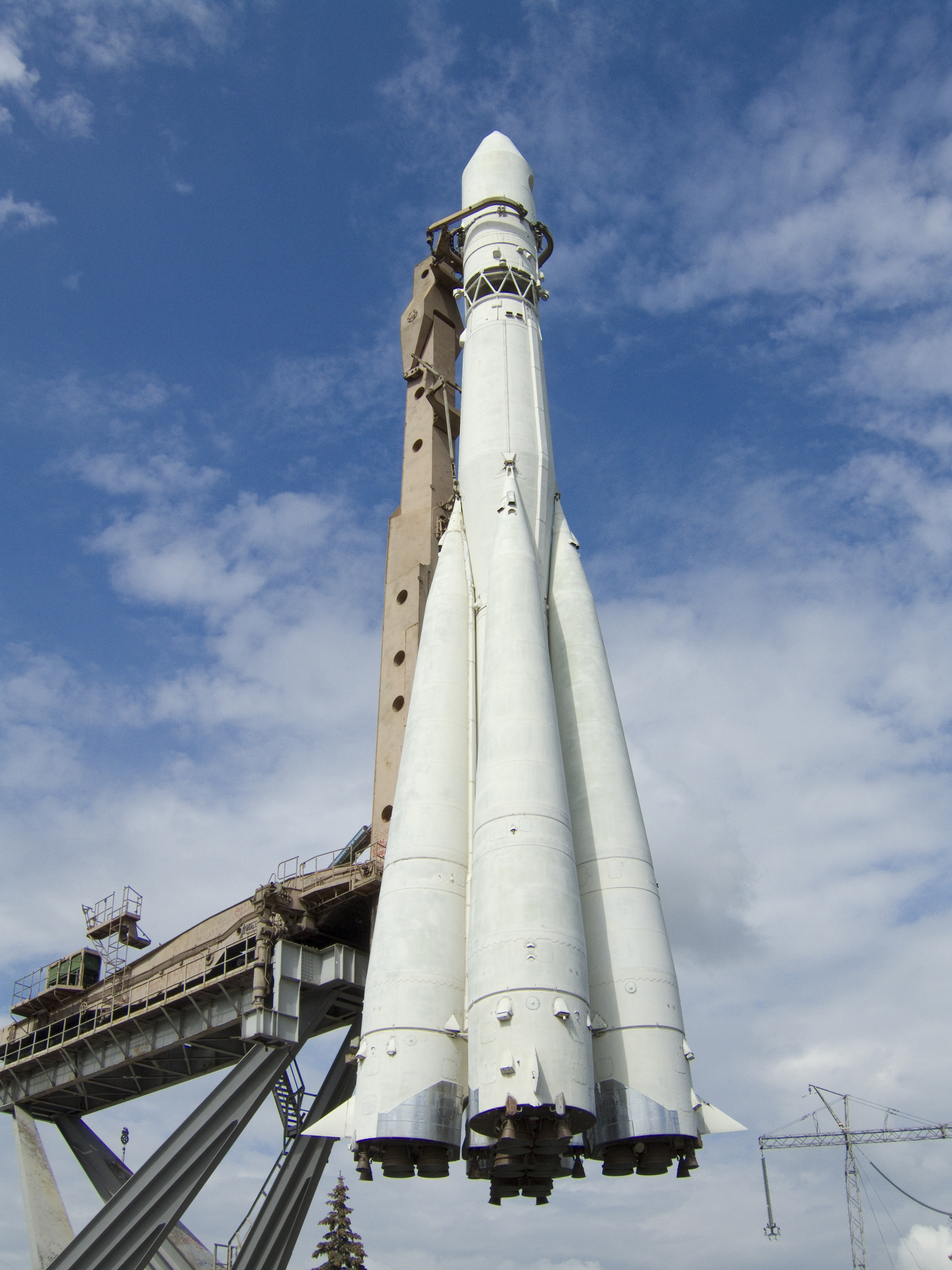
An R-7-family rocket displayed at VDNKh in Moscow in 2007.
Sergei Arssenev · CC BY-SA 4.0 · Original recordImage changes
Display copies resized; original preserved.
The words
Ballistic
Following a largely unpowered path governed mainly by gravity.
The R-7 began as a missile intended to carry a warhead toward a distant target. Its military development provided the rocket later adapted to launch Sputnik.
Harford: R-7 tests and Sputnik (opens a new tab) · NASA Glenn: meaning of ballistic (opens a new tab)
Boosters
The R-7 had four side boosters around a central core. They fired together at liftoff, giving the rocket its distinctive clustered form.
p. 108 · Siddiqi: R-7 boosters and engines (opens a new tab)
Chief Designer
Chief Designer was the public title used for Korolev while his name stayed secret. It described responsibility for rocket-space systems, distinguishing him from Glushko’s engine-design role.
Design Bureau
Korolev’s group became Experimental Design Bureau No. 1, or OKB-1. It developed military missiles before its R-7 work provided the basis for satellite launches.
Glushko
Valentin Glushko’s bureau developed the R-7’s engines. Like Korolev, he had been imprisoned during Stalin’s purges; both later held central roles in the Soviet space program.
pp. 129–130 · Siddiqi: R-7 boosters and engines (opens a new tab) · ESA: Korolev and Stalin’s purges (opens a new tab)
Kamchatka
Kamchatka was the target region for the R-7’s long-range test flight on August 21, 1957. The flight carried a dummy warhead before the rocket’s satellite-launching role began.
Kerosene
Kerosene was the R-7’s fuel, burned with liquid oxygen. This pairing powered the early satellite launcher and later members of the rocket family.
Siddiqi: Korolev and Sputnik (opens a new tab) · ESA: Semyorka and its later flight (opens a new tab)
Korolev
Sergei Korolev led Soviet work that produced the R-7 and Sputnik. During Stalin’s purges, he had been imprisoned in a labor camp and later put to work in a prison design bureau.
Launch Pad
Sputnik’s rocket was assembled in a hangar and rolled to the launch pad. The installation served a missile program that had also taken on a satellite mission.
Semyorka
A Russian nickname meaning “Little Seven.”
Semyorka was the R-7 family’s familiar nickname. The name stayed with the rocket as its role expanded from carrying a nuclear warhead to launching satellites and a human spacecraft.
Testing
Early R-7 launches failed before the successful August 1957 test. Korolev’s team then used that capability to press ahead with the first satellite launch.
Thermonuclear
Relating to a hydrogen bomb.
The R-7 was designed to carry a heavy hydrogen-bomb warhead. That military requirement gave its designers a rocket powerful enough to carry a scientific satellite instead.
Tsiolkovsky
Konstantin Tsiolkovsky was an earlier spaceflight thinker whose birth centenary fell in 1957. Korolev’s group hoped to mark the anniversary with a satellite launch, but was not ready.
Did you know?
Korolev and Glushko attended Tsiolkovsky’s centenary celebration in Moscow on September 17, 1957, while preparations for Sputnik’s launch were still unfinished.
Turbine
A turbine failure cut the R-7’s main engine off early during Sputnik 1’s launch. The satellite still separated successfully and entered orbit.
Warhead
The R-7’s original payload was intended as a weapon. The August 21, 1957 test instead carried a dummy warhead toward Kamchatka, testing the missile without a live hydrogen bomb.
Sources
- Korolev, Sputnik, and The International Geophysical YearAsif A. Siddiqi; historical essay hosted by NASA, with documentary notes
- Korolev’s Triple Play: Sputniks 1, 2, and 3James J. Harford; NASA-hosted essay adapted from Korolev: How One Man Masterminded the Soviet Drive to Beat America to the Moon, John Wiley, 1997
- Sergei Korolev: Father of the Soviet Union’s success in spaceEuropean Space Agency; historical biography, March 9, 2007
- Forty years on...European Space Agency; historical account of Gagarin’s 1961 flight and the R-7 family
- Challenge to Apollo: The Soviet Union and the Space Race, 1945–1974Asif A. Siddiqi; NASA History Division, NASA/SP-2000-4408, 2000, printed pp. 108–109 and 129–130
- Ballistic Flight CalculatorNASA Glenn Research Center; Beginner’s Guide to Aeronautics, introductory Force and Aerodynamic Drag sections