
The Space Race
Puzzle 05 · Dawn of the Space Age · Page 17 in print
Explorer 1
Launched in 1958.
Jump to a word
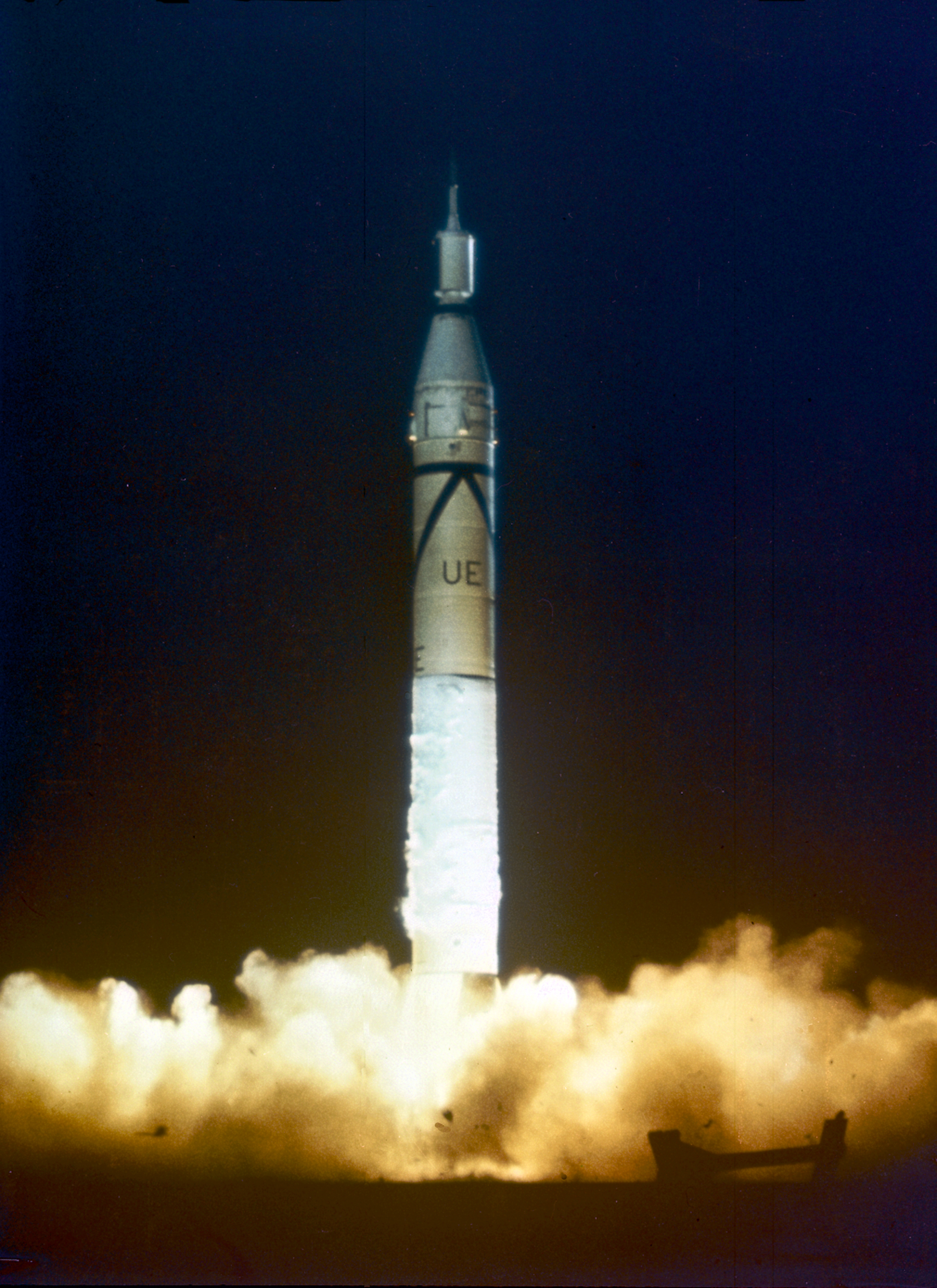
The launch carrying Explorer 1 from Cape Canaveral, Florida, on January 31, 1958.
NASA / Marshall Space Flight Center (0100074) · NASA media-use guidelines · Original recordThe words
Baby Sergeant
Baby Sergeant rockets were small solid-fuel rockets developed at JPL. They formed the upper-stage clusters of Explorer 1’s launcher, above its modified Redstone first stage.
Cosmic Rays
Energetic particles arriving from space, often beyond the solar system.
Explorer 1’s experiment was intended to measure cosmic rays above the atmosphere. Instead, its readings revealed far more radiation than that source alone could explain.
Did you know?
Before Explorer 1, researchers studied cosmic rays with instruments on the ground and carried by balloons. The satellite took those measurements above the atmosphere.
Explorer
Explorer 1 became the first U.S. satellite when it launched from Cape Canaveral on January 31, 1958. It carried scientific instruments as well as the radio equipment needed to send measurements home.
Geiger Counter
An instrument that detects and counts ionizing radiation.
Explorer 1’s Geiger counter registered unexpectedly strong radiation, followed by missing counts at higher altitude. Scientists had to explain this puzzling response while investigating the environment around Earth.
Huntsville
Huntsville, Alabama, was home to the Army Ballistic Missile Agency’s rocket team. Its launch-vehicle work combined with JPL’s satellite effort and Van Allen’s experiment to produce Explorer 1.
Juno
Juno I was the satellite-launching version of Jupiter-C. It combined a modified Redstone first stage with solid-propellant upper stages to carry Explorer 1.
Jupiter-C
Jupiter-C was the rocket design adapted for Explorer 1’s launch. The satellite-launching version, Juno I, used a modified Redstone first stage and solid-propellant upper stages.
Medaris
Major General John B. Medaris headed the Army Ballistic Missile Agency. He backed the Huntsville team’s effort to launch a satellite and pressed for a rapid response after Sputnik.
Microlock
Microlock was a ground receiving system tested near JPL before Explorer 1’s launch. Its antenna and radio equipment later helped track the satellite’s successful orbit.
Pasadena
Pasadena, California, was the home of JPL, directed by William Pickering. The laboratory joined the Army team and Van Allen’s group in preparing the Explorer 1 mission.
Payload
The equipment or cargo a launch vehicle carries.
Explorer 1’s payload included a cosmic-ray detector, temperature sensors and instruments for micrometeorites. The scientific equipment traveled with radio transmitters that sent the measurements back to Earth.
Pickering
William H. Pickering directed JPL during Explorer 1’s development. His laboratory worked with the Army’s launch-vehicle team and the University of Iowa scientists who supplied the radiation experiment.
Did you know?
At the Washington press conference after launch, Pickering, Van Allen and von Braun posed together with a model of Explorer 1.
Radiation Belt
Explorer 1’s measurements opened the investigation of energetic particles trapped near Earth. These regions became known as the Van Allen belts, after the scientist who led the radiation experiment.
Van Allen
James Van Allen led the design of Explorer 1’s radiation instruments and the study of their data. The unexpected results helped open a new field of space physics.
Von Braun
Wernher von Braun led Explorer 1’s Army rocket team. Earlier, the Nazi Party and SS member helped develop Germany’s V-2, whose production exploited concentration-camp forced labor.
NASA: Explorer 1 and its launcher (opens a new tab) · Neufeld: von Braun’s Nazi-era work (opens a new tab)
Sources
- Explorer 1NASA Science; Explorer 1 mission record, science, launch and celebration sections
- Story of Explorer 1Brian C. Odom; NASA Marshall historical account, January 19, 2018
- Studying the Van Allen Belts 60 Years After America’s First SpacecraftJessica Evans, NASA; historical space-physics article, January 31, 2018
- JPL Ground AntennaNASA/JPL-Caltech; archival image account, January 3, 2008, JPL photograph 331-2426A
- Wernher von Braun and the Nazi Rocket Program: An Interview with Michael Neufeld, PhD, of the National Air and Space MuseumJason Dawsey interviews historian Michael Neufeld; The National WWII Museum, September 10, 2019