
The Space Race
Puzzle 04 · Dawn of the Space Age · Page 16 in print
Project Vanguard
Vanguard TV-3 rose about four feet before exploding in December 1957.
Jump to a word
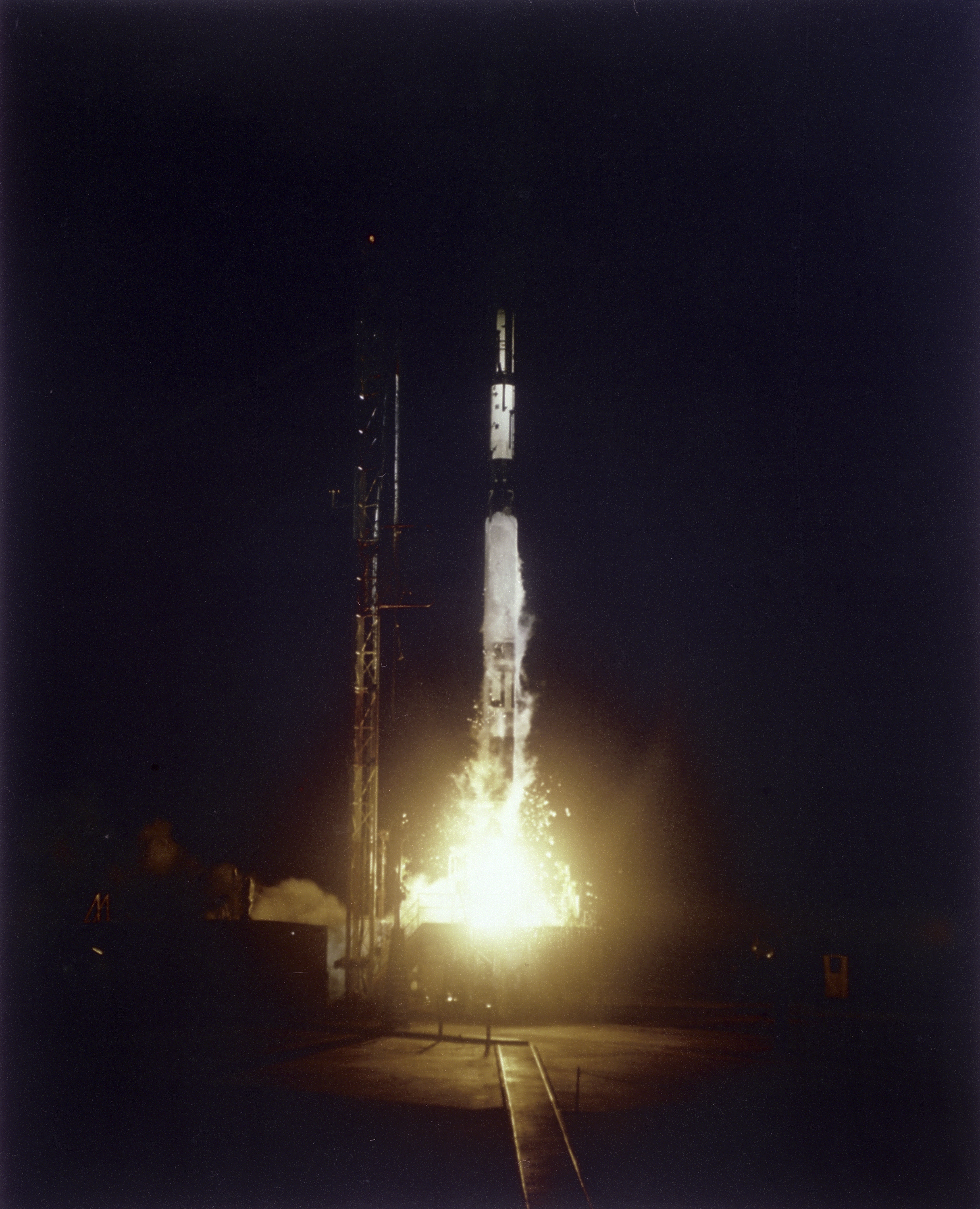
Vanguard III launches from Cape Canaveral, Florida, on September 18, 1959.
A later Project Vanguard mission, following the failed TV-3 launch described on this page.
NASA / Marshall Space Flight Center (9139356) · NASA media-use guidelines · Original recordThe words
Explosion
On December 6, 1957, TV-3 rose only a few feet before losing thrust and falling back onto the pad. The explosion ended that attempt to reach orbit.
Flopnik
Flopnik was a mocking press name for TV-3’s failure, playing on Sputnik. The nickname captured the public embarrassment surrounding an American launch attempt after the Soviet successes.
Geodesy
The science of measuring Earth’s shape and size.
Tracking Vanguard 1 helped scientists estimate Earth’s equatorial and polar diameters. Its orbit also supplied information about changes in the upper atmosphere.
p. 244 · Green and Lomask: Vanguard history (opens a new tab)
Martin Company
The Glenn L. Martin Company designed and produced Vanguard’s launch vehicle under Naval Research Laboratory supervision, building on its earlier work with Viking rockets.
p. 58 · Green and Lomask: Vanguard history (opens a new tab)
Milton Rosen
Milton Rosen was Vanguard’s technical director under John Hagen. His engineering team included specialists in propulsion, tracking and other parts of the project.
p. 62 · Green and Lomask: Vanguard history (opens a new tab)
Minitrack
Minitrack compared radio signals received by paired ground antennas. These measurements gave the satellite’s direction, helping tracking teams determine where it was along its orbit.
pp. 145–148 · Green and Lomask: Vanguard history (opens a new tab)
Pear Shape
Pear shape described the asymmetry revealed by Vanguard 1’s measurements. Tracking its orbit helped scientists learn that Earth’s figure was more complex than a perfectly symmetrical sphere.
Solar Cells
Vanguard 1 became the first solar-powered spacecraft in March 1958. Its cells turned sunlight into electricity, providing an alternative to relying entirely on batteries carried from Earth.
Did you know?
Vanguard 1 transmitted for six years, far longer than the battery-only satellites that opened the Space Age.
Stage
A stage was one propulsion section of the rocket. Vanguard combined three stages to accelerate its small scientific satellite toward the speed required for orbit.
pp. 43–44 · Green and Lomask: Vanguard history (opens a new tab)
Test Vehicle
TV-3 stood for Test Vehicle 3. It carried a satellite during the December 1957 attempt, but the rocket’s failure prevented that payload from entering orbit.
Thrust
The pushing force produced by an engine.
TV-3 lost thrust just after leaving the pad and fell back. The failure happened before its satellite could begin an orbit around Earth.
Vanguard
Project Vanguard began in 1955 as an effort to launch a scientific satellite for the International Geophysical Year. Vanguard 1 reached orbit on March 17, 1958, after Explorer 1.
Viking
Viking supplied engineering experience for Vanguard. Two research rockets already on order were redirected into the new satellite-launching test program.
p. 58 · Green and Lomask: Vanguard history (opens a new tab)
Sources
- 60 Years Ago: Vanguard Fails to Reach OrbitJohn Uri, NASA Johnson Space Center; historical article, December 6, 2017
- Vanguard: A HistoryConstance McLaughlin Green and Milton Lomask; NASA SP-4202, 1970; printed page pinpoints on each entry
- NASA Goddard’s Beginnings in Project VanguardChristine Stevens, NASA Chief Archivist; NASA Goddard Space Flight Center historical article, February 15, 2024
- How NASA Uses and Improves Solar PowerNASA Science; historical overview, Solar Power in Space section