
The Space Race
Puzzle 03 · Dawn of the Space Age · Page 15 in print
Operation Moonwatch
Moonwatch teams saw Sputnik’s carrier casing, not the small satellite.
Jump to a word
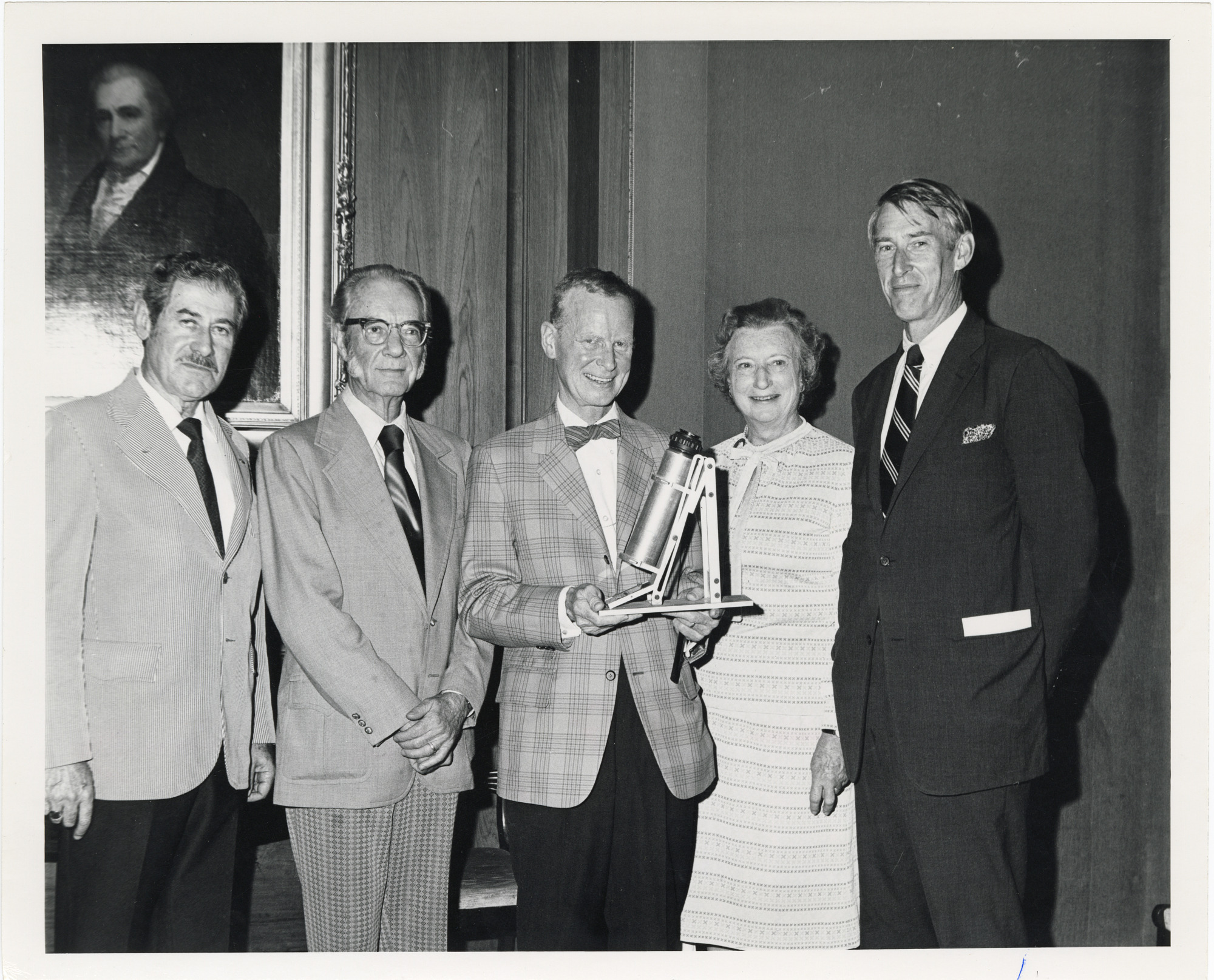
Frederick Durant holds a Moonwatch telescope at the program’s closing gathering in 1975.
Vincent P. Connolly / Smithsonian Institution Archives (75-6750-12) · No Copyright — United States · Original recordImage changes
Display copies resized; original preserved.
The words
Acquisition
Acquisition meant finding the moving satellite before precision tracking could begin. Moonwatch’s spotters helped camera stations know where to look in the sky.
Baker-Nunn
Baker-Nunn cameras photographed faint satellites for precise orbit measurements. The Smithsonian operated this professional network alongside Moonwatch stations, whose visual reports supplied additional, approximate observations.
Did you know?
Satellite tracking also helped scientists study Earth itself. The 1960 report describes work on Earth’s shape and the relative positions of the continents.
p. 65 · 1960 report: precision camera network (opens a new tab)
Binoculars
Moonwatch observers searched with binoculars and small telescopes. Their visual watching complemented a professional network that photographed satellites, rather than requiring every volunteer to operate a camera.
Cambridge
Moonwatch teams sent their preliminary observations to Cambridge, Massachusetts. The Smithsonian’s observatory gathered the reports there and circulated predictions to help guide further tracking.
Ephemeris
A table of an object’s calculated positions at particular times.
The Smithsonian issued ephemerides to Moonwatch observers while collecting their sightings. These predictions helped organize searches as observations from around the world kept track of changing orbits.
RASC: predictions and observations (opens a new tab) · NASA glossary: ephemeris (opens a new tab)
Hynek
J. Allen Hynek joined the Smithsonian in 1956 to direct its optical satellite-tracking program, including Moonwatch. He helped organize the amateur teams alongside the program’s professional work.
p. 643 · McCray: Moonwatch’s people and methods (opens a new tab)
Moonwatch
Moonwatch enlisted amateur observers to help locate artificial satellites. Their reports fed a Smithsonian system that calculated predicted orbits and directed professional cameras toward the objects.
pp. 643, 647–648 · McCray: Moonwatch’s people and methods (opens a new tab)
New Haven
New Haven’s team supplied the first verified U.S. observation in the Vanguard history’s account. Its report came on October 10, 1957.
p. 194 · Vanguard history: Sputnik sightings (opens a new tab)
Orbit Data
Orbit data came from repeated observations, rather than one glimpse of a moving light. Moonwatch reports helped astronomers keep track of satellite paths as those orbits changed over time.
Sightings
According to Whipple’s account in the Vanguard history, these early visual sightings followed Sputnik’s carrier casing. It had entered orbit alongside the much smaller satellite.
p. 194 · Vanguard history: Sputnik sightings (opens a new tab)
Smithsonian
The Smithsonian Astrophysical Observatory organized Moonwatch within its wider satellite-tracking effort. It brought amateur sky watchers into a scientific network that also employed professional observers and computing.
pp. 634, 642, 648 · McCray: Moonwatch’s people and methods (opens a new tab)
Sydney
Sydney’s Moonwatch team contributed one of the first verified reports listed in the Vanguard history. The Australian observations arrived on October 8, 1957.
p. 194 · Vanguard history: Sputnik sightings (opens a new tab)
Volunteers
Moonwatch volunteers worked in organized teams and practiced before observing satellites. They recorded timed passages and sent their reports to the Smithsonian for calculation and follow-up tracking.
Did you know?
Some Moonwatch telescopes used a mirror so observers could look down at the instrument instead of craning their necks toward the sky.
pp. 647–648 · McCray: Moonwatch’s people and methods (opens a new tab)
Whipple
Fred Whipple championed amateur participation in satellite tracking. He promoted Moonwatch beyond astronomy clubs, inviting ordinary citizens to contribute observations to the Smithsonian’s expanding scientific network.
pp. 642–643 · McCray: Moonwatch’s people and methods (opens a new tab)
Woomera
Woomera’s team reported an early sighting on October 8, 1957, alongside Sydney’s observers. The two Australian reports preceded the verified New Haven observation.
p. 194 · Vanguard history: Sputnik sightings (opens a new tab)
Sources
- Vanguard: A History — Chapter 9, The Tracking SystemsConstance McLaughlin Green and Milton Lomask; NASA SP-4202, 1970, chapter 9
- Vanguard: A HistoryConstance McLaughlin Green and Milton Lomask; NASA SP-4202, 1970, chapter 11, p. 194
- Amateur Scientists, the International Geophysical Year, and the Ambitions of Fred WhippleW. Patrick McCray; Isis 97 (2006), pp. 634–658, History of Science Society; author’s university-hosted copy
- U.S. Aeronautics and Space Activities, January 1 to December 31, 1960: Report to CongressPresident of the United States; annual report to Congress, chapter VIII, Smithsonian Astrophysical Observatory, p. 65; NASA-hosted copy
- SAO MoonwatchRoyal Astronomical Society of Canada; Encyclopedia Uranica historical archive and correspondence index
- Exoplanet Watch GlossaryNASA Science; Exoplanet Watch, Ephemeris glossary entry