
The Space Race
Puzzle 02 · Dawn of the Space Age · Page 14 in print
Laika and Sputnik 2
Laika, reportedly a terrier mix, orbited Earth aboard Sputnik 2 in 1957.
Jump to a word
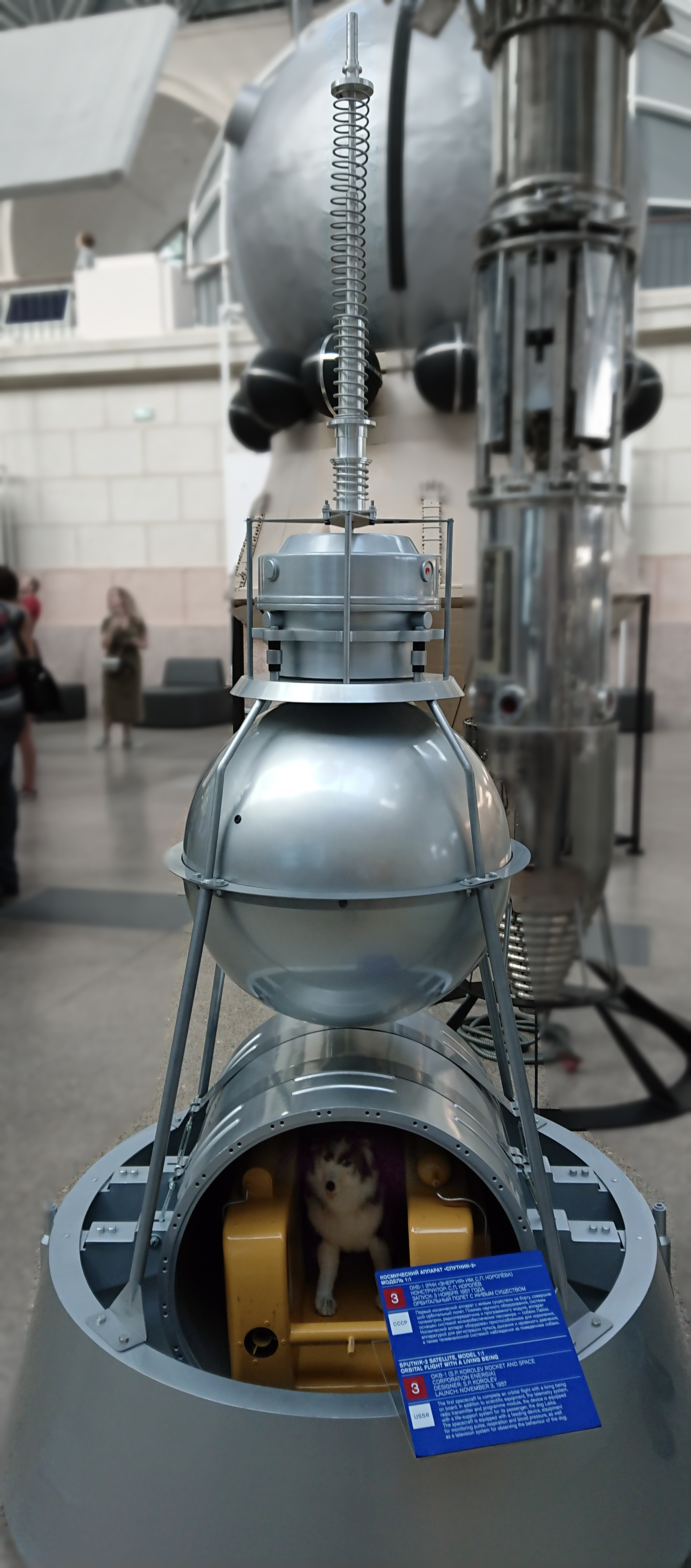
A full-size Sputnik 2 model, including a representation of Laika, at Moscow’s VDNKh exhibition.
Stanislav Kozlovskiy · CC BY-SA 4.0 · Original recordImage changes
Display copies resized; original preserved.
The words
Albina
Albina had already made two earlier flights when she became Laika’s backup. She was one of three dogs prepared for Sputnik 2, rather than a passenger on its orbital flight.
p. 173 · Siddiqi: selecting Laika’s backup (opens a new tab)
Batteries
Sputnik 2’s batteries powered its instruments after launch. They ran out on November 10, 1957, ending the return of scientific data even though the satellite remained in orbit.
Cages
The dogs were confined in progressively smaller cages to prepare them for Sputnik 2’s cramped cabin. This restricted movement was part of the conditions imposed during their training.
Cooling
Keeping the cabin cool was essential to Laika’s survival. The Science Museum’s account says that she overheated and died only hours after launch, despite supplies intended for a longer flight.
Habitat
Laika’s habitat was a pressurized cabin equipped to supply oxygen and food. Instruments measured conditions inside it and monitored her heartbeat and blood pressure during the flight.
Haste
Sputnik 2 was prepared hurriedly after Sputnik 1’s success. The short development period left no system to bring Laika back and inadequate environmental controls for a long mission.
Laika
Laika became the first animal to orbit Earth on November 3, 1957, aboard Sputnik 2. There was no way to return her safely, and she died from overheating within hours of launch.
Moscow
Moscow’s streets supplied stray dogs for the Soviet research program. Researchers selected small, healthy animals and favored light coats because they would show up more clearly in flight recordings.
Mushka
Mushka was one of the three dogs prepared for Sputnik 2. While Laika flew, Mushka was used to test the instruments and life-support equipment on the ground.
Oxygen
Oxygen was supplied by equipment inside Laika’s pressurized cabin. Providing breathable air was one task of the life-support system, alongside supplying food and monitoring the enclosed environment.
Propaganda
Sputnik 2 followed Sputnik 1 as another public demonstration of Soviet space capability. NASA’s history describes propaganda value as a reason for preparing the second satellite so quickly.
Recovery
Recovery meant bringing Laika back to Earth safely, but Sputnik 2 had no provision for that. Its designers had not developed a return system before sending her into orbit.
Stray
The program recruited dogs that had lived on Moscow’s streets. Researchers believed these mixed-breed animals were hardy; that was their selection rationale, rather than evidence that confinement caused no distress.
Terrier
Espace des sciences describes Laika as a possible husky–terrier cross. Her pedigree was unknown, so the printed term should not be read as a documented breed.
Training
Training exposed the dogs to acceleration, vibration, noise and confinement. Researchers recorded their bodily responses to these stresses while trying to identify animals that could withstand the conditions of flight.
Sources
- 60 years ago: The First Animal in OrbitJohn Uri, NASA Johnson Space Center; historical article, November 6, 2017
- Challenge to Apollo: The Soviet Union and the Space Race, 1945–1974Asif A. Siddiqi, NASA History Division; NASA/SP-2000-4408, 2000, chapter 5, p. 173
- What the dogs did: animal agency in the Soviet manned space flight programmeAmy Nelson; BJHS Themes 2 (2017), pp. 79–99, Cambridge University Press, DOI 10.1017/bjt.2017.9
- L’extraordinaire histoire de Laïka...Espace des sciences, Rennes; French-language astronomy education article
- Dogs In SpaceDoug Millard, Science Museum; museum history article, November 3, 2014