
The Space Race
Puzzle 01 · Dawn of the Space Age · Page 13 in print
Sputnik 1
Sputnik 1 reached orbit on October 4, 1957.
Jump to a word
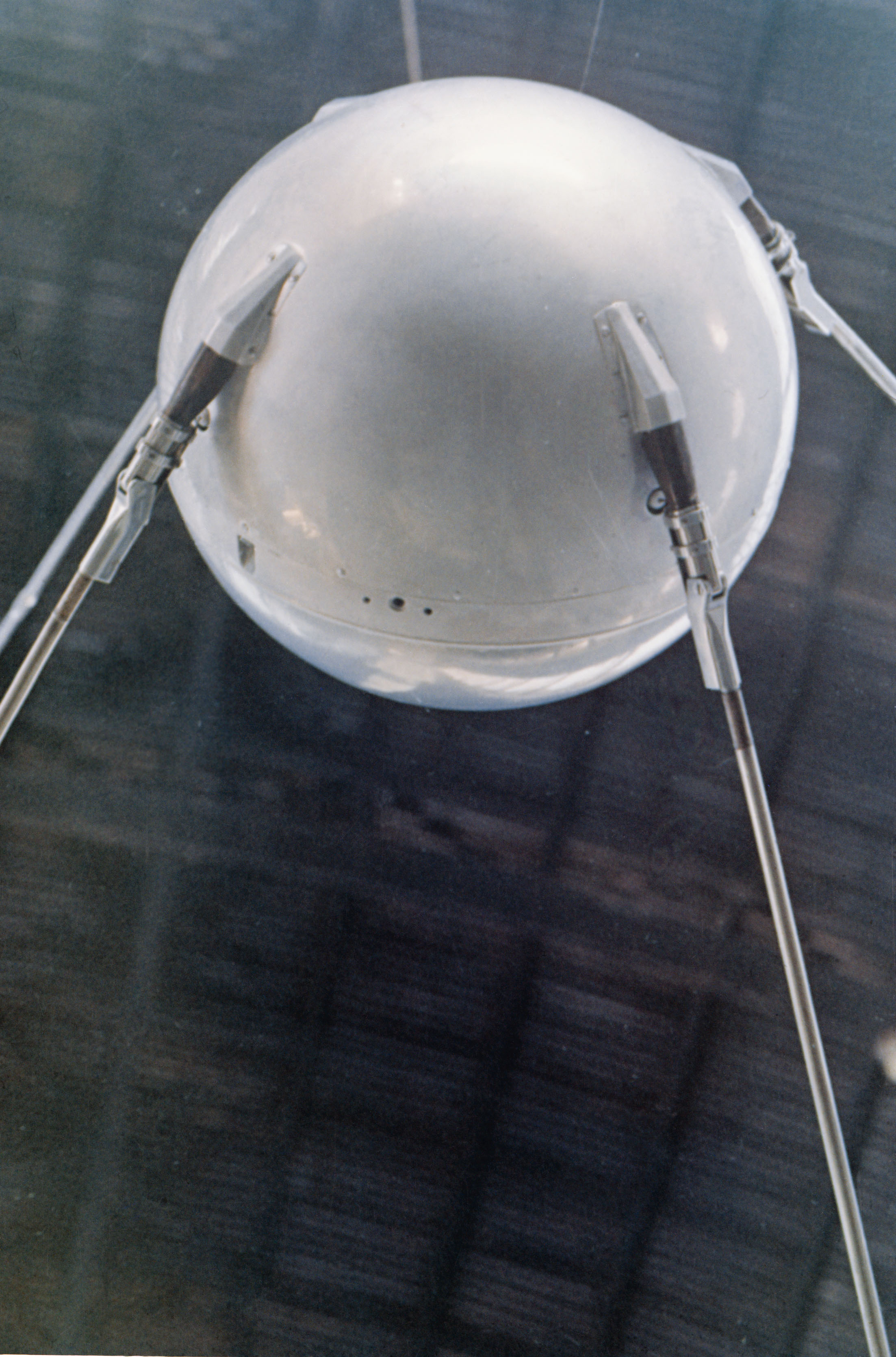
A full-scale Sputnik 1 mock-up at the Soviet Pavilion of the Paris Air Show.
This later display model shows the spacecraft’s spherical body and antennas.
NASA / Johnson Space Center (S76-22361) · NASA media-use guidelines · Original recordThe words
Antenna
Four spring-loaded rod antennas trailed behind Sputnik’s ball, two about 7.9 feet (2.4 m) long and two about 9.5 feet (2.9 m), carrying its radio signals to listeners on Earth.
Did you know?
In a 1980s interview, Korolev’s colleague Mark Gallai said no one could imagine the first sputnik as anything but “an elegant ball” with “an antenna thrown back like a galloping horse.”
Siddiqi, Korolev, Sputnik and the IGY (opens a new tab) · Launius, Origins of the Space Age (opens a new tab) · Harford, Korolev's Triple Play (opens a new tab)
Apogee
The high point of an orbit around Earth, from the Greek apo-, “away from.”
On launch night, ballistics experts in Moscow put Sputnik’s apogee at about 588 miles (947 km) above Earth.
Did you know?
That high point came out about 50 miles (80 km) lower than planned, because a turbine failure shut down the rocket’s main engine one second early.
Siddiqi, Korolev, Sputnik and the IGY (opens a new tab) · NASA Science: Supermoons (opens a new tab) · Wikipedia: Apsis (opens a new tab)
Beep
The famous “beep-beep” was Sputnik’s radio signal. The Soviet announcement described short, telegraph-style pulses, with one transmitter sending while the other paused.
Did you know?
When a station in Kamchatka reported signals, cheering broke out, but chief designer Sergei Korolev cut everyone short: “Hold off on the celebrations.” Only when the “beep-beep-beep” came in clearly did the crowd celebrate.
NASA: Pravda's Sputnik announcement (opens a new tab) · Siddiqi, Korolev, Sputnik and the IGY (opens a new tab)
Cold War
In Roger Launius’s NASA history, the Soviet announcement “changed the course of the Cold War” to a remarkable degree. State Department historians say the launch “served to intensify the arms race and raise Cold War tensions.”
Did you know?
American and Soviet scientists heard the news together at a reception in the Soviet embassy in Washington. America’s delegate to the international IGY committee, Lloyd Berkner, called for silence and said, “I wish to congratulate our Soviet colleagues on their achievement.”
Launius, Origins of the Space Age (opens a new tab) · State Dept. historians: Sputnik, 1957 (opens a new tab)
Doppler
The Doppler effect: a wave’s frequency is higher while its source approaches and lower as it moves away, like a passing siren’s pitch.
As Sputnik passed overhead, the tone of its radio signal slid from high to low. Measured carefully, that slide revealed the satellite’s speed and how close it came.
Did you know?
Two Johns Hopkins physicists, William Guier and George Weiffenbach, showed Sputnik’s whole orbit could be worked out from its Doppler shift. Run in reverse, the method became Transit, a navigation satellite system for Navy submarines, which the two later counted among the roots of GPS.
NASA Imagine the Universe: Doppler shift (opens a new tab) · Guier & Weiffenbach, Satellite Navigation (opens a new tab)
Ham Radio
Sputnik’s radio was designed with enough power “to be tracked by amateurs,” and ham radio operators around the world listened for its signal as it passed overhead.
Did you know?
Sputnik’s frequencies were no secret. They had appeared earlier in 1957 in the journal Radio, though without any details of the satellite program.
Siddiqi, Korolev, Sputnik and the IGY (opens a new tab) · Seventeen Moments: Sputnik audio (opens a new tab) · NASA: Sputnik ushers in the Space Age (opens a new tab)
Missile Gap
Sputnik rode into orbit on the R-7, built as an intercontinental ballistic missile. Fear of a “missile gap” between U.S. and Soviet nuclear arsenals followed, and campaigners exploited it in the 1960 presidential election, State Department historians say.
Did you know?
The CIA’s own account says U.S. intelligence made “wild overestimates” of Soviet missile production. Within months of the first fully successful CORONA spy-satellite mission, on August 18, 1960, CIA photo interpreters found the Soviets “significantly behind the US” in building a workable intercontinental missile.
NASA: Sputnik ushers in the Space Age (opens a new tab) · Harford, Korolev's Triple Play (opens a new tab) · State Dept. historians: Sputnik, 1957 (opens a new tab) · CIA: the CORONA satellite program (opens a new tab)
Perigee
The low point of an orbit around Earth, from the Greek peri-, “near.”
Sputnik’s perigee was first put at about 142 miles (228 km). The satellite slowly lost height and, after more than 1,400 orbits, fell back into the atmosphere on January 4, 1958.
Did you know?
Its fall was part of the plan. One of Sputnik’s five scientific aims was to learn about the atmosphere’s density by calculating how long the satellite stayed in orbit.
Siddiqi, Korolev, Sputnik and the IGY (opens a new tab) · NASA Science: Supermoons (opens a new tab) · Wikipedia: Apsis (opens a new tab) · NASA: Sputnik ushers in the Space Age (opens a new tab) · Harford, Korolev's Triple Play (opens a new tab)
Pravda
Pravda (“Truth”), the official newspaper of the Soviet Communist Party, printed the TASS news agency’s announcement of the launch on October 5, 1957.
Did you know?
Pravda’s first report sat partway down a right-hand column on page one, under the routine heading “Tass Report.” The next day, a headline across the top hailed the “World’s First Artificial Satellite of Earth Created in Soviet Nation.”
NASA: Pravda's Sputnik announcement (opens a new tab) · Britannica: Pravda (opens a new tab) · Wikipedia: Pravda (opens a new tab) · Harford, Korolev's Triple Play (opens a new tab) · Siddiqi, Korolev, Sputnik and the IGY (opens a new tab)
Satellite
Sputnik 1 was the world’s first artificial satellite. About five and a half minutes after liftoff, it separated from the rocket’s core stage and began circling Earth.
Did you know?
The next morning, The New York Times ran a rare three-line headline across its whole front page: “SOVIET FIRES EARTH SATELLITE INTO SPACE; IT IS CIRCLING THE GLOBE AT 18,000 M.P.H.; SPHERE TRACKED IN 4 CROSSINGS OVER U.S.”
NASA: Sputnik ushers in the Space Age (opens a new tab) · Siddiqi, Korolev, Sputnik and the IGY (opens a new tab) · Harford, Korolev's Triple Play (opens a new tab)
Sphere
Most senior designers wanted a cone to fit the rocket’s nose, but chief designer Sergei Korolev chose a ball. Sputnik became a polished aluminum-alloy sphere about 23 inches (58 cm) across, filled with nitrogen.
Did you know?
Korolev had the sphere polished until it shone, partly because the radio engineers feared overheating and wanted it to reflect sunlight. Angry at a poorly finished mockup, he shouted, “This ball will be exhibited in museums!”
Siddiqi, Korolev, Sputnik and the IGY (opens a new tab) · Harford, Korolev's Triple Play (opens a new tab)
Sputnik
Russian for “satellite,” often loosely translated as “fellow traveler.”
Soviet news reports gave the satellite no special name, simply calling it Sputnik. Its builders knew it as PS-1, officially “Simple Satellite No. 1.”
Did you know?
Roger Launius writes in a NASA history that two phrases entered American speech almost at once to mark time: “pre-Sputnik” and “post-Sputnik.” Another soon followed: “Space Age.”
Siddiqi, Korolev, Sputnik and the IGY (opens a new tab) · NASA: Pravda's Sputnik announcement (opens a new tab) · Launius, Origins of the Space Age (opens a new tab)
Tikhonravov
Mikhail Tikhonravov, Sergei Korolev’s friend from 1930s amateur rocketry, wrote the 1954 “Report on an Artificial Satellite of the Earth.” Korolev sent it to the government six days after the R-7 missile was ordered.
Did you know?
Sputnik 1 was the fallback. The satellite first approved, Object D, was a laboratory of 2,200 to 3,100 pounds (1,000 to 1,400 kg). When it fell behind, Tikhonravov asked, “What if we make the satellite a little lighter?” Object D later flew as Sputnik 3.
Siddiqi, Korolev, Sputnik and the IGY (opens a new tab) · NASA: Tikhonravov biography (opens a new tab) · Harford, Korolev's Triple Play (opens a new tab)
Transmitter
Two radio transmitters inside the sphere sent Sputnik’s signals on 20.005 and 40.002 megacycles. The radios were also meant to yield data on how radio waves travel through the atmosphere.
Did you know?
More than half of Sputnik’s weight was its power supply: 112 pounds (51 kg) of silver-zinc batteries. They ran down on October 26, 1957, and the satellite fell silent.
Siddiqi, Korolev, Sputnik and the IGY (opens a new tab) · NASA: Sputnik ushers in the Space Age (opens a new tab) · Harford, Korolev's Triple Play (opens a new tab)
Tyuratam
A railway station and village in Kazakhstan, also spelled Tyura-Tam, near the launch range better known as the Baikonur Cosmodrome.
Sputnik 1 lifted off from the secret Soviet rocket-testing range in the desert near Tyuratam, in what was then the Kazakh Soviet republic.
Did you know?
At a 1975 Apollo-Soyuz press conference, ABC’s Jules Bergman broke in: “I’m going to call it Tyuratam.” Tom Stafford called Tyuratam “a little bitty old city,” and Deke Slayton said the name the Soviets commonly used was Baikonur.
Launius, Origins of the Space Age (opens a new tab) · ESA: Baikonur Cosmodrome (opens a new tab) · NASA SP-4209, The Partnership, ch. 9 (opens a new tab) · Siddiqi, Korolev, Sputnik and the IGY (opens a new tab)
Sources
- Sputnik and the Origins of the Space AgeNASA History Office
- 65 Years Ago: Sputnik Ushers in the Space AgeNASA, Johnson Space Center
- Korolev, Sputnik, and The International Geophysical YearNASA History Office
- Korolev's Triple Play: Sputniks 1, 2, and 3NASA History Office
- Announcement of the First Satellite, from Pravda, October 5, 1957NASA History Office
- Mikhail K. Tikhonravov (1901-1974)NASA History Office
- Baikonur CosmodromeEuropean Space Agency
- The Partnership (NASA SP-4209), ch. 9: Final Round of Crew TrainingNASA History Office (Internet Archive copy)
- Doppler ShiftNASA Goddard Space Flight Center, Imagine the Universe!
- Genesis of Satellite NavigationJohns Hopkins APL Technical Digest
- Launch of Sputnik AudioSeventeen Moments in Soviet History, Michigan State University
- Sputnik, 1957Office of the Historian, U.S. Department of State
- CORONA: America's First Imaging Satellite ProgramCentral Intelligence Agency
- SupermoonsNASA Science
- ApsisWikipedia
- PravdaWikipedia
- PravdaEncyclopaedia Britannica