
The Space Race
Puzzle 73 · Stations and Handshakes · Page 103 in print
Salyut 1 and Soyuz 11
The first space station crew, Dobrovolski, Volkov and Patsayev, grew cabbage and onions.
Jump to a word
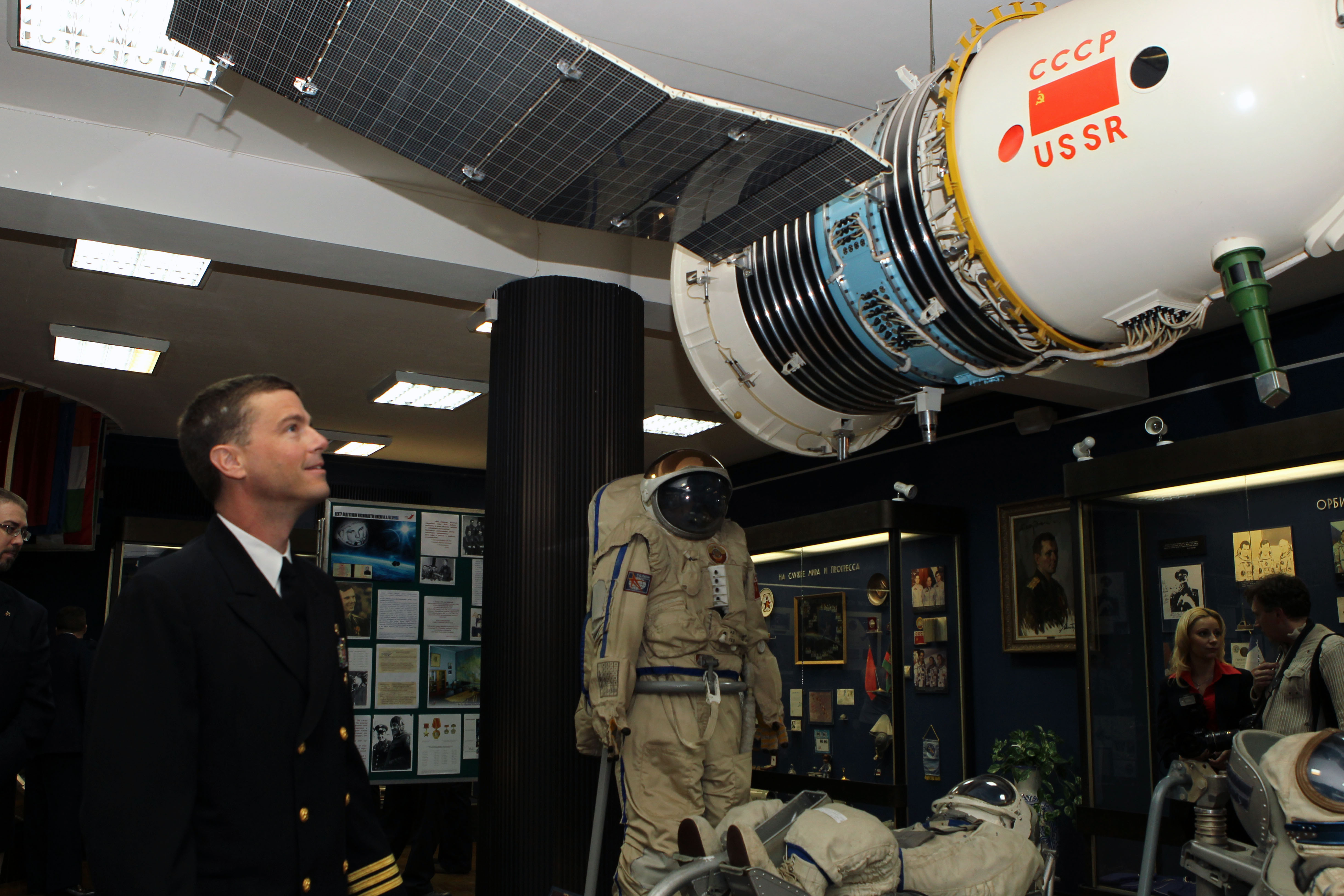
Reid Wiseman examines a Salyut space-station model at the Gagarin Museum in 2014.
A later museum view of the Salyut program; this is not Salyut 1 in orbit.
NASA / Stephanie Stoll (jsc2014e042126) · NASA media-use guidelines · Original recordImage changes
Display copies resized; original preserved.
The words
Ballots
The Soyuz 11 crew cast ballots in Soviet elections while aboard Salyut 1. NASA identifies them as the first people to vote from space.
Cabbage
Chinese cabbage grew alongside onions in Salyut 1’s Oazis-1 plant-growth facility. The crew grew these plants as part of the biology research during the first occupied space-station mission.
Dobrovolski
Georgi Dobrovolski commanded Soyuz 11 on his first spaceflight. He led the first crew to occupy Salyut 1 and died with his crewmates when their return capsule depressurized.
Kolodin
Pyotr Kolodin trained with Leonov and Kubasov for Soyuz 11. After doctors grounded Kubasov over a suspected lung illness, managers replaced the entire crew with their backups.
Kremlin Wall
After Dobrovolski, Volkov and Patsayev died in Soyuz 11’s depressurization, the Soviet Union held a state funeral in Moscow. Their ashes were interred in the Kremlin Wall.
Onions
Onions were another crop grown in Oazis-1 aboard Salyut 1. Their cultivation formed part of the station’s biology work while the cosmonauts also conducted observations and medical experiments.
Did you know?
Patsayev celebrated his 38th birthday on June 19, 1971. His crewmates presented him with an onion and a lemon that Volkov had smuggled aboard their spacecraft.
Patsayev
Viktor Patsayev flew as Soyuz 11’s test engineer on his first spaceflight. He was the first crew member to enter Salyut 1 and later died in the capsule’s depressurization.
Penguin Suit
The Penguin garment used sewn-in elastic bands to place a steady load on the cosmonauts’ muscles. It formed part of Salyut’s effort to counter the effects of prolonged weightlessness.
Pressure Suits
Soyuz 11’s crew wore no pressure suits. They died when their cabin depressurized; afterward, Sokol suits became required for Soyuz launches and landings.
NASA: the Soyuz 11 crew and station work (opens a new tab) · NASA: Salyut’s launch and first crews (opens a new tab)
Salyut
Salyut 1 reached orbit in April 1971 as the world’s first space station. Its living quarters and scientific equipment gave a visiting crew a laboratory for an extended stay.
Did you know?
The station had first been named Zarya. Managers changed it to Salyut before launch, but the earlier name had already been painted on the module.
Shatalov
Vladimir Shatalov guided Soyuz 10 to Salyut in April 1971. The docking connection could not be completed, preventing his crew from entering the station for its planned stay.
Soyuz Eleven
Soyuz 11 carried Dobrovolski, Volkov and Patsayev to Salyut 1 for its first occupation. All three died when their return capsule lost pressure before reaching Earth.
Soyuz Ten
Soyuz 10 reached Salyut before Soyuz 11, but failed to achieve a firm docking connection. Its crew remained aboard Soyuz and returned to Earth without entering the station.
Volkov
Vladislav Volkov served as Soyuz 11’s flight engineer. Unlike his two crewmates, he had flown in space before, in 1969; all three died when their capsule depressurized on return.
Yantar
Russian for amber.
Yantar was the crew’s radio call sign. Chertok’s account records Yeliseyev addressing Yantar during the approach to Salyut, while using Zarya for ground control.
Sources
- 50 Years Ago: Remembering the Crew of Soyuz 11John Uri; NASA Johnson Space Center; June 30, 2021; experiments, election, birthday, lack of pressure suits and funeral
- 50 Years Ago: Launch of Salyut, the World’s First Space StationJohn Uri; NASA Johnson Space Center; April 19, 2021; first station, Soyuz 10 docking, Penguin garments and post-accident Sokol suits
- Challenge to Apollo: The Soviet Union and the Space Race, 1945–1974Asif A. Siddiqi; NASA/SP-2000-4408; 2000; part 2 PDF; printed pp. 776–777 and 781–783 / PDF pp. 277–278 and 282–284; crew replacement, roles and fatal depressurization
- Rockets and People, Volume IV: The Moon RaceBoris Chertok; Asif Siddiqi, series editor; NASA SP-2011-4110; 2011; The Hot Summer of 1971, printed p. 371 / PDF p. 416, radio exchange and footnote 22