
The Space Race
Puzzle 74 · Stations and Handshakes · Page 104 in print
Saving Skylab
Jack Kinzler’s Mylar parasol, pushed out through an eight-inch port, cooled Skylab.
Jump to a word
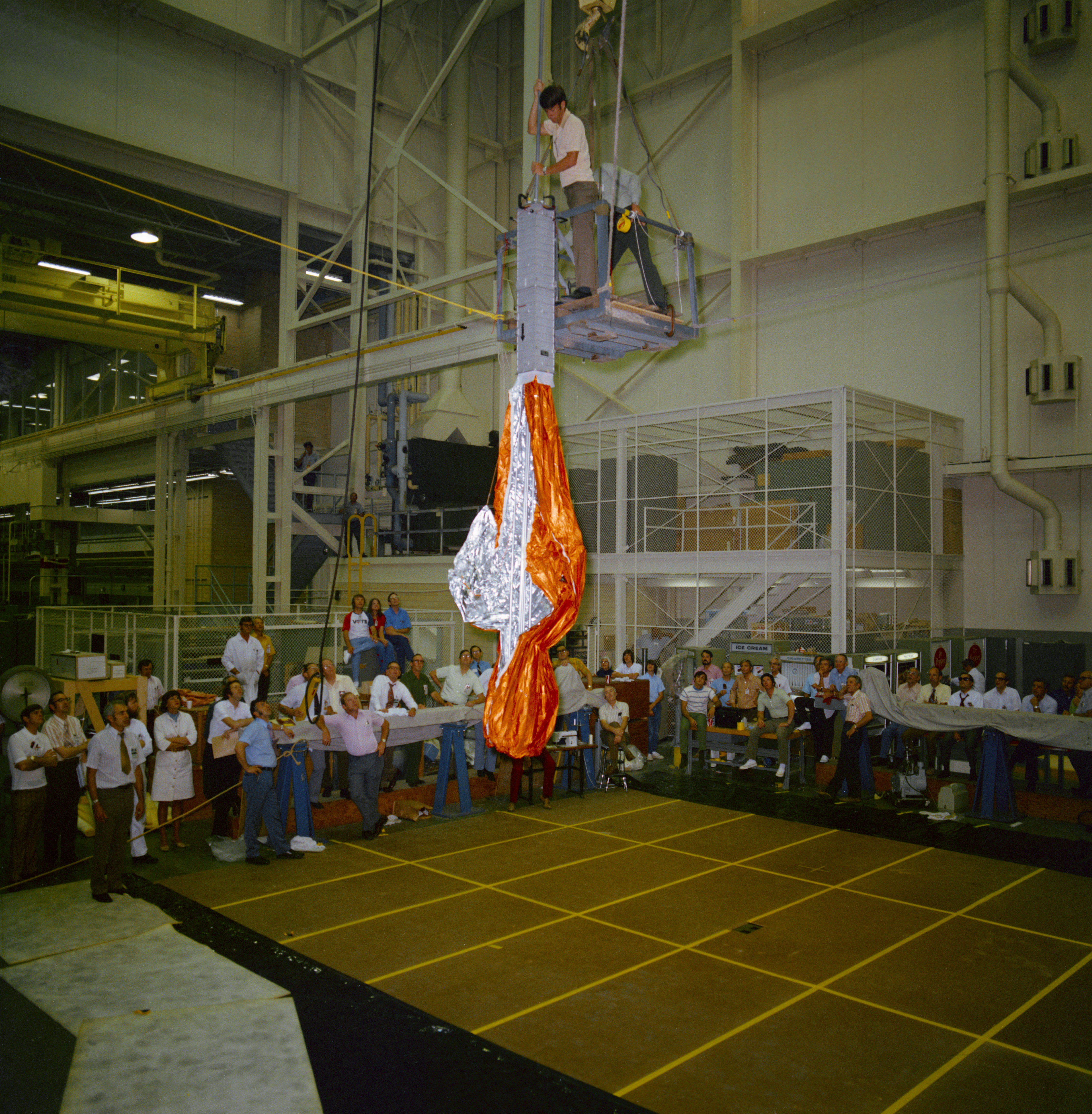
The Skylab parasol sunshade being tested on the ground before flight.
NASA / Johnson Space Center (s73-26401) · NASA media-use guidelines · Original recordThe words
Cable Cutter
On June 7, Conrad and Kerwin used a cable cutter to sever the metal strap pinning Skylab’s solar wing. Cutting the strap released the obstruction, though the wing still needed help opening.
Gas Masks
The astronauts wore gas masks when they first entered Skylab because heating might have released toxic gases from insulation. Kerwin later tested the workshop air and found no sign of the suspected gas.
Jack Kinzler
Jack Kinzler proposed an umbrella-like parasol to shade Skylab’s damaged workshop. His team’s design could pass through an instrument port and be deployed from inside.
Kerwin
Joseph Kerwin was a physician and Skylab 2’s science pilot. He also joined Conrad in the June 7 spacewalk, helping free the solar array that the station needed for power.
NASA: Joseph Kerwin’s medical and flight work (opens a new tab)
Mylar
Mylar joined nylon and aluminum in the parasol’s fabric. The layered material formed the broad cover intended to protect the workshop from direct sunlight after its original shield was lost.
Overheating
Skylab lost its protective shield during launch, exposing the workshop to solar heating. High temperatures threatened equipment, food and film, making a replacement shade essential before the crew could live aboard.
Parasol
Folded like an umbrella, the parasol passed through Skylab’s small scientific airlock. Once extended outside the workshop, its fabric shaded the damaged area facing the Sun and helped cool the interior.
Saturn V
On May 14, 1973, the final Saturn V launched Skylab. During ascent, the station lost its protective shield and suffered damage to its workshop’s solar wings.
Did you know?
Skylab’s orbital workshop was built from a modified Saturn S-IVB stage. A large protective fairing covered its docking adaptor, telescope mount and airlock during launch.
Shepherd's Hook
Weitz tried to pull the jammed solar wing free with a shepherd’s hook while standing in the Apollo hatch. The attempt failed, leaving the obstruction for the later repair spacewalk.
Skylab Two
Skylab 2 carried Conrad, Kerwin and Weitz on the station’s first crewed mission. Their repairs made the laboratory usable, allowing them to complete a month-long flight devoted to scientific research.
Solar Wing
Freeing the solar wing restored power that Skylab’s experiments needed. After the strap was cut, Conrad and Kerwin also overcame a stuck hinge so the array could open fully and generate electricity.
Ticonderoga
USS Ticonderoga was the aircraft carrier that recovered Skylab 2 after its June 22, 1973 splashdown. Navy personnel lifted the command module aboard before Conrad, Weitz and Kerwin emerged.
Did you know?
The mission’s medical research continued aboard the recovery ship. In Skylab’s Mobile Laboratory, measurements tracked how the astronauts readapted to conditions on Earth after their flight.
Twin Pole
Skylab’s second crew installed the twin-pole sunshade on August 6, 1973. Garriott and Lousma spread it over the earlier parasol, providing more lasting shade for the damaged workshop.
Did you know?
The second crew found the new shade already aboard Skylab. The first crew had carried it into space, leaving it for the later installation.
Water Tank
At Marshall Space Flight Center, astronauts rehearsed repair work in the Neutral Buoyancy Simulator. The large water tank let ground teams test tool handling and spacewalk movements before the crew attempted the repair in orbit.
Weitz
Paul Weitz was Skylab 2’s pilot. He made the first attempt to free the damaged solar wing from the Apollo hatch and later helped activate the station for research.
Sources
- Saving SkylabBob Craddock; Smithsonian National Air and Space Museum; May 12, 2023; launch damage, Kinzler’s parasol, layered fabric and modified Saturn stage
- 50 Years Ago: Skylab 2, The “We Fix Anything” CrewJohn Uri; NASA Johnson Space Center; May 25, 2023; first crew, masks, Weitz’s hook attempt and underwater rehearsals; read in browser October 25, 2026
- 50 Years Ago: Second Skylab Crew Begins Record-Breaking MissionNASA Johnson Space Center; July 31, 2023; twin-pole sunshade, prior delivery and August 6 spacewalk; read in browser October 25, 2026
- Skylab 2: Mission Accomplished!NASA; June 22, 2018; first mission, June 22 recovery and mobile medical laboratory; read in browser October 25, 2026
- Skylab 2: First Repair SpacewalkJohn Uri; NASA Johnson Space Center; June 6, 2018; June 7 cable-cutter and solar-wing repair; read in browser October 25, 2026
- Joseph P. Kerwin, M.D.NASA; medical background, science-pilot role and June 7 solar-array repair caption; read in browser October 25, 2026