
The Space Race
Puzzle 72 · Exploring the Moon · Page 100 in print
Moon Rocks
Apollo 14’s Big Bertha rock may hold a small sliver of ancient Earth.
Jump to a word
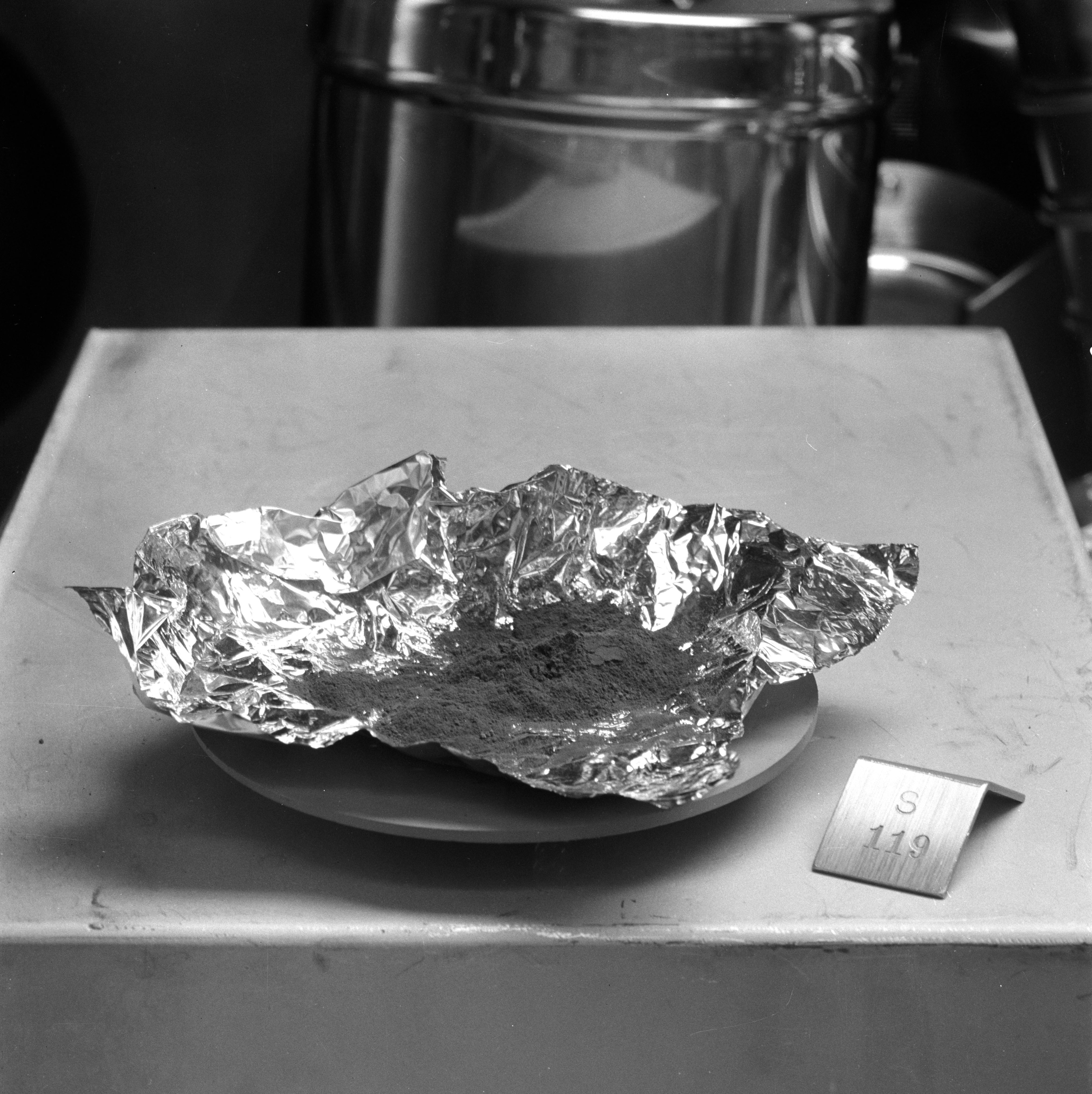
Fine lunar material under examination in the Lunar Receiving Laboratory.
NASA / Johnson Space Center (S71-19269) · NASA media-use guidelines · Original recordThe words
Anorthosite
A rock made chiefly of feldspar crystals.
Light-colored anorthosite helped scientists reconstruct the Moon’s early crust. NASA describes this rock crystallizing from molten material and floating upward, leaving evidence of an ancient ocean of magma.
NASA: lunar rock types (opens a new tab) · NASA: how lunar rocks inform Moon origins (opens a new tab)
Big Bertha
Big Bertha was Apollo 14 sample 14321, collected near Cone Crater. NASA’s 2021 account described one embedded fragment as possible ancient Earth material carried to the Moon by an impact.
NASA: sample 14321, Big Bertha (opens a new tab) · NASA: a possible Earth fragment (opens a new tab)
Big Muley
Big Muley was sample 61016, the largest individual rock returned by the Apollo astronauts. NASA compared its size with an American football, giving readers a familiar sense of its scale.
Breccia
A rock assembled from fragments of earlier rocks.
Meteorite impacts broke lunar rocks apart and welded fragments into new rocks. Apollo breccias preserved those collisions within their mixed pieces, rather than recording only a single episode of cooling.
Did you know?
Big Bertha contained fragments of smaller breccias within the larger rock. Its mixed pieces gave researchers a record of earlier rocks incorporated into a later one.
NASA: lunar rock types (opens a new tab) · NASA: sample 14321, Big Bertha (opens a new tab)
Curator
NASA’s sample-curation staff preserved lunar material together with its records. They prepared portions for approved research and education, keeping returned research material separate from samples maintained in pristine condition.
Giant Impact
The giant-impact theory linked the Moon’s origin to a collision with the young Earth. Apollo sample chemistry and evidence of early melting helped scientists investigate how that collision might have formed the Moon.
Glovebox
Lunar samples were handled inside stainless-steel glove cabinets filled with high-purity nitrogen. Built-in gloves separated human hands from the material, helping preserve the samples for scientific work.
Goodwill Rocks
In March 1973, President Nixon directed that fragments of Apollo 17 sample 70017 be distributed as goodwill gifts. The recipients included U.S. states and territories and foreign heads of state.
Lunar Samples
The six Apollo landing missions returned rocks, soil, pebbles and core samples from different lunar sites. Studying that material on Earth gave scientists evidence about the Moon’s crust, impacts and volcanic history.
Magma Ocean
The young Moon was thought to have had a deep layer of molten rock. Anorthosite and other sample evidence helped scientists reconstruct how this magma ocean cooled and formed an early crust.
Rake
The lunar rake separated pebbles from finer soil. Apollo 17’s geology tools also included scoops for gathering soil and tongs for picking up individual rocks, giving the crew different ways to collect samples.
Did you know?
Extension handles attached to the geology tools let astronauts reach the ground while standing. They could collect samples without having to bend all the way down.
Touch Rock
The Smithsonian’s lunar touchrock was cut from a basalt collected during Apollo 17. Prepared as a public exhibit, the slice let visitors feel a piece of material brought back from the Moon.
Did you know?
The museum’s touchable Moon-rock exhibit opened in 1976. Its small slice came from the largest rock that the Apollo 17 crew brought home.
Vesicles
Hollows left by gas bubbles in rock as it solidifies.
Apollo 17 sample 76015 contained vesicles formed when gas bubbles were trapped in molten rock after an impact. Its cavities recorded that melting history, unlike the tiny impact scars on its surface.
Lunar Surface Journal: holes in Moon rocks (opens a new tab)
Volcanic Glass
Apollo 17’s orange soil near Shorty Crater contained particles of volcanic glass. Laboratory examination on Earth identified the glass that gave the collected soil its distinctive orange color.
Zap Pits
Tiny particles striking exposed lunar rocks blasted small craters called zap pits into their surfaces. On sample 76015, pale areas around these pits marked rock shattered by the impacts.
Lunar Surface Journal: holes in Moon rocks (opens a new tab)
Sources
- Lunar Rocks and Soils from Apollo MissionsNASA Astromaterials Acquisition and Curation Office; Apollo collection and sample-study paragraphs; accessed October 25, 2026
- Lunar Sample Disk Information & Search ResultsNASA ARES; Lunar Sample Disks material descriptions; accessed October 25, 2026
- 14321: Clast-rich, Crystalline Matrix BrecciaCharles Meyer; Lunar Sample Compendium; 2009; PDF p. 1, introduction and breccia clasts; relocated Apollo Lunar Surface Journal host
- The lunar football!NASA; February 3, 2017; complete sample 61016 description
- Lunar Sample Laboratory FacilityNASA Astromaterials Acquisition and Curation Office; preservation, records, research distribution and glove cabinets; accessed October 25, 2026
- 50 Years Ago: Apollo 17 Post Mission ActivitiesJohn Uri; NASA Johnson Space Center; January 4, 2023; March 1973 distribution of sample 70017
- Spacewalking ToolsNASA; Print your own 3D Apollo 17 Geology Tools, Rake, Extension Handle, Scoop and Tongs descriptions; accessed October 25, 2026
- The Long Journey of our Lunar TouchrockSmithsonian National Air and Space Museum; June 16, 2016; basalt slice, Apollo 17 collection and 1976 exhibit opening
- Apollo 17 Sample 76015, 143Ulrich Lotzmann and Eric Jones; Apollo Lunar Surface Journal; opening surface description, vesicles and zap pits; revised May 5, 2025; accessed October 25, 2026
- Close-up color image of the orange soil at Shorty Crater on the MoonNASA Space Science Data Coordinated Archive; Apollo 17 image AS17-137-20990, December 12, 1972; laboratory identification of orange glass; accessed October 25, 2026
- Found on the Moon: Candidate for Oldest Known Earth RockRobert Nemiroff and Jerry Bonnell; NASA Astronomy Picture of the Day; February 3, 2021; explanation of candidate terrestrial fragment in 14321
- Moon FormationNASA Science; How did the Moon form?, Written in Stone and Lunar Archaeology; accessed October 25, 2026