
The Space Race
Puzzle 71 · Exploring the Moon · Page 99 in print
The Lunar Rover
General Motors made the rover’s wheels, their tires woven from piano wire.
Jump to a word
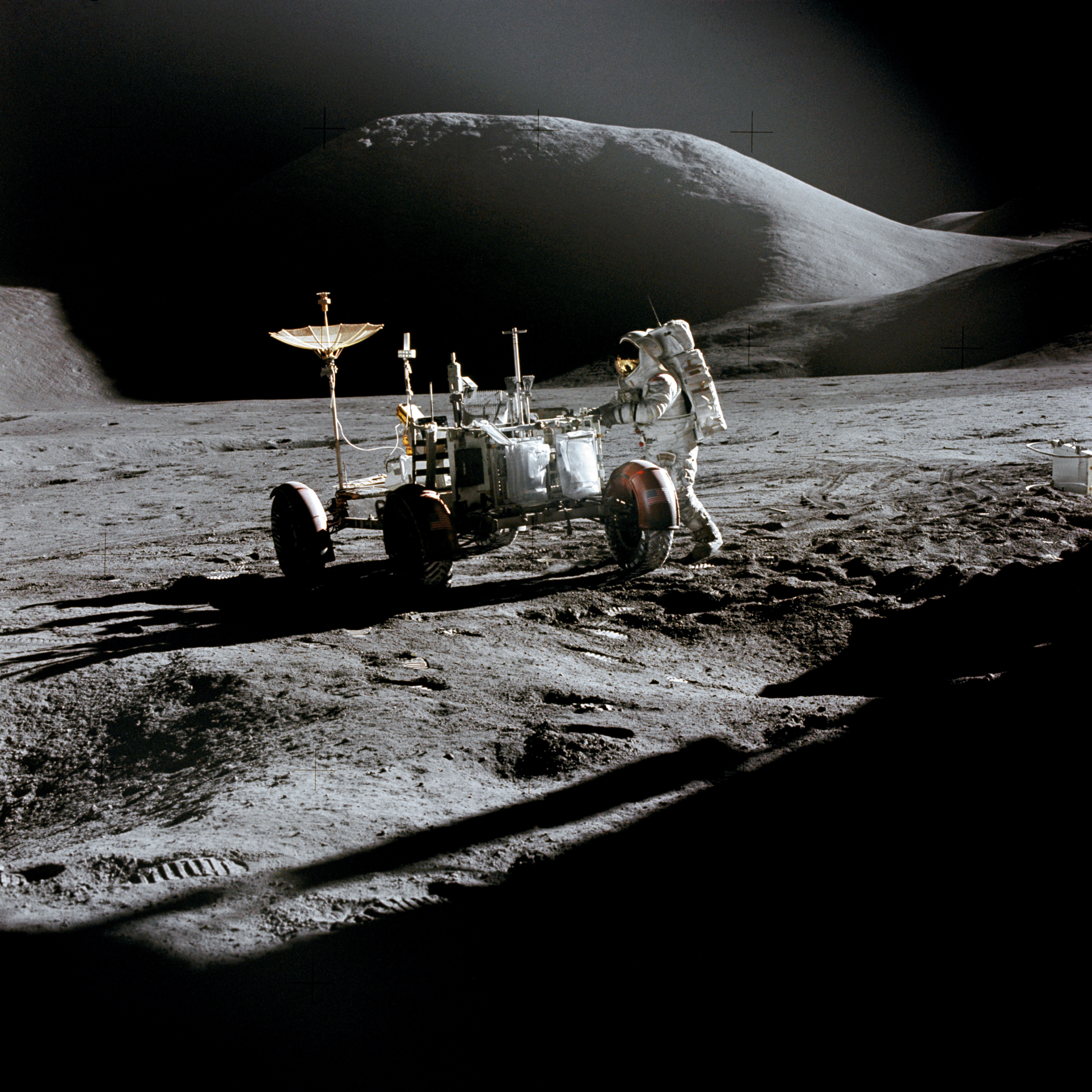
James Irwin works at the lunar rover during Apollo 15.
NASA / Johnson Space Center (as15-86-11603) · NASA media-use guidelines · Original recordThe words
Chassis
The rover’s chassis was a hinged aluminum frame. Its three sections folded for storage against the lunar module, then opened to support the astronauts, equipment and wheels.
Dead Reckoning
Estimating position from direction and distance traveled.
The rover’s computer combined wheel-travel measurements with heading information. Its display showed the astronauts their estimated direction and distance back to the lunar module.
Did you know?
Young and Duke favored a simple display showing the way back to the lander. Their suggestion replaced a more complex plan to display map coordinates.
NASA: the rover’s structure and systems (opens a new tab) · Lunar Surface Journal: rover navigation (opens a new tab)
Ferenc Pavlics
Ferenc Pavlics belonged to General Motors’ rover development team. NASA’s history of the wheel design draws on his engineering work and later recollections of how the lunar vehicle took shape.
NASA Glenn: the lunar rover’s wheel design (opens a new tab)
First Drive
Scott and Irwin used the first crewed lunar rover during Apollo 15 in 1971. Their drives extended surface exploration beyond the distances practical for carrying equipment and samples on foot.
Did you know?
For the first time, a lunar-module liftoff was shown on television back on Earth. The pictures came from the rover’s camera, left on the surface.
General Motors
General Motors’ Defense Research Laboratories developed the rover’s mobility system as a major subcontractor to Boeing. Its engineers turned NASA’s mission needs into requirements for wheels suited to the lunar terrain.
NASA Glenn: the lunar rover’s wheel design (opens a new tab)
Grand Prix
During Apollo 16, Charles Duke filmed John Young driving the rover over uneven ground near the lander. The astronauts called this demonstration of its driving ability the Grand Prix.
Harmonic Drive
Each rover wheel had its own electric motor connected through a harmonic drive. This compact reduction gear slowed the motor’s rotation as it transmitted power to the wheel.
Mesh Wheels
The rover’s flexible wire-mesh wheels were developed for travel over lunar soil. NASA selected this design after comparing it with a competing hoop-spring wheel and testing how both handled the terrain.
NASA Glenn: the lunar rover’s wheel design (opens a new tab)
Odometer
The odometer measured the rover’s travel from wheel movement. Combined with heading information, that distance fed the navigation computer’s estimate of the way back to the lunar module.
One Horsepower
Each wheel had a motor rated at one-quarter horsepower. Together, the four electric motors gave the rover a nominal combined rating of one horsepower.
Smithsonian: rover systems and display model (opens a new tab)
Piano Wire
The rover’s tires were woven from zinc-coated piano wire, a steel wire material. Their flexible mesh construction suited a vehicle that had to carry astronauts across the Moon’s uneven surface.
Smithsonian: rover systems and display model (opens a new tab) · NASA Glenn: the lunar rover’s wheel design (opens a new tab)
Rooster Tail
Spinning rover wheels could throw a curved spray of lunar dust behind them. During Apollo 16’s Grand Prix drive, Duke filmed these rooster tails rising as Young bounced over uneven ground.
Rover
The Lunar Roving Vehicle was a battery-powered vehicle for two astronauts and their equipment. Used on Apollo 15, 16 and 17, it expanded the reach of their geological exploration.
Did you know?
The Smithsonian’s vehicle labeled No. 4 was a non-operable display mockup made chiefly from surplus parts. NASA transferred it to the museum in 1975.
Smithsonian: rover systems and display model (opens a new tab)
Seat Belt
The rover’s seats had Velcro seat belts to hold the suited astronauts in place. The restraints were part of a seating arrangement built for travel over uneven lunar ground.
Walkback Limit
Mission planners limited rover excursions so astronauts could return to the lander on foot if the vehicle failed. The available supplies in their spacesuits helped determine that historical planning boundary.
Sources
- The Apollo Lunar Roving VehicleNASA Space Science Data Coordinated Archive; frame, seats, drivetrain and navigation paragraphs; accessed October 25, 2026
- Apollo 16 on the Moon at DescartesJohn Uri; NASA Johnson Space Center; April 21, 2022; first-excursion Grand Prix and dust from wheels
- The Development of Wheels for the Lunar Roving VehicleVivake Asnani, Damon Delap and Colin Creager; NASA/TM-2009-215798; December 2009; printed pp. 1–2 and 7, PDF pp. 5–6 and 11; GM team, contract and flexible wire-mesh development
- Lunar Roving Vehicle, #4Smithsonian National Air and Space Museum; object A19750842000; rover description, motor ratings, materials and non-operable display mockup; accessed October 25, 2026
- Apollo 15 Lunar Surface Journal : Mission SummaryEric M. Jones and Ken Glover; Apollo Lunar Surface Journal; rover introduction and Young/Duke navigation-design suggestions; relocated journal host; accessed October 25, 2026
- Apollo 15: Mission DetailsNASA; July 8, 2009; Mission Highlights, first crewed lunar rover and televised lunar-module liftoff
- Walking to Olympus: An EVA ChronologyDavid S. F. Portree and Robert C. Treviño; NASA Monographs in Aerospace History 7; October 1997; printed pp. 20 and 22, PDF pp. 34 and 36; Apollo 15 walkback capability and limits