
The Space Race
Puzzle 70 · Exploring the Moon · Page 98 in print
Apollo 17
When Cernan broke a rover fender, he and Schmitt made a new one from four maps.
Jump to a word
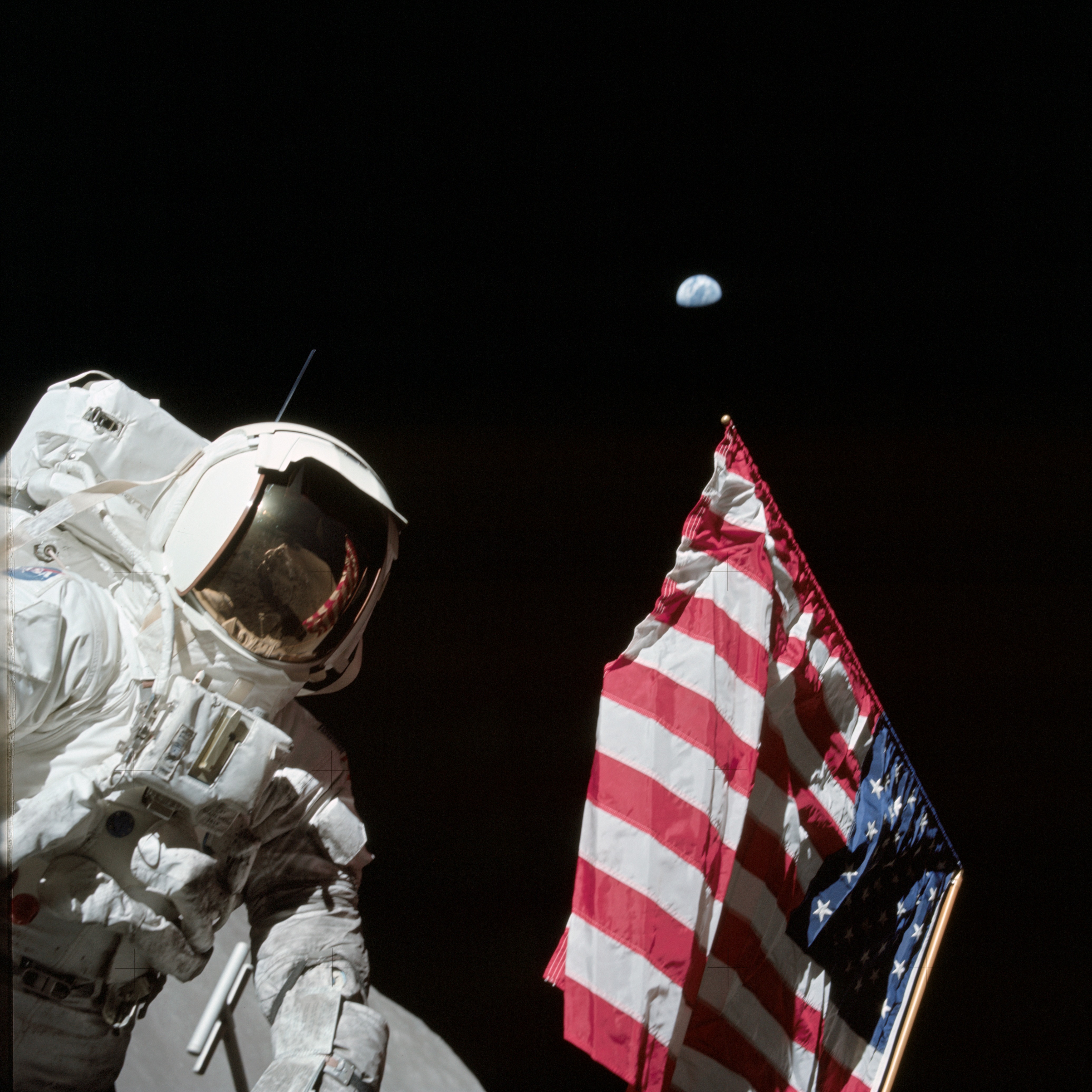
Harrison Schmitt beside the flag during Apollo 17, with Earth visible above.
NASA / Johnson Space Center (AS17-134-20384) · NASA media-use guidelines · Original recordThe words
America
America was Apollo 17’s command module, operated by Ron Evans in lunar orbit. After Cernan and Schmitt returned from the surface, it carried the reunited crew home to Earth.
Blue Marble
The Apollo 17 crew photographed Earth on December 7, 1972. Their color image, known as the Blue Marble, presented the planet as a single world set against the darkness of space.
Did you know?
NASA used the Blue Marble name again in 2002 for a mosaic built from four months of satellite observations, combining views of land, oceans, ice and clouds.
NASA: the Blue Marble photograph and mosaics (opens a new tab)
Challenger
Challenger was Apollo 17’s lunar module. It sheltered Cernan and Schmitt during their surface stay, then lifted them from Taurus-Littrow to rejoin Evans in America for the journey home.
Eugene Cernan
Eugene Cernan commanded Apollo 17 after earlier flights on Gemini 9 and Apollo 10. He explored the Moon with Schmitt while Evans carried out scientific work from lunar orbit.
Fender
A rover fender kept dust thrown up by the wheels from covering the astronauts and equipment. When it broke on Apollo 17, Cernan and Schmitt needed a replacement to limit that dust.
Jack Schmitt
Harrison “Jack” Schmitt was Apollo 17’s lunar module pilot and a trained geologist. He explored Taurus-Littrow with Cernan, applying his scientific background to the mission’s rock and soil investigations.
Laminated Maps
Maps protected by a plastic covering.
Cernan and Schmitt turned four lunar maps into a substitute fender extension. Joined with tape, the sheets served a new purpose as a shield against dust from the rover’s wheel.
Did you know?
NASA transferred this improvised fender extension to the Smithsonian in 1975. The museum object consists of the four maps and their connecting tape.
Last Step
Cernan closed Apollo’s final moonwalk with a farewell expressing hope for peace and a future return to the Moon. He climbed back aboard Challenger after Schmitt, ending the surface exploration.
Night Launch
Apollo 17 lifted off from Kennedy Space Center after midnight on December 7, 1972. It was the first Apollo launch at night, beginning the program’s final lunar landing expedition.
North Massif
The northern mountain wall of Taurus-Littrow was a destination on Apollo 17’s third moonwalk. At Station 6, Cernan and Schmitt sampled fragments of a large boulder that had rolled down from it.
Ron Evans
Ron Evans stayed aboard America to study the Moon from orbit while Cernan and Schmitt worked below. During the return flight, he went outside the spacecraft to retrieve camera film cassettes.
Shorty Crater
Schmitt noticed orange soil at Shorty Crater during the second moonwalk. The astronauts collected it, and postflight analysis identified tiny, titanium-rich glass beads as the source of its unusual color.
South Massif
Cernan and Schmitt traveled to the foot of South Massif during their second moonwalk. At the Nansen depression, they sampled boulders that had rolled down from the mountain.
Taurus Littrow
Taurus-Littrow was Apollo 17’s landing valley near the edge of Mare Serenitatis. Cernan and Schmitt used the rover to investigate its terrain, collect lunar samples and deploy scientific experiments.
Tracy's Rock
This fractured boulder at Station 6 was also called Split Rock. Cernan and Schmitt collected samples from it during their visit near North Massif on Apollo 17’s final surface excursion.
Did you know?
Alan Bean later painted Tracy’s name into a picture of the boulder, honoring Cernan’s daughter. Cernan said he had only wished afterward that he had written it there.
Sources
- Apollo 17 Command and Service Module (CSM)NASA Space Science Data Coordinated Archive; record 1972-096A; Description and Mission Profile, crew, night launch, landing valley and return; accessed October 25, 2026
- 50 Years Ago: Apollo 17 Heads Home to EarthJohn Uri; NASA Johnson Space Center; December 15, 2022; Challenger, crew roles, geology and Evans’s return-flight EVA
- 50 Years Ago: Apollo 17 Lands at Taurus-LittrowJohn Uri; NASA Johnson Space Center; December 12, 2022; second and third traverses, massifs, orange soil and final lunar-surface farewell
- Maps, Fender Extension, Lunar Roving Vehicle, Apollo 17Smithsonian National Air and Space Museum; object A19760010000; four-map replacement fender, dust protection, plastic construction and 1975 transfer; accessed October 25, 2026
- History of the Blue MarbleNASA Earth Observatory; October 13, 2005; Apollo 17 photograph and later 2002 satellite-data mosaic
- Geology Station 6Eric M. Jones; Apollo Lunar Surface Journal; revised August 23, 2014; station introduction and commentary following 165:28:58, boulder, Cernan and Bean painting; relocated journal host