
The Space Race
Puzzle 69 · Exploring the Moon · Page 97 in print
Apollo 16
Charles Duke left a photo of his family on the Moon at Descartes.
Jump to a word
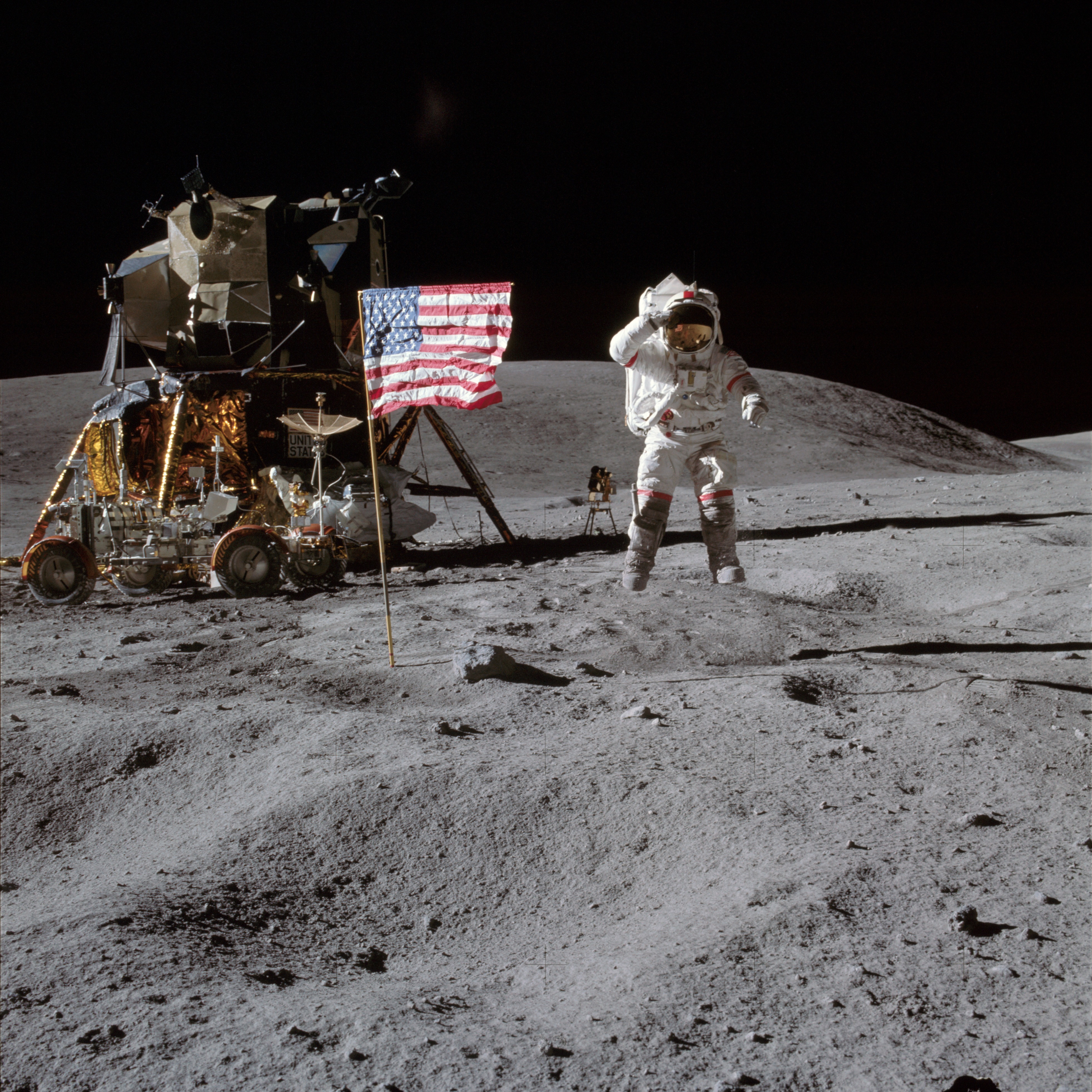
John Young jumps while saluting the flag during Apollo 16.
NASA / Johnson Space Center (as16-113-18339) · NASA media-use guidelines · Original recordThe words
Carruthers
George Carruthers developed Apollo 16’s ultraviolet camera at the Naval Research Laboratory. Operated by John Young on the Moon, it studied Earth’s outer atmosphere as well as stars and clouds of gas in space.
Casper
Casper was Apollo 16’s command module, piloted by Ken Mattingly. It remained in lunar orbit while Young and Duke explored the surface, then carried the reunited crew back to Earth.
Did you know?
Casper’s name came from the friendly cartoon ghost. NASA’s naming history links the choice to the shapeless appearance of the crew’s white suits on television.
NASA archive: Apollo 16’s command spacecraft (opens a new tab) · Orloff: Casper’s name (opens a new tab)
Charles Duke
Charles Duke was Apollo 16’s lunar module pilot. He landed with commander John Young in the Descartes region, where they used a rover to collect samples and set up scientific experiments.
NASA archive: Apollo 16’s command spacecraft (opens a new tab)
Descartes
The Descartes highlands were Apollo 16’s exploration region. Young and Duke landed there in Orion, then used three moonwalks and the rover to investigate the plains, mountain slopes and nearby craters.
Family Photo
Duke left a photograph of his family on the Moon during Apollo 16. The image turned a family portrait into a personal memento at the Descartes exploration site.
Did you know?
A message on the photograph identified the Duke family as being from planet Earth. It recorded the lunar landing as April 1972.
Heat Flow
Young accidentally disconnected the heat-flow experiment’s cable while setting up the surface instruments. That broken link prevented this experiment from returning data, despite the work already done to deploy it.
House Rock
House Rock was a huge boulder near North Ray Crater. Young and Duke approached it during their final moonwalk, taking photographs and collecting samples before returning toward the rover.
Lunar Surface Journal: Apollo 16’s traverses (opens a new tab)
Jump Salute
Young jumped into the air while saluting beside the American flag during Apollo 16’s first moonwalk. He and Duke took turns photographing each other, leaving a record of the moment.
Landing Delay
Apollo 16’s landing was delayed while engineers assessed oscillations in the service module engine’s steering system. After controllers judged the problem manageable, Young and Duke continued their descent in Orion.
NASA archive: Apollo 16’s command spacecraft (opens a new tab)
Mattingly
Ken Mattingly piloted Casper in lunar orbit while Young and Duke worked on the surface. He carried out orbital science and later retrieved camera film during a spacewalk on the return journey.
NASA archive: Apollo 16’s command spacecraft (opens a new tab)
North Ray
North Ray Crater was a destination on Apollo 16’s third moonwalk. NASA’s mission account describes it as the largest crater explored by an Apollo crew; nearby boulders offered material for sampling.
Orange Juice
A leaking drink bag soaked Duke with orange juice while he was still in lunar orbit. The sticky liquid coated his hair and the inside of his helmet, complicating preparations for surface work.
Lunar Surface Journal: Apollo 16’s traverses (opens a new tab)
Orion
Orion was Apollo 16’s lunar module. It carried Young and Duke down to Descartes and served as their base between three moonwalks before lifting them back to Mattingly in orbit.
Stone Mountain
Young and Duke sampled Stone Mountain’s slopes during their second moonwalk. The rocks from the Cinco Craters pointed to an impact-shaped landscape, rather than the volcanic material some geologists had expected.
Lunar Surface Journal: Apollo 16’s traverses (opens a new tab)
UV Camera
UV means ultraviolet.
Apollo 16’s camera observed Earth’s upper atmosphere, stars and nebulae from the lunar surface. It recorded both direct images and spectra, spreading light into a record that scientists could analyze.
Did you know?
During restoration for a 1993 display, Carruthers fitted a backup camera with the film-transport assembly returned from the Moon. Replica parts filled gaps in the reconstruction.
Sources
- Apollo 16 Command and Service Module (CSM)NASA Space Science Data Coordinated Archive; record 1972-031A; Description and Mission Profile, crew roles, landing delay and orbital science; accessed October 25, 2026
- Apollo 16 on the Moon at DescartesJohn Uri; NASA Johnson Space Center; April 21, 2022; Descartes landing, surface work, heat-flow failure, flag salute and North Ray
- Apollo by the Numbers: A Statistical ReferenceRichard W. Orloff; NASA SP-2000-4029; 2000; Call Signs table, printed p. 282, PDF p. 292, Apollo 16 command-module name
- Camera, Lunar Surface Ultraviolet, Apollo 16Smithsonian National Air and Space Museum; object A19830142000; Carruthers, lunar ultraviolet observations and restored backup camera with flown film transport; accessed October 25, 2026
- Apollo 16 Lunar Surface Journal : Mission SummaryEric M. Jones and Ken Glover; Apollo Lunar Surface Journal; revised May 5, 2025; drink-bag account, Stone Mountain and House Rock sections; relocated journal host
- Charles M. Duke, Jr.NASA astronaut profile; Quick Facts, family picture and inscription; accessed October 25, 2026