
The Space Race
Puzzle 68 · Exploring the Moon · Page 96 in print
Apollo 15
Al Worden orbited alone in Endeavour while Scott and Jim Irwin explored Hadley by car.
Jump to a word
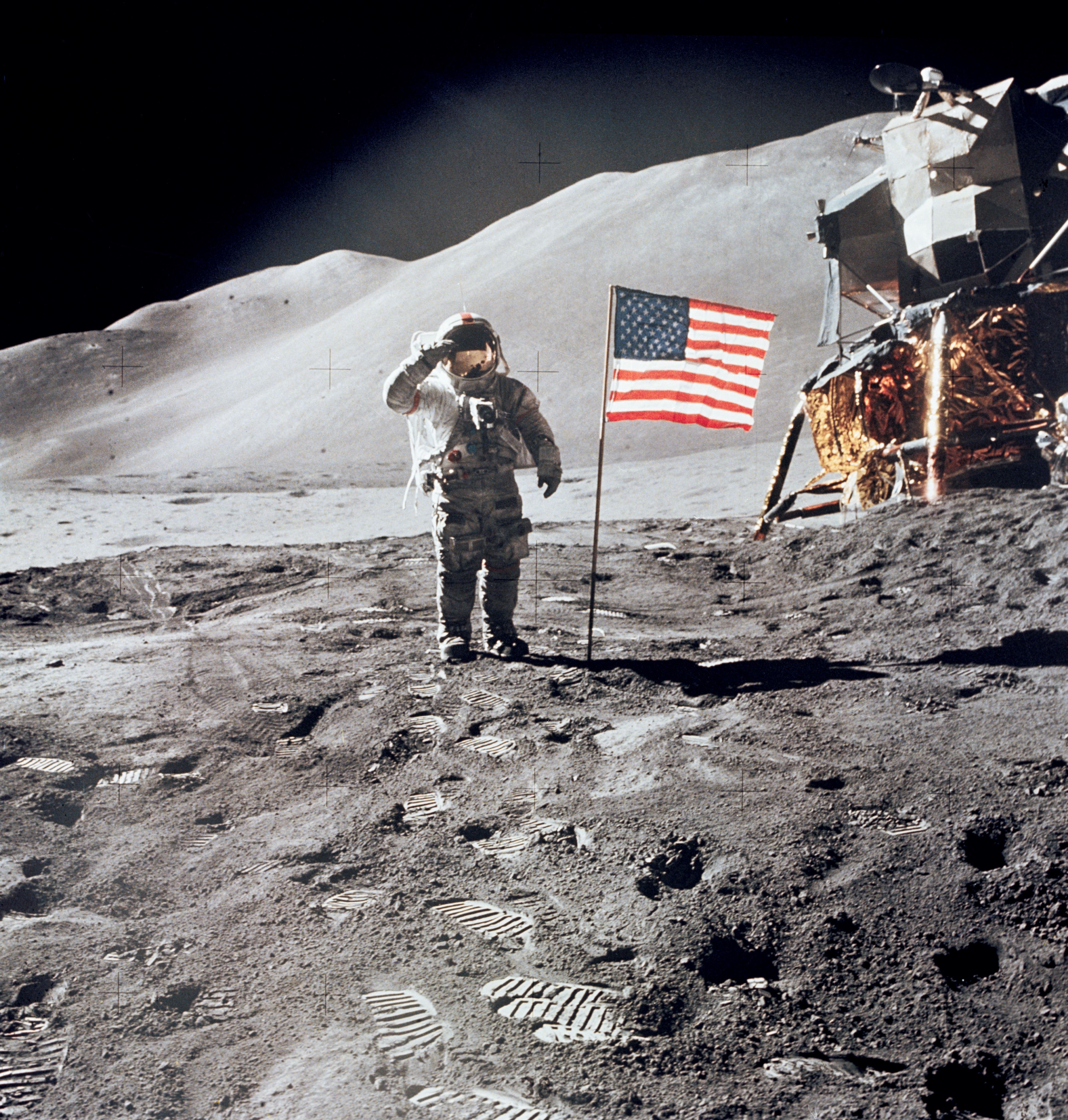
David Scott salutes beside the flag during Apollo 15’s surface exploration.
NASA / Johnson Space Center (as15-88-11863) · NASA media-use guidelines · Original recordThe words
Al Worden
Al Worden was Apollo 15’s command module pilot. While Scott and Irwin explored the surface, he conducted lunar observations and photography from orbit, extending the mission’s science beyond the landing site.
Apennines
The lunar Apennine mountains rose beside Apollo 15’s landing area. Scott and Irwin flew over the range during their descent, then explored the nearby plains and mountain slopes with the rover.
Captain Cook
Apollo 15’s command module took the name Endeavour from the ship that carried Captain James Cook on scientific voyages in the eighteenth century. The spacecraft’s name linked lunar exploration with an earlier sea expedition.
Deep Space EVA
EVA means extravehicular activity: work outside a spacecraft.
On the journey home, Worden left Endeavour to retrieve film cassettes from cameras in the service module. Apollo 15 made this the first spacewalk performed between the Moon and Earth.
Endeavour
Endeavour was Apollo 15’s command module. Falcon docked with it after leaving the surface, reuniting the crew before the return flight and Worden’s retrieval of the orbital camera film.
Did you know?
Falcon referred to the U.S. Air Force Academy’s mascot. Apollo 15’s three astronauts all served in the Air Force, and their lunar module’s name reflected that shared background.
NASA: Apollo 15 mission details (opens a new tab) · Orloff: Apollo 15 spacecraft names (opens a new tab)
Falcon Feather
Scott dropped a falcon feather beside a geological hammer near the end of Apollo 15’s final moonwalk. They reached the surface together because the Moon’s near-vacuum offered virtually no air resistance.
NASA: the hammer-and-feather demonstration (opens a new tab)
Galileo
Scott’s hammer-and-feather demonstration illustrated Galileo’s conclusion that objects fall alike without air resistance. On Earth, air slows a feather much more than a hammer; the lunar setting made their shared acceleration visible.
NASA: the hammer-and-feather demonstration (opens a new tab)
Genesis Rock
Lunar sample 15415 became known as the Genesis Rock. Geologists studied it for clues to the Moon’s ancient crust, although it was not the oldest rock returned by the Apollo astronauts.
Hadley
Hadley Rille, a lunar canyon, lay beside Apollo 15’s landing area near the Apennines. Scott and Irwin drove to its rim to photograph the opposite wall and collect geological samples.
Jim Irwin
Jim Irwin explored the Moon with David Scott using Apollo 15’s electric rover. The vehicle carried them on three traverses, letting the pair reach more widely separated geological sites than walking alone.
Did you know?
The rover’s tires were woven from metal wire, with titanium strips providing traction. Its wheels had no rubber air-filled tires like those on an ordinary car.
Lee Silver
Geologist Lee Silver coordinated field training for Scott, Irwin and their backups. Trips to volcanic terrain helped prepare them to examine and collect lunar rocks during Apollo 15.
Did you know?
Some exercises included a simulated science support room in Houston. Scientist-astronauts acted as capsule communicators, helping the field crews rehearse the exchanges they would use during lunar exploration.
Scott
David Scott commanded Apollo 15, the first mission to drive a rover on the Moon. He and Irwin used it to collect samples and document geological features beyond their landing craft.
SIM Bay
SIM stood for Scientific Instrument Module.
This equipment compartment in the service module held instruments and cameras for studying the Moon from orbit. Its camera film had to be retrieved outside the spacecraft before the journey ended.
Spur Crater
During their second rover excursion, Scott and Irwin stopped at Spur Crater. Among the samples they collected there was a white crystalline rock later given the name Genesis Rock.
Statuette
Scott left a small statuette and memorial plaque on the Moon to honor astronauts and cosmonauts who had died in the line of duty. The memorial was described publicly after the flight.
Sources
- Apollo 15: Mission DetailsNASA; July 8, 2009; mission objectives, crew, first lunar rover, scientific instrument module and return-flight EVA
- 50 Years Ago: Apollo 15 on the Moon at Hadley-ApennineJohn Uri; NASA Johnson Space Center; July 29, 2021; landing region, Apennines, Hadley Rille, Spur Crater and memorial
- The Apollo Lunar Roving VehicleNASA Space Science Data Coordinated Archive; opening mission-use account and wheel-construction paragraph; accessed October 25, 2026
- Apollo by the Numbers: A Statistical ReferenceRichard W. Orloff; NASA SP-2000-4029; 2000; Call Signs table, printed p. 282, PDF p. 292, Apollo 15 row and footnote 21
- The Apollo 15 Hammer-Feather DropDavid R. Williams; NASA Space Science Data Coordinated Archive; updated March 31, 2023; demonstration description and Joe Allen’s science-report account
- Genesis RockNASA Science Editorial Team; September 22, 2017; sample 15415, early lunar crust and distinction from oldest returned sample
- 50 Years Ago: Three Months Until Apollo 15John Uri; NASA Johnson Space Center; April 26, 2021; Silver-coordinated geology field trips, simulated science support and orbital observation training