
The Space Race
Puzzle 67 · Exploring the Moon · Page 95 in print
Apollo 14
Alan Shepard hit two golf balls on the Moon with a six iron he had snuck aboard.
Jump to a word
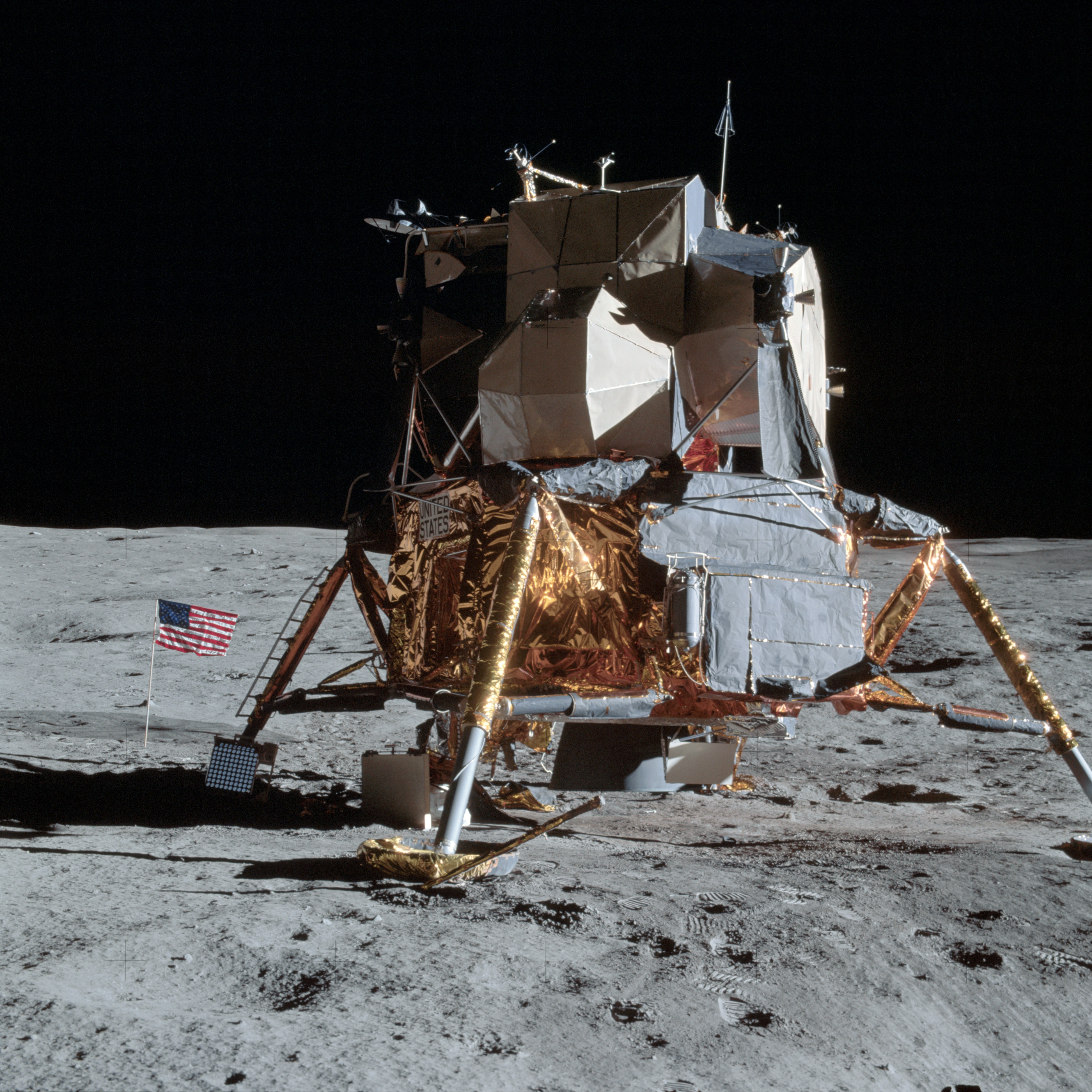
Apollo 14’s lunar module on the surface of the Moon.
NASA / Johnson Space Center (as14-66-09277) · NASA media-use guidelines · Original recordThe words
Abort Switch
Antares’ computer received an unwanted abort signal before the descent. Controllers developed a way to bypass the faulty signal so Shepard and Mitchell could continue toward their landing site.
Antares
Antares was Apollo 14’s lunar module. It carried Shepard and Mitchell to Fra Mauro, served as their shelter between two moonwalks, and later returned them to Roosa in lunar orbit.
Capture Latch
Capture latches were supposed to hold the spacecraft together at the start of docking. On the outward journey, they repeatedly failed to engage; Kitty Hawk and Antares finally joined on the sixth attempt.
Did you know?
Engineers brought a model of the docking probe into Mission Control as they worked on the problem. It gave the controllers a physical example of the mechanism they were discussing.
Cone Crater
Shepard and Mitchell climbed toward Cone Crater to gather rocks thrown out when it formed. Difficult terrain and limited time brought them back before they reached the rim, but they collected material from nearby.
Edgar Mitchell
Edgar Mitchell was Apollo 14’s lunar module pilot and the sixth person to walk on the Moon. He flew with Shepard to the surface after serving as Apollo 10’s backup lunar module pilot.
Fra Mauro
Fra Mauro had been Apollo 13’s intended destination. After that mission’s oxygen-tank accident prevented a landing, NASA reassigned the site to Apollo 14, giving the region another place in the exploration plan.
NASA: Fra Mauro reassigned after Apollo 13 (opens a new tab)
Golf Ball
Shepard hit two golf balls near the end of Apollo 14’s surface work. In his later account, he explained that Robert Gilruth had agreed to the demonstration after the mission’s serious work was complete.
Kitty Hawk
Kitty Hawk was Apollo 14’s command spacecraft. Roosa piloted it during the outward docking maneuver, turning it around to connect with Antares before the crew continued their journey to the Moon.
Moon Trees
Roosa carried tree seeds in Kitty Hawk during Apollo 14. After returning to Earth, the seeds were germinated and grown into saplings, which became known as Moon Trees.
Did you know?
Many saplings were given to schools, parks, universities and government offices for the United States’ bicentennial in 1976. Planting locations were chosen partly to suit the climate needs of each tree species.
Shepard
Alan Shepard commanded Apollo 14 and became the fifth person to walk on the Moon. He had first flown in space aboard Freedom 7 in 1961, nearly a decade before his lunar mission.
Six Iron
Shepard’s lunar club used a modified six-iron head attached to the handle of a sample-collection tool. The compact arrangement let him carry the club head in his spacesuit pocket.
Did you know?
Shepard gave a replica to the Smithsonian’s National Collection in 1975. The original club head went to the US Golf Association, so the two museum objects have different histories.
Smokejumper
Before becoming an astronaut, Roosa worked as a smokejumper, a firefighter who parachuted from aircraft to fight wildfires. His Forest Service background helped inspire the project that sent tree seeds around the Moon.
Solder Ball
Controllers suspected a loose metal particle, possibly a bead of solder, inside Antares’ abort switch. The changing electrical contact could make the computer receive a false command to cancel the landing.
Stuart Roosa
Stuart Roosa stayed in Kitty Hawk while Shepard and Mitchell explored Fra Mauro. From lunar orbit, he conducted observations, photography and experiments, with the tree seeds traveling in his personal kit.
Thumper
Mitchell used the thumper for Apollo 14’s active seismic experiment. Small explosive charges produced vibrations that nearby sensors recorded, helping scientists investigate the structure beneath the lunar surface.
Sources
- 50 Years Ago: Apollo 14 Lands at Fra MauroJohn Uri; NASA Johnson Space Center; February 4, 2021; Antares, Cone Crater traverse and active seismic experiment
- 50 Years Ago: Apollo 14 Launches to the MoonJohn Uri; NASA Johnson Space Center; February 1, 2021; Kitty Hawk and initial capture-latch trouble, model and successful docking
- Apollo 13: Mission DetailsNASA; July 8, 2009; Mission Objective, Fra Mauro target reassigned to Apollo 14
- Moon Trees Stand as Living Testaments to First Voyages to MoonLee Mohon; NASA; February 4, 2021; Roosa’s orbital work, smokejumper background, seed project and bicentennial plantings
- Oral History Transcript: Alan B. Shepard, Jr.NASA Johnson Space Center Oral History Project; interview by Roy Neal; February 20, 1998; printed pp. 12-27–12-28, PDF pp. 27–28; Gilruth’s approval and lunar golf
- Head, Golf Club, Apollo 14, ReplicaSmithsonian National Air and Space Museum; object A19751468000; modified six-iron head, sample-tool handle and 1975 replica donation; accessed October 25, 2026
- Landing at Fra MauroEric M. Jones; Apollo Lunar Surface Journal; revised January 12, 2016; opening abort-switch commentary and 106:25:29–106:25:59 exchange; relocated journal host
- Apollo 14 Lunar Surface Journal : CrewEric M. Jones; Apollo Lunar Surface Journal; revised May 11, 2006; Shepard and Mitchell mission biographies; relocated journal host