
The Space Race
Puzzle 66 · Exploring the Moon · Page 94 in print
Apollo 13
It was Jack Swigert who first radioed, “Okay, Houston, we’ve had a problem here.”
Jump to a word
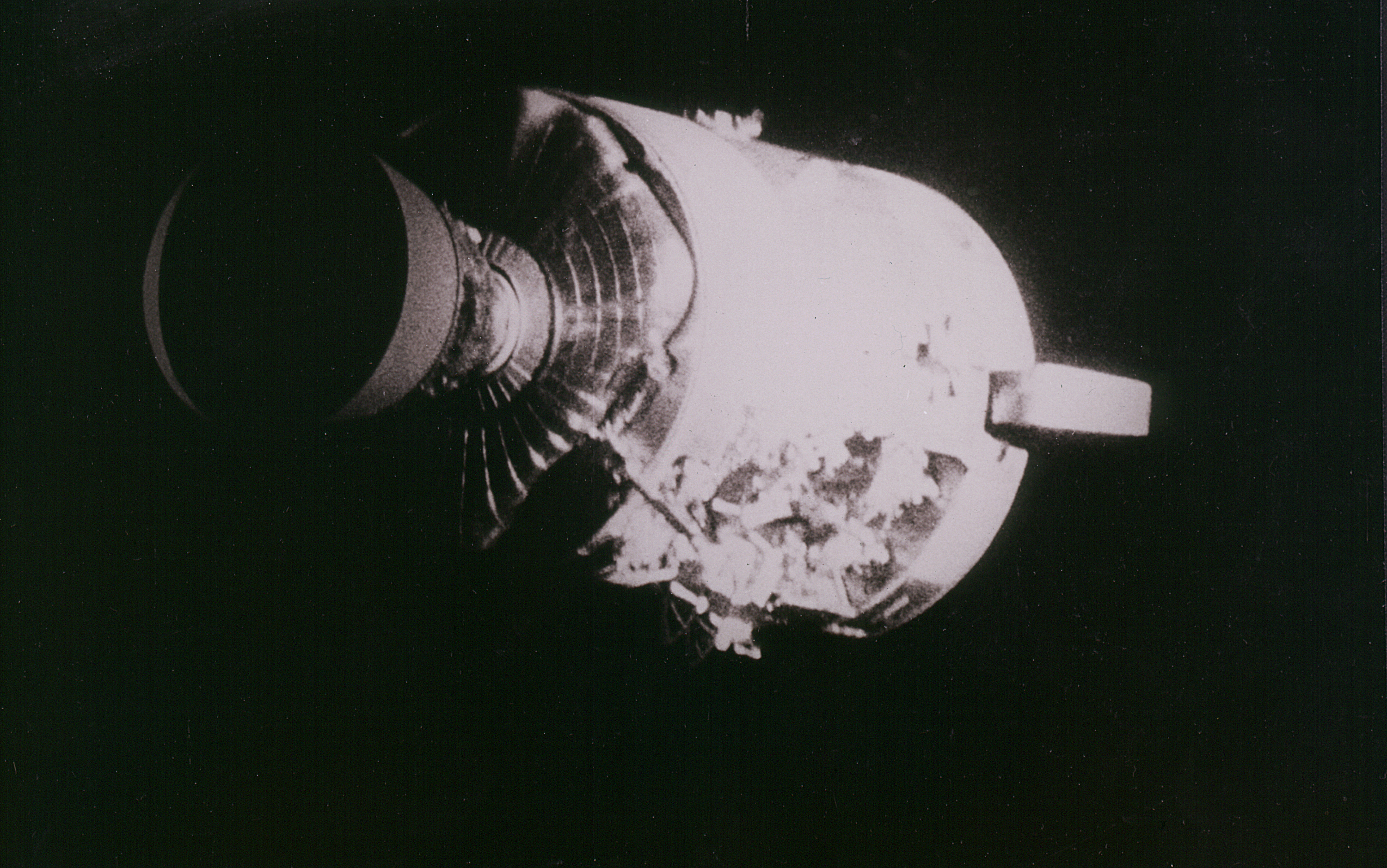
Apollo 13’s damaged service module photographed after separation.
NASA / Marshall Space Flight Center (7010516) · NASA media-use guidelines · Original recordThe words
Aquarius
Aquarius was Apollo 13’s lunar module. After the accident, its oxygen, electrical power and other life-support resources sustained three astronauts instead of the two it had been designed to carry.
Condensation
With most electrical equipment off, Odyssey grew cold and water droplets collected on its walls, wiring and panels. During reentry, the droplets fell through the cabin, creating the rain described in the printed note.
Dehydration
The astronauts conserved drinking water because the remaining supply also had to cool equipment. Their restricted intake left them dehydrated during the return journey, adding to the cold and exhaustion of the emergency.
Duct Tape
Duct tape helped join an improvised adapter that connected command-module carbon-dioxide filters to Aquarius’s air-cleaning system. Engineers worked with materials already aboard, and the crew recreated their solution in space.
Fred Haise
Fred Haise was Apollo 13’s lunar module pilot. During the emergency, he helped bring Aquarius’s power, communications and life-support systems into operation as the crew prepared to leave the command module.
Jack Swigert
Jack Swigert joined Apollo 13 as command module pilot shortly before launch, replacing Ken Mattingly. He completed intensive refresher training and then flew with Lovell and Haise.
Did you know?
Before the accident, a reminder about April 15 prompted Swigert to admit that he had forgotten to file his income taxes in the rush of joining the crew.
James Lovell
James Lovell commanded Apollo 13 after flying Gemini 7, Gemini 12 and Apollo 8. His earlier Apollo mission had already taken him into orbit around the Moon.
Did you know?
Lovell and Haise had already trained together on Apollo 11’s backup crew. For Apollo 13, they were assigned to make the lunar landing themselves.
Ken Mattingly
Ken Mattingly was replaced before launch after exposure to German measles, because he lacked immunity. The decision concerned the risk of illness during the mission, rather than an existing diagnosis.
Lifeboat
The lunar module became a refuge after the command spacecraft lost its normal oxygen and electrical supply. Its resources kept the astronauts alive while Odyssey’s remaining power was reserved for reentry.
Mailbox
The mailbox was the nickname for the improvised filter adapter. It allowed square command-module filters to work with the lunar module’s differently shaped fittings, keeping carbon dioxide from accumulating in the cabin.
Did you know?
In 1975, the National Air and Space Museum commissioned a replica from people who had worked on Apollo 13. The flown adapter had stayed aboard Aquarius and was not recovered.
Odyssey
Odyssey was Apollo 13’s command module. The astronauts reactivated it for the final return, transferred aboard from Aquarius, and descended under its parachutes to a safe Pacific splashdown.
Oxygen Tank
The failure of an oxygen tank in Apollo 13’s service module damaged the spacecraft and depleted the oxygen supply. It also interrupted fuel-cell electricity, forcing the crew to abandon the lunar landing.
Tiger Team
Gene Kranz led Apollo 13’s Tiger Team. After handing over his control-room shift, his team stayed to study the accident and help plan the crew’s return.
NASA Goddard: Gene Kranz’s career (opens a new tab) · NASA: Apollo 13’s emergency (opens a new tab)
Undervolt
An electrical supply voltage below its normal level.
A low-voltage warning appeared after the bang aboard Apollo 13. Swigert reported trouble, and Lovell identified the affected electrical bus, one of the spacecraft’s main power-distribution circuits.
USS Iwo Jima
USS Iwo Jima was Apollo 13’s recovery ship. Navy swimmers and helicopters brought Lovell, Swigert and Haise aboard after the Pacific splashdown, and sailors later recovered Odyssey as well.
Sources
- “Houston, We’ve Had a Problem”John Uri; NASA Johnson Space Center; April 13, 2020; initial warning, crew roles, lunar-module activation and mission-control response
- Apollo 13: Mission DetailsNASA; July 8, 2009; crew change, oxygen-tank failure, water conservation and condensation
- 50 Years Ago: Apollo 13 Off to the MoonJohn Uri; NASA Johnson Space Center; April 10, 2020; Swigert’s replacement training and pre-accident income-tax exchange
- Gene Kranz Goddard Engineering Colloquium AnnouncementNASA Goddard Space Flight Center; September 19, 2005 event announcement; speaker biography identifies Apollo 13 Tiger Team leadership
- Conserving the Creativity that Saved the Apollo 13 AstronautsLauren Gottschlich; Smithsonian National Air and Space Museum; April 16, 2020; incompatible filters, mailbox adapter and 1975 commissioned replica
- Apollo 13 Crew Returns Safely to EarthJohn Uri; NASA Johnson Space Center; April 17, 2020; reactivation, reentry, splashdown and USS Iwo Jima recovery; original address redirects to retitled page
- 50 Years Ago: NASA Names Apollo 13 and 14 CrewsJohn Uri; NASA Johnson Space Center; August 6, 2019; Lovell’s prior missions, Haise and the Apollo 11 backup crew