
The Space Race
Puzzle 65 · Exploring the Moon · Page 93 in print
Apollo 12
Conrad landed Intrepid so near the robot Surveyor Three that he and Bean walked to it.
Jump to a word
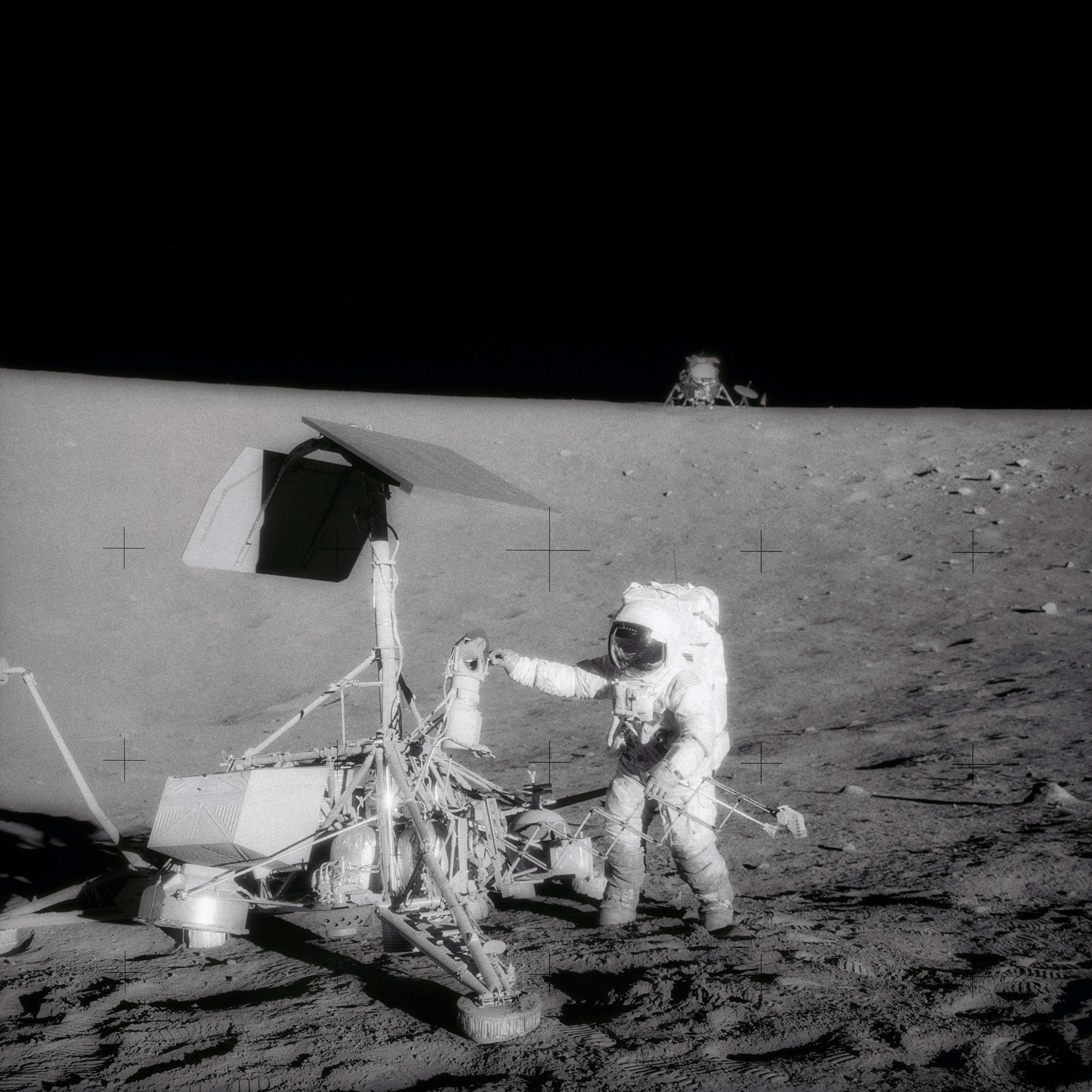
An Apollo 12 astronaut examines Surveyor 3, with the lunar module in the distance.
NASA / Johnson Space Center (AS12-48-7133) · NASA media-use guidelines · Original recordThe words
Alan Bean
Alan Bean was Apollo 12’s lunar module pilot and the fourth person to walk on the Moon. He and Conrad explored the Ocean of Storms and deployed scientific instruments.
Did you know?
Bean left NASA in June 1981 to paint full time. He hoped his art would capture the places and sights he had experienced during his years as an astronaut.
NASA: Alan Bean’s astronaut profile (opens a new tab) · NASA: Alan Bean’s flight and art (opens a new tab)
ALSEP
Short for Apollo Lunar Surface Experiments Package.
Conrad and Bean left this group of scientific instruments on the Moon. Its seismometer measured vibrations, including the impact of Intrepid’s empty ascent stage after the crew had departed.
Did you know?
The impact’s strong seismic signals lasted more than half an hour. Weaker signals continued longer, giving scientists a record of how the Moon responded to the collision.
Apollo Twelve
Apollo 12 made the second crewed lunar landing in November 1969. Conrad and Bean conducted two moonwalks, while Gordon carried out scientific work from orbit above the Moon.
Bolt Cutters
Conrad and Bean used bolt cutters to remove Surveyor 3’s television camera and sampling scoop. Returning the hardware let researchers examine equipment that had stood on the Moon since 1967.
Conrad
Charles “Pete” Conrad commanded Apollo 12. With Bean reading updates from the guidance computer, he piloted Intrepid to a landing in the Ocean of Storms near the earlier Surveyor spacecraft.
Head Crater
Intrepid landed northeast of Head Crater. On their second moonwalk, Conrad and Bean skirted its rim while collecting rocks along a route that eventually reached Surveyor 3.
Intrepid
Intrepid was Apollo 12’s lunar module, carrying Conrad and Bean down to the surface. Its ascent stage later lifted them back to a rendezvous and docking with Gordon in Yankee Clipper.
John Aaron
Flight controller John Aaron recognized the electrical-data problem after Apollo 12’s lightning strikes. His recommendation, relayed through Mission Control and carried out by Bean, restored useful readings so controllers could assess the spacecraft.
Lightning
Lightning struck Apollo 12’s rocket twice during its November 14, 1969 ascent, disrupting spacecraft electrical systems and the data reaching Mission Control. The crew continued after restoring systems and checking them in Earth orbit.
Pinpoint
The landing was precise enough for Conrad and Bean to walk to Surveyor 3. Reaching a chosen site let Apollo 12 combine lunar geology with an examination of previously landed equipment.
Richard Gordon
Richard Gordon remained in Yankee Clipper while Conrad and Bean explored the surface. His work in lunar orbit included photographing the Moon, including sites being considered for later missions.
Did you know?
Using the spacecraft’s sextant telescope, Gordon could see both Intrepid and Surveyor 3 from lunar orbit. The two landers were visible together shortly after the astronauts had touched down.
Snowman
The Snowman was a recognizable grouping of craters at Apollo 12’s landing site. Surveyor Crater formed its body, with smaller craters suggesting feet and Head Crater above it.
Surveyor Three
Surveyor 3 was a robotic spacecraft that landed on the Moon in April 1967. Apollo 12’s astronauts walked to it in November 1969 and brought parts back to Earth for study.
Whoopie
Conrad exclaimed “Whoopie!” as he jumped from Intrepid’s ladder onto its footpad. His following joke contrasted his shorter stature with Armstrong’s first step on the Moon.
Yankee Clipper
Yankee Clipper was Apollo 12’s command and service module. Gordon turned it around after launch to dock with Intrepid, joining the two spacecraft for their journey to the Moon.
Sources
- Apollo 12: The Pinpoint MissionNASA; July 8, 2009; mission objectives, ALSEP, Head Crater, Gordon’s orbital photography and sextant observation
- 55 Years Ago: Apollo 12 Makes a Pinpoint Landing on the MoonJohn Uri; NASA Johnson Space Center; November 14, 2024; crew roles, landing, spacecraft and first-step sequence
- 50 Years Ago: Return to the MoonJohn Uri; NASA Johnson Space Center; November 14, 2019; lightning, Aaron’s diagnosis and Yankee Clipper docking
- APOD: 1999 April 08 - Apollo 12: Surveyor 3 and IntrepidRobert Nemiroff and Jerry Bonnell; NASA Astronomy Picture of the Day; April 8, 1999; bolt cutters, camera and scoop; inherited APOD address redirects to NASA Science
- Alan BeanNASA; May 26, 2018; lunar module pilot, exploration of the Ocean of Storms and later painting career
- Alan BeanNASA astronaut profile; role, fourth moonwalker and June 1981 retirement; accessed October 25, 2026
- Apollo 12 Lunar Surface MapsEric M. Jones; Apollo Lunar Surface Journal; revised May 30, 2007; map annotation on the Snowman grouping; relocated journal host, original NASA path redirects to a general index