
The Space Race
Puzzle 62 · Apollo 11 · Page 88 in print
Collins in Columbia
On each pass, Collins hunted for Eagle through Columbia’s sextant but never saw it.
Jump to a word
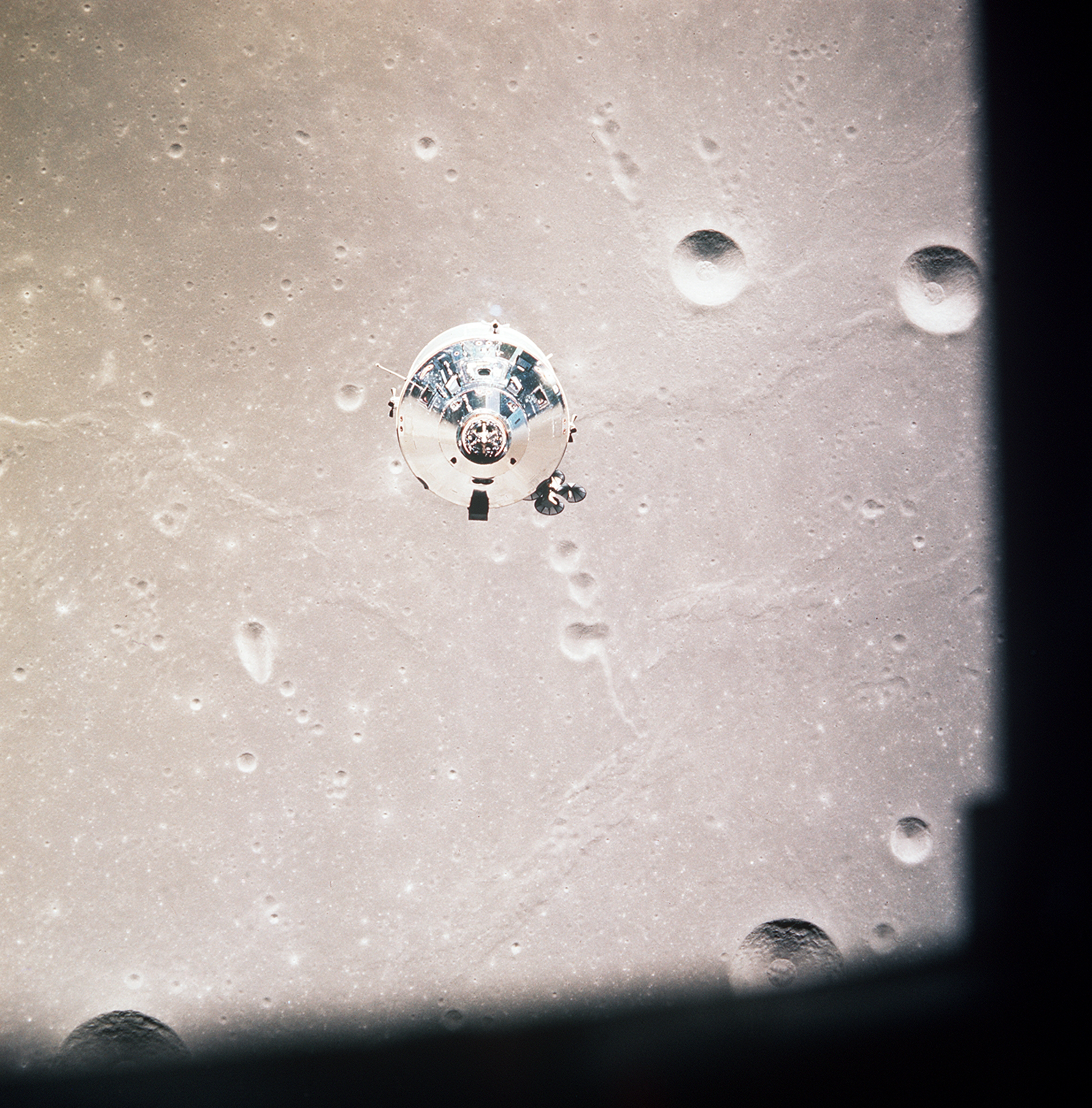
Apollo 11’s command and service modules photographed from Eagle in lunar orbit.
NASA / Johnson Space Center (as11-37-5445) · NASA media-use guidelines · Original recordThe words
Collins
Michael Collins remained in Columbia while Armstrong and Aldrin explored the Moon. He photographed the surface, relayed communications and later docked with Eagle to reunite the crew.
Smithsonian: Collins’s work in orbit (opens a new tab) · Smithsonian: Collins alone in Columbia (opens a new tab)
Colossus
Colossus was Columbia’s guidance-computer software. It supported navigation and other flight tasks in the command module, while Eagle carried the separate Luminary software for its own work.
Did you know?
The software names followed the spacecraft initials: Colossus began with C for command module, while Luminary began with L for lunar module.
Tomayko: Apollo’s software names (opens a new tab) · Orloff: Apollo 11’s computer programs (opens a new tab)
Columbia
Columbia’s command module carried all three astronauts back through Earth’s atmosphere. During the lunar journey it stayed attached to a service module that provided propulsion, power and other support.
Far Side
As Columbia passed behind the Moon, the lunar body blocked its direct radio link with Earth. Contact returned when the spacecraft came around to the side facing the ground stations.
Flying Machine
After Eagle separated from Columbia, Collins admired it as a fine-looking flying machine. He also noted that Eagle was upside down relative to his view from the command module.
Did you know?
Armstrong answered that somebody was upside down. The two pilots were looking at each other’s spacecraft from different orientations above the Moon.
Hallelujah
When Houston reported that the moonwalkers were back inside Eagle and the cabin was pressurized, Collins responded with a single word: “Hallelujah.” He then resumed work with Mission Control.
Hard Dock
A firm, latched connection between two spacecraft.
After Eagle returned to lunar orbit, docking joined the two spacecraft firmly. The connection let Armstrong and Aldrin transfer back to Columbia with the samples they had collected on the Moon.
NASA mission report, p. 26 · NASA report: Collins’s solo work (opens a new tab)
KAMP
Kate, Ann, Michael and Patricia: Collins’s three children and wife.
Collins chose a bright crater in the Foaming Sea as a navigation landmark. He informally named it KAMP; it was a working nickname rather than an official lunar name.
Landmark
Collins took timed sightings of chosen lunar craters. The measurements helped establish Columbia’s position and motion in orbit, giving the crew and Mission Control another check on navigation.
NASA mission report, p. 18 · NASA report: Collins’s solo work (opens a new tab)
Orbiting Base
After the landing, Collins congratulated the crew from orbit. Armstrong asked him to keep Columbia ready as their “orbiting base,” the place they would return before heading home.
Photography
Collins photographed the lunar surface from Columbia while his crewmates worked below. His pictures added an orbital view to the photographs Armstrong and Aldrin took around the landing site.
Service Module
The service module carried Columbia’s main engine, fuel cells and oxygen supplies. It stayed attached through the lunar journey and separated before the command module returned through Earth’s atmosphere.
Sextant
An optical instrument for measuring angles between objects.
Collins used Columbia’s sextant to track landmarks and search for Eagle on the ground. He never spotted the landed module, though the instrument could detect it in flight.
NASA mission report, pp. 20–21 · NASA report: Collins’s solo work (opens a new tab)
Solitude
Collins was physically alone in Columbia while Armstrong and Aldrin explored the surface. His radio links brought news from below, except when the Moon itself blocked the signals.
Smithsonian: Collins alone in Columbia (opens a new tab) · NASA transcript: Collins on the radio (opens a new tab)
Solo Book
Collins gathered the documents for his time alone into one Solo Book. It combined flight-plan material, rendezvous instructions, updates and emergency checklists so he could work from a single volume.
Did you know?
The book was usually secured to a clip on Collins’s helmet tie-down strap. That kept his working pages within reach in the weightless cabin.
NASA mission report, pp. 20–21 · NASA report: Collins’s solo work (opens a new tab)
Sources
- Apollo 11: The Moon LandingSmithsonian National Air and Space Museum; mission account, Collins remaining in Columbia as communications link and photographing the lunar surface
- Michael Collins: orbiting aloneSmithsonian National Air and Space Museum; command-module role, far-side isolation and docking after the surface stay; text of the illustrated story
- 50 Years Ago: One Small Step, One Giant LeapJohn Uri; NASA Johnson Space Center; July 19, 2019; post-undocking exchange, Collins’s flying-machine remark and Armstrong’s reply
- Apollo 11 Mission ReportNASA Mission Evaluation Team; NASA SP-238 edition, title page dated 1971; pp. 18, 20–21 and 26 (PDF pp. 30, 32–33 and 38), landmark navigation, solo activities, sextant searches and command-module docking
- Apollo 11 Command and Service Module (CSM)NASA Space Science Data Coordinated Archive, spacecraft 1969-059A; Mission Profile and Command Module/Service Module descriptions, return capability, main engine, fuel cells and oxygen supplies
- Computers in Spaceflight: The NASA Experience — The Apollo guidance computer: SoftwareJames E. Tomayko; NASA Contractor Report 182505, March 1988; Chapter 2, software discussion, Colossus and Luminary roles and choice of names
- Apollo by the Numbers: A Statistical ReferenceRichard W. Orloff; NASA SP-2000-4029; 2000; Designations table, p. 274 (PDF p. 284), Computer Programs row and Apollo 11 column
- Apollo 11 - Technical Air-to-Ground Voice TranscriptionNASA; original technical voice transcript; mission day 04 06:58:40–06:58:55 and 04 16:06:16–16:06:59 (102:58 and 112:06 GET), orbiting-base exchange and Collins’s Hallelujah response
- Apollo 11 Flight Journal — Day 4, part 3: TV from OrbitW. David Woods, Kenneth D. MacTaggart and Frank O’Brien; Apollo Flight Journal, updated February 22, 2025; 078:37:32–078:37:41 and commentary, informal KAMP landmark and family initials; authors’ current journal publication