
The Space Race
Puzzle 63 · Apollo 11 · Page 89 in print
Experiments on the Surface
The Apollo 11 seismometer picked up the astronauts’ footsteps on the Moon.
Jump to a word
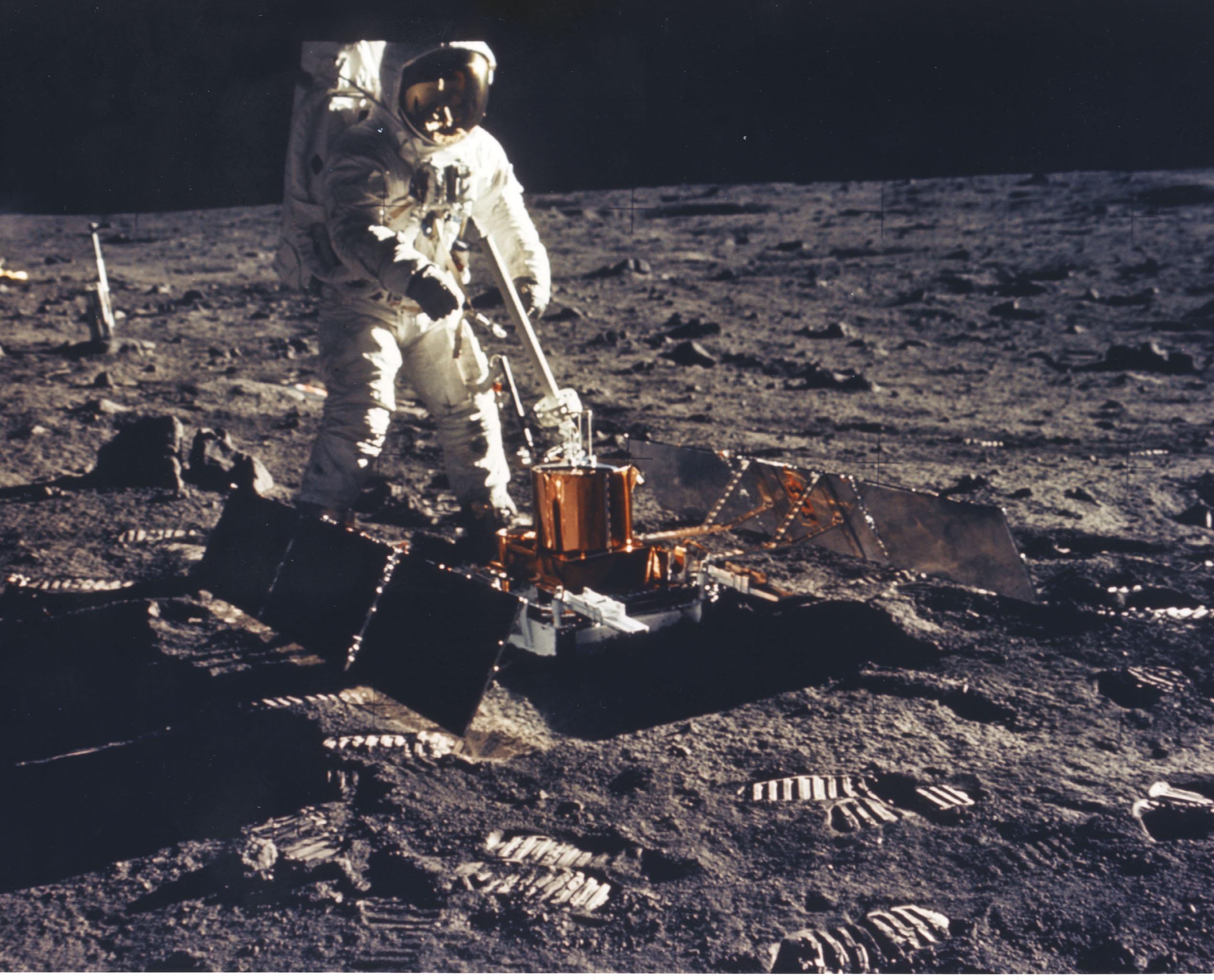
Buzz Aldrin deploys the passive seismic experiment near Tranquility Base.
NASA / Kennedy Space Center (as11-40-5951) · NASA media-use guidelines · Original recordThe words
Armalcolite
A newly identified mineral in the Apollo 11 samples was named armalcolite. Its name combined letters from Armstrong, Aldrin and Collins, honoring all three members of the crew.
NASA’s 1970 chronology, p. 234 · NASA’s 1970 chronology: armalcolite (opens a new tab)
Basalt
A volcanic rock formed as lava cools.
Apollo 11 brought home basalts among its lunar rocks. Their crystals and gas cavities recorded cooling from molten material, helping scientists study the rock that formed the Moon’s dark plains.
NASA science report: rocks and dust (opens a new tab) · NASA Science: the lunar plains (opens a new tab)
Bootprint
The fine lunar soil kept clear impressions of the astronauts’ boot treads. Their tracks provided a visible record of movement around Eagle and a chance to study the surface.
Did you know?
Aldrin took close-up photographs of the impressions as part of the Bootprint Penetration Experiment. The pictures helped document how his boot pressed into the surface.
NASA report: collecting lunar samples (opens a new tab) · NASA: footprints and the solar-wind foil (opens a new tab)
Bulk Sample
After securing the early contingency sample, Armstrong collected a larger selection of rocks and soil near Eagle. This bulk collection supplied laboratories with material for a wider range of studies.
NASA mission report, pp. 22–23, 143 · NASA report: collecting lunar samples (opens a new tab)
Buzz Aldrin
Buzz Aldrin carried the seismic package and laser reflector away from Eagle. Armstrong photographed him with one instrument in each hand as they prepared the surface experiments.
Core Tube
Aldrin used a hammer to drive hollow tubes into lunar soil. They collected material below the surface, but he found it difficult to drive them as deeply as planned.
NASA mission report, pp. 23–24, 143 · NASA report: collecting lunar samples (opens a new tab)
Corner Cubes
Apollo 11’s reflector panel held an array of glass prisms. Their geometry sent laser light back toward the Earth-based source, providing a target for precise distance measurements.
Dust Detector
Small solar cells on Apollo 11’s experiment package monitored changes in their output. Scientists used those readings to investigate dust deposited on the equipment and the effects of radiation.
Apollo 11 Preliminary Science Report, p. 199 · NASA science report: rocks and dust (opens a new tab)
Gold Camera
The camera developed for Thomas Gold took paired close-up views of soil and rocks. Researchers studied the pictures in three dimensions to examine fine textures and small surface features.
Did you know?
Kodak built the instrument, which was also used on Apollo 12 and Apollo 14. Its close-up photographs covered both undisturbed ground and surfaces changed by the astronauts.
Laser Ranging
Earth-based observatories sent laser pulses toward Apollo 11’s reflector and timed their return. The travel time provided a precise measure of the distance between the observatory and the lunar panel.
Did you know?
The reflector needed no electrical power on the Moon. Earth-based equipment supplied the laser pulses and measured their return, while the lunar panel acted as a passive target.
Little West
Armstrong hurried to Little West Crater near Eagle to photograph its interior. The visit added a view into a nearby crater to the mission’s record of the landing area.
Moonquake
Apollo seismometers recorded tremors from within the Moon as well as surface impacts. Deep moonquakes were linked to Earth’s gravitational pull, which stretched and flexed the lunar interior.
Rock Box
Special sample containers held the rocks, loose soil and core tubes for the trip home. The crew transferred the boxes from Eagle to Columbia after the lunar-orbit docking.
NASA mission report, pp. 26, 143 · NASA report: collecting lunar samples (opens a new tab)
Seismometer
The passive seismic experiment measured movement of the lunar ground. Houston reported short-period oscillations while the astronauts were nearby; the instrument was detecting their footsteps.
Solar Wind
Aldrin exposed a sheet of aluminum foil to the solar wind during the moonwalk. The foil trapped particles from the Sun and was rolled up for analysis back on Earth.
Sources
- Buzz Aldrin Deploys Apollo 11 ExperimentsNASA; September 12, 2014; photograph caption, Aldrin carrying the passive seismic package and laser reflector, photographed by Armstrong
- 50 Years Ago: One Small Step, One Giant LeapJohn Uri; NASA Johnson Space Center; July 19, 2019; Bootprint Penetration Experiment and solar-wind foil exposed, retrieved and returned for analysis
- EASEP Deployment and CloseoutEric M. Jones and contributors; NASA Apollo Lunar Surface Journal; 111:10–111:15 and commentary, Armstrong’s Little West visit and 111:12:31 seismic oscillations from footsteps
- Apollo 11 Mission ReportNASA Mission Evaluation Team; NASA SP-238 edition, title page dated 1971; pp. 22–23, 26, 134–135 and 143 (PDF pp. 34–35, 38, 146–147 and 155), bulk collection, bootprints, core tubes and sample containers
- Astronautics and Aeronautics, 1970: Chronology on Science, Technology, and PolicyScience and Technology Division, Library of Congress; NASA Historical Office, NASA SP-4015, published 1972; July 15, 1970 entry, p. 234 (PDF p. 244), announcement of armalcolite’s name
- Apollo 11 Preliminary Science ReportNASA SP-214; 1969; p. 124 (PDF p. 132), crystalline rocks and cooling from melts; Chapter 10, p. 199 (PDF p. 207), Bates, Freden and O’Brien, modified dust-detector objectives
- The Apollo Experiment That Keeps on GivingAnthony Greicius; NASA; July 24, 2019; prism arrays, reflected laser-pulse timing and passive operation without lunar electrical power; historical article
- Study and Interpretation of Lunar Close-Up Stereo PhotographyThomas Gold; Cornell University CRSR 458, NASA CR-115500; title page dated August 1971; Introduction (PDF p. 3), Kodak camera, Apollo 11/12/14 use and interpretation of surface textures
- MoonquakesNASA Science; What Are Moonquakes section, Apollo seismic observations, deep tidal quakes and other sources of ground vibrations
- Moon FactsNASA Science; Surface section, dark maria as basins filled with lava and the geological record of lunar surface materials; no current exploration schedule adopted