
The Space Race
Puzzle 60 · Apollo 11 · Page 86 in print
Tranquility Base
Aldrin used a felt tip pen to push in a broken breaker needed for liftoff.
Jump to a word
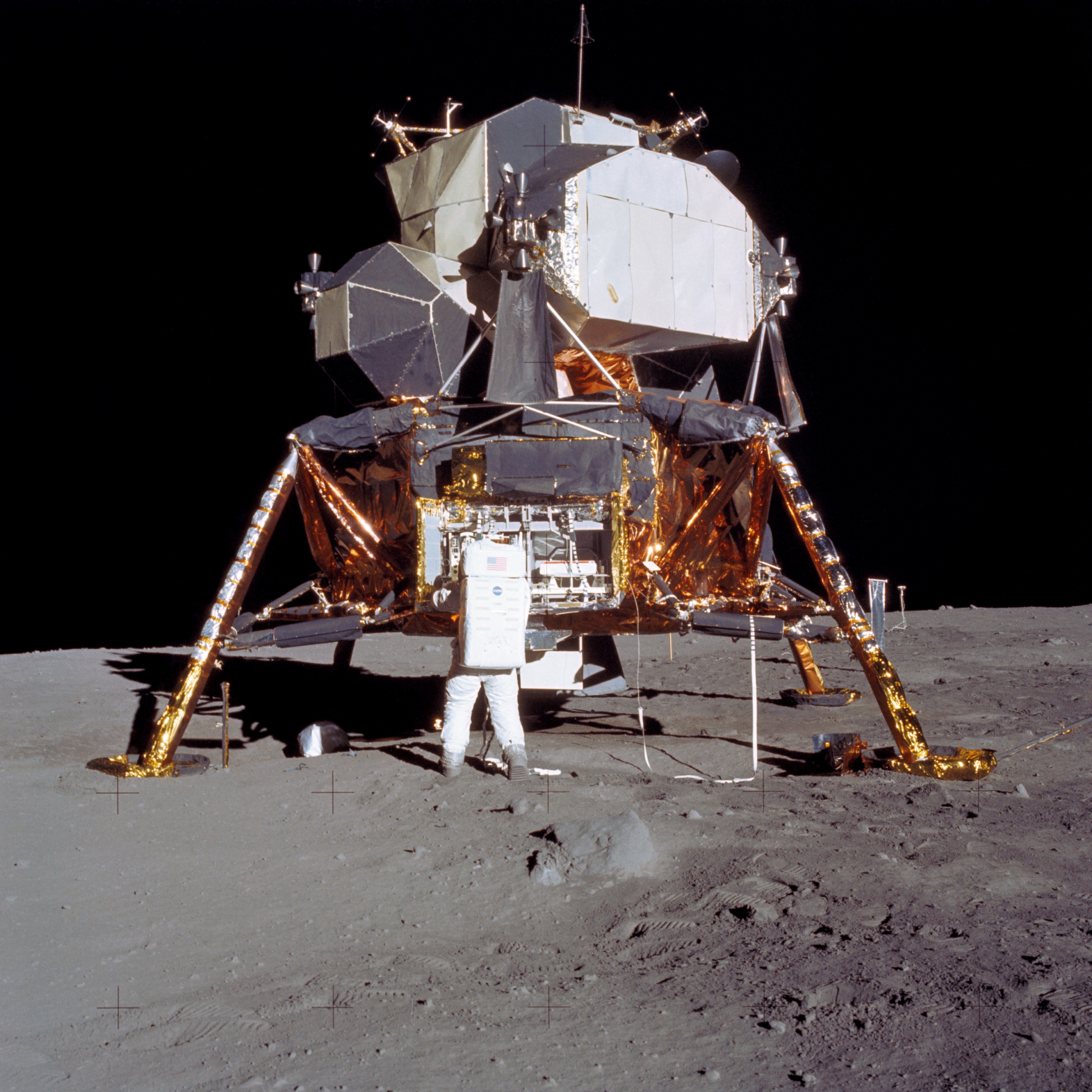
Buzz Aldrin works beside Eagle at the Apollo 11 landing site.
NASA / Johnson Space Center (as11-40-5927) · NASA media-use guidelines · Original recordThe words
Breaker
The knob of Eagle’s ascent-engine arming breaker was found broken after the moonwalk. The circuit still had to be closed before the crew could leave the Moon.
Did you know?
NASA planned guards over the circuit breakers on Apollo 12 and later vehicles. They were intended to prevent the astronauts’ bulky equipment from striking the controls.
NASA mission report, p. 196 · NASA report: rest and the broken control (opens a new tab)
Communion
After landing and before the moonwalk, Aldrin took communion inside Eagle. He had brought a chalice and wine. His radio message invited listeners to give thanks in their own way.
Eagle
Eagle was the lunar module that carried Armstrong and Aldrin down to the Moon. Michael Collins remained in Columbia, ready for their return from the surface.
Engine Cover
During the lunar rest period, Armstrong lay on the ascent-engine cover. Light through the navigation telescope, equipment noise and a cold cabin kept him from sleeping.
NASA mission report, pp. 24–25 · NASA report: rest and the broken control (opens a new tab)
Felt Tip Pen
Aldrin recalled using a felt-tipped pen where the breaker’s knob had broken off. The improvised tool allowed the crew to arm Eagle’s ascent engine for departure.
Hammock
Armstrong used a waist tether to support his legs while resting on the engine cover. Aldrin curled up on the floor; their improvised arrangements filled Eagle’s cramped cabin.
Jettison
To discard something from a spacecraft.
After the moonwalk, Armstrong and Aldrin discarded their life-support backpacks, lunar boots and other unneeded equipment. This cleared space inside Eagle and reduced the weight that had to leave the Moon.
Moltke
Moltke lay southeast of Tranquility Base. NASA’s preliminary science team considered it a possible source of rock fragments near the landing site, without identifying particular samples as coming from it.
Apollo 11 Preliminary Science Report, p. 42 · NASA science report: the Moltke crater (opens a new tab)
Olive Branch
Apollo 11 left a small gold olive branch on the Moon as a symbol of peace. It was part of a packet of commemorative objects placed near Eagle before departure.
Did you know?
Matching gold olive branches made the round trip to the Moon for the astronauts’ wives. The crew left another at Tranquility Base.
NASA: Apollo 11’s surface stay (opens a new tab) · NASA: the goodwill disc and olive branch (opens a new tab)
Plaque
A plaque attached to Eagle’s descent stage bore a map of Earth and a message of peace. The crew’s signatures and President Nixon’s accompanied the words marking the first lunar landing.
NASA press kit: plaque and landing sites (opens a new tab) · NASA: Apollo 11’s mission overview (opens a new tab)
Sabine
Several minutes after liftoff, Aldrin reported Sabine crater on Eagle’s right. It was a landmark during the climb back toward lunar orbit after the stay at Tranquility Base.
Silicon Disc
A small silicon disc carried goodwill messages from leaders around the world. Apollo 11 left it on the Moon with other commemorative items, its writing reduced to microscopic size.
Did you know?
Messages were photographed and reduced before being etched into the silicon. A microscope was needed to read the tiny writing on the disc.
Site Two
Apollo 11’s target was Site 2 in the Sea of Tranquility. Planners studied Lunar Orbiter photographs and Surveyor data to find terrain suitable for the first crewed landing.
NASA press kit: plaque and landing sites (opens a new tab) · NASA: Apollo 11’s mission overview (opens a new tab)
Tranquility
When Eagle landed in the Sea of Tranquility, Armstrong announced the name Tranquility Base. The new call sign told Houston that the lunar module was on the surface.
NASA: Apollo 11’s mission overview (opens a new tab) · NASA journal: Tranquility’s first call (opens a new tab)
Turn Blue
After the landing, Duke told the crew that people in Houston had been about to turn blue. His next words made the relief plain: “We’re breathing again.”
Sources
- 50 Years Ago: One Small Step, One Giant LeapJohn Uri; NASA Johnson Space Center; July 19, 2019; postlanding communion, commemorative objects, equipment jettison and cabin space
- Apollo 11 Mission OverviewSarah A. Loff; NASA; April 17, 2015; Mission Highlights, Eagle and Columbia, landing in Site 2, plaque attached to the descent stage
- Apollo 11 Mission ReportNASA Mission Evaluation Team; NASA SP-238 edition, title page dated 1971; pp. 24–25 and 196 (PDF pp. 36–37 and 208), rest period and broken engine-arm breaker knob
- Trying to RestEric M. Jones and contributors; NASA Apollo Lunar Surface Journal; 112:56:28–112:57:41 and commentary quoting Aldrin’s Men from Earth account, damaged breaker and felt-tipped pen
- Apollo 11 Memorial ItemsUlrich Lotzmann; NASA Apollo Lunar Surface Journal; text derived from NASA News Release 69-83F, July 13, 1969; gold olive branch and silicon goodwill-message disc
- Apollo 11 Lunar Landing Mission: Press KitNASA; Release 69-83K, July 6, 1969; pp. 1–2 and 82 (PDF pp. 5–6 and 86), commemorative plaque and landing-site selection criteria; preflight document
- The Return to OrbitEric M. Jones and contributors; NASA Apollo Lunar Surface Journal; 121:41:02 and commentary, waist tether used for rest; 124:26:12, Aldrin’s Sabine crater observation
- Apollo 11 Preliminary Science ReportNASA SP-214; 1969; E. M. Shoemaker and colleagues, Geologic Setting of the Lunar Samples Returned by the Apollo 11 Mission, p. 42 (PDF p. 50), possible distant sources of rock fragments including Moltke
- The First Lunar LandingEric M. Jones and contributors; NASA Apollo Lunar Surface Journal; 102:45:58–102:46:16 and commentary, Tranquility Base call sign and Duke’s relief